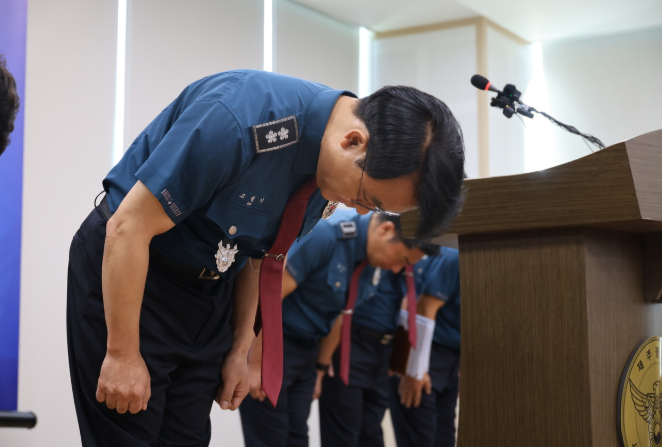
A public apology from Jeju Police Commissioner Ko Pyeong-gi has thrust South Korean law enforcement into fresh scrutiny after revelations that a police officer under his command closed at least two missing person investigations on false pretences, only for both individuals to be discovered deceased within days of those case closures. The commissioner's statement, delivered at the Jeju Provincial Police Agency on Thursday, August 27, represents an institutional acknowledgment of systemic failures that have left grieving families questioning the competence and integrity of authorities tasked with locating vulnerable people.
The scandal centres on a Jeju police officer identified as Bu, who is accused of employing deceptive practices to administratively close investigations without conducting proper due diligence. In the case of Jang Mi-ran, a 37-year-old woman who vanished in May, Officer Bu purportedly fabricated documentation indicating he had made personal contact with the missing woman to confirm her safety. When Jang's body was discovered on Monday, August 24, investigators realised the officer's claim was entirely fabricated. A parallel investigation revealed that Bu had deployed identical tactics in a second case involving an unidentified man in his sixties, whose remains were found on Saturday, suggesting a pattern of deliberate misconduct rather than isolated administrative error.
In his formal statement, Commissioner Ko articulated the gravity of institutional betrayal that such actions represent. His words—"I bow my head in apology to the two deceased people who never made it back to their families, and to the bereaved families suffering grief beyond description"—acknowledge not merely procedural failure but a profound ethical breach. The phrasing underscores the permanence of loss experienced by relatives who may have held faint hope for recovery had investigations continued unimpeded. The double tragedy of losing loved ones compounded by police negligence amplifies the emotional and psychological trauma for families already navigating incomprehensible grief.
The commissioner's broader statement to Jeju residents carries implications extending beyond these two cases. By apologising to the island's population at large, Ko implicitly recognised that public confidence in police institutions has been damaged and that citizens have legitimate concerns about whether similar lapses might affect their own communities. In densely populated regions or island communities where police resources are concentrated, such acknowledgments of institutional failure can ripple through society, affecting crime reporting rates, victim cooperation with investigations, and general faith in law enforcement capacity to respond to genuine crises.
The decision to launch a comprehensive review of all missing person cases handled on Jeju represents a critical intervention, though one that raises uncomfortable questions about how long such problems may have persisted undetected. By committing to examining the island's entire caseload to identify additional errors or misconduct, authorities are tacitly admitting that the two identified cases may represent only the tip of a broader problem. This audit-style approach, while necessary for institutional accountability, also highlights how resource constraints or inadequate oversight mechanisms allowed individual officers to operate with insufficient scrutiny.
For Malaysian and Southeast Asian observers, this incident resonates within broader discussions about police accountability and victim services across the region. Missing person investigations often languish in bureaucratic systems across Asia, and the combination of resource limitations with insufficient checks on officer conduct creates environments where falsification of records becomes possible. The case demonstrates how administrative convenience—closing cases through fabricated contact rather than conducting legitimate follow-up—can become institutionalised if supervisory frameworks lack robustness.
The characterisation of Officer Bu's actions as a violation of fundamental police duty provides insight into how professional standards are being articulated in South Korean policing. Commissioner Ko's statement that "a police officer has a responsibility to protect the safety and lives of the people, yet he disregarded that duty and lied" establishes explicit expectations that go beyond procedure to encompass moral obligations. This framing suggests that South Korean police leadership views the scandal not merely as procedural misconduct but as a fundamental betrayal of professional ethics, positioning truthfulness and diligent investigation as non-negotiable dimensions of police work.
The timing of these discoveries and the subsequent apology also raises questions about detection mechanisms within police organisations. That both cases were closed falsely yet later discovered to involve fatalities suggests either that follow-up verification processes failed or that community members, family members, or external agencies ultimately reported the individuals' deaths to police rather than police proactively discovering the failures through systematic review. This distinction matters considerably for institutional reform, as it determines whether improvements should focus on internal audit systems or external accountability channels.
The commitment to thorough and transparent investigation pledged by Commissioner Ko will face scrutiny from multiple stakeholders. Bereaved families will scrutinise whether disciplinary measures against Officer Bu reflect appropriate consequences for his actions. Civil society organisations monitoring police conduct will assess whether systemic reforms address underlying conditions that enabled the misconduct. Other law enforcement agencies across South Korea will likely reference this incident when evaluating their own missing person protocols and supervisory practices.
For regional context, this incident underscores recurring tensions in police modernisation across East and Southeast Asia. Institutions balancing resource scarcity, public safety demands, and administrative efficiency sometimes inadvertently create perverse incentives where case closure through administrative sleight of hand becomes more attractive than sustained investigation of difficult cases. The Jeju cases illustrate how individual officer dishonesty, when operating within systems lacking sufficient oversight, can cascade into institutional failures affecting vulnerable populations.
The police commissioner's public apology, while necessary, represents only the beginning of institutional reckoning. The families of Jang Mi-ran and the unidentified man in his sixties have lost loved ones under circumstances where law enforcement failed in basic duties. The broader public across Jeju has witnessed institutional betrayal that will require sustained effort to remedy through transparent investigation, proportionate disciplinary action, and systemic reforms ensuring such lapses cannot recur. Whether this incident catalyses genuine reform or becomes archived as an isolated scandal will depend substantially on how thoroughly police leadership implements the promised comprehensive review and what structural changes emerge from findings.

