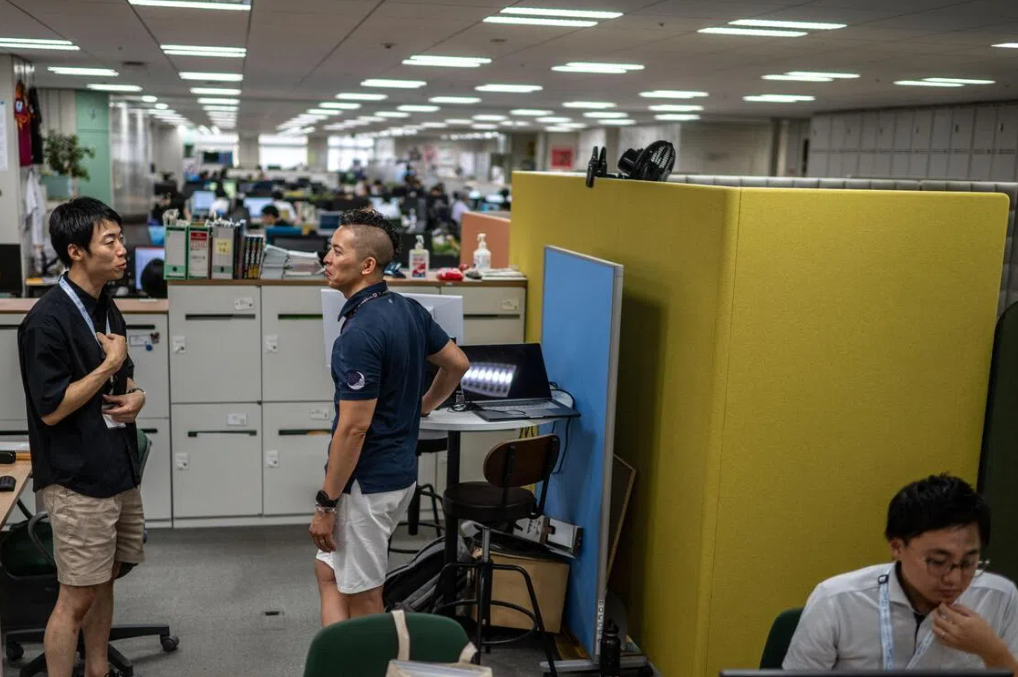
Japan's efforts to help office workers endure the summer heat have collided with an unexpected cultural flashpoint: the visibility of male leg hair in professional settings. Tokyo's metropolitan government expanded its Cool Biz initiative in April to permit employees to abandon traditional formal wear in favour of T-shirts, trainers, and crucially, shorts. What officials presented as a pragmatic response to brutal summer conditions has instead ignited debate about workplace decorum, gender dynamics, and what constitutes acceptable professional appearance in modern Japan.
The controversy centres on a term that has gained traction in online discourse: "sunehara", or "leg hair harassment", describing the discomfort some women report experiencing when exposed to their male colleagues' visible shin hair. This seemingly absurd grievance reflects deeper anxieties about bodily presentation in Japanese workplaces, where strict dress codes have historically governed appearance with remarkable precision. By challenging those conventions around temperature management, the Tokyo government inadvertently opened questions about which bodily displays remain taboo in corporate environments.
Tokyo environmental official Noboru Watanabe sought to position the initiative as inclusive rather than prescriptive. "We want to give people more options in the severe heat, not tell them what to wear," he told the BBC, emphasising that the campaign aimed at expanding choice. Yet his caveat—that attire should not be "offensive to anyone"—proved prophetic, as determining offensiveness emerged as far thornier than anticipated. The tension reveals how workplace dress codes function not merely as temperature regulation tools but as social protocols encoding unstated norms about gender, propriety, and professional identity.
A June survey conducted by Gorilla Clinic, a men's cosmetic treatment chain, crystallised the generational and gender divides underlying the debate. The findings showed nearly even split opinion: 53.5 per cent of respondents opposed wearing shorts to work, whilst 46.5 per cent supported it. Critically, body hair and body shape anxieties dominated opponents' concerns. Women respondents significantly outnumbered men among those objecting, suggesting asymmetric comfort levels about male physical exposure in office settings. This gender imbalance indicates that the shorts question touches on broader dynamics about whose bodies are permitted visibility and under what circumstances.
The survey's findings have produced unexpected consequences within Japan's beauty and grooming industries. Akifumi Funatsu, a director at Gorilla Clinic, reported that male clients increasingly seek laser hair removal treatments, framing the procedure not as cosmetic enhancement but as "social etiquette when wearing shorts". This response signals how workplace dress policies can reshape bodily practices and self-perception. Men who previously gave leg hair little thought now perceive it as a potential source of colleague discomfort, internalising concerns they may never have consciously registered. The dynamic illustrates how professional norms extend well beyond the office, shaping intimate grooming decisions and consumer behaviour.
Japan's journey toward casual workplace dress spans nearly two decades, though the path has proven uneven. The original Cool Biz campaign launched in 2005 under then-environment minister Yuriko Koike, now Tokyo's governor, advocating for short-sleeved shirts and eliminating jackets and ties to reduce air-conditioning consumption. The campaign gained cultural weight when Prime Minister Junichiro Koizumi appeared in public without a tie or jacket, lending symbolic authority to the relaxation. Following the 2011 earthquake and tsunami, which strained Japan's electrical grid, the government introduced Super Cool Biz, further loosening workplace dress protocols and signalling that casualisation would become permanent policy rather than temporary emergency measure.
In the years since, particularly at technology companies and startups, casual attire has become normalised. Yet the Tokyo government's explicit endorsement of shorts represents a boundary-pushing escalation that more conservative sectors have not necessarily embraced. The shorts initiative thus confronts not merely individual discomfort but institutional resistance to visible informality, suggesting that decades of gradual liberalisation have not fully eroded assumptions about what constitutes appropriate professional presentation.
The shorts debate occurs against a backdrop of genuine climatic urgency. Japan faces extreme summer temperatures and humidity conditions that substantially impair the body's natural cooling mechanisms through perspiration. Between July 6 and July 12 alone, the Fire and Disaster Management Agency documented seven heat-stroke deaths and 4,580 hospitalisations. Public health officials have intensified messaging around hydration, air-conditioning use, and gradual heat acclimatisation. Consumer markets have responded by expanding offerings in cooling technology: clothing embedded with fans, temperature-reducing wipes, light-blocking umbrellas, and portable cooling devices now constitute a significant retail category. Within this context, shorts represent a modest intervention in a broader portfolio of heat-mitigation strategies.
The leg hair controversy exposes how dress codes remain deeply embedded in Japanese workplace culture despite decades of formal loosening. Whilst comparable Western office environments have largely moved toward business casual norms, Japan's persistence of formalised dress reflects broader cultural values around restraint, uniformity, and the subordination of individual bodily presentation to collective professional standards. The shorts question thus becomes not simply about temperature comfort but about whether Japanese workplaces are prepared to tolerate visible embodied difference in the service of practical climate adaptation.
Moving forward, the shorts initiative will likely crystallise into an informal negotiation between official policy and workplace custom. Some organisations may explicitly permit shorts whilst others impose informal expectations that preserve trouser-wearing norms. Individual workers face the prospect of calculating whether shorts offer sufficient comfort benefit to offset potential social friction. Meanwhile, the cosmetic industry stands positioned to profit from anxieties generated by the transition itself. Whether leg hair harassment represents genuine discomfort or merely the friction of cultural change remains unclear, but the debate itself suggests that Japanese professional norms remain far more rigid than surface-level casualisation might suggest. The question of how much leg is too much leg will ultimately be answered not through official policy but through thousands of individual workplace negotiations.

