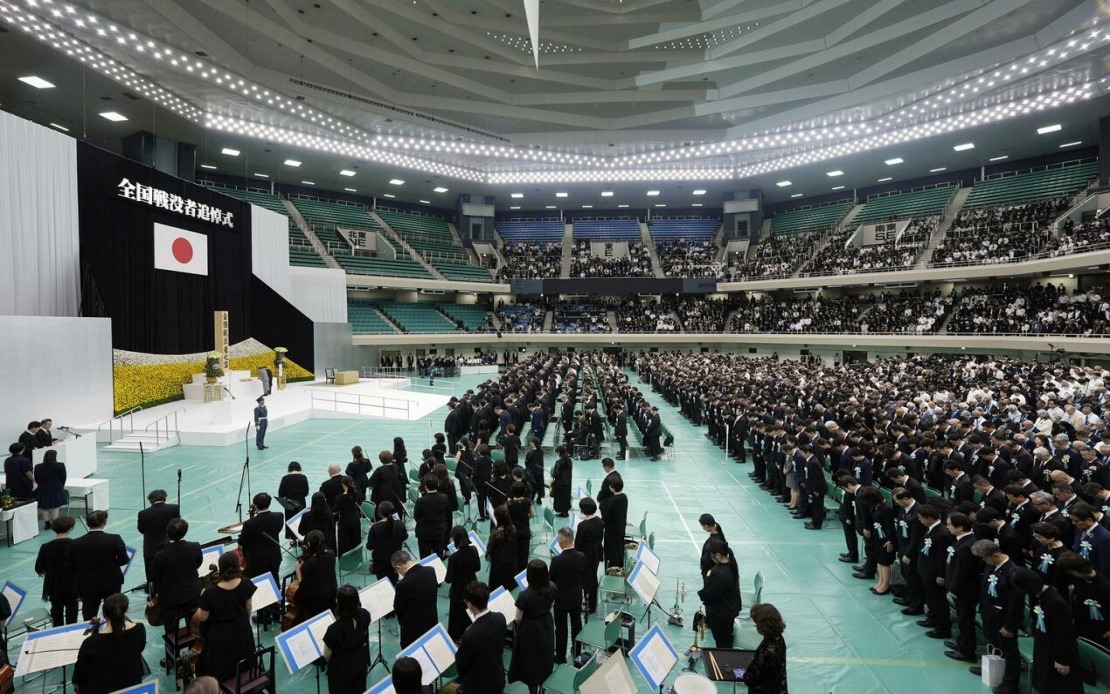
Japan commemorated the 81st anniversary of its World War II surrender on Saturday with a solemn state ceremony in Tokyo attended by Emperor Naruhito and Empress Masako, drawing fresh attention to the country's evolving approach to its wartime history. Prime Minister Sanae Takaichi delivered remarks at the annual memorial service honouring approximately 2.3 million military personnel and roughly 800,000 civilians who perished during the conflict that concluded in 1945. Her speech, however, contained notable linguistic omissions that highlight the ideological direction Japan's leadership is taking regarding its historical reckoning with the war.
Takaichi, whose hawkish stance on national defence is well established, used her first anniversary ceremony since assuming office last October to reaffirm Japan's commitment to peace. In her remarks, she stated that Japan has "consistently walked the path of a nation that values peace and made all possible efforts for world peace and prosperity." Yet she conspicuously refrained from employing terminology that had marked her predecessor's address, specifically declining to invoke Japan's "remorse" over the conflict or to express a "resolute pledge to renounce war"—language that Shigeru Ishiba had deployed at the previous year's memorial.
Ishiba's inclusion of the word "remorse" at last year's August 15 ceremony was itself historically significant, as it marked the first time in 13 years that a Japanese prime minister had explicitly acknowledged this sentiment at the annual commemoration. That momentary linguistic return to a more introspective framing of Japan's wartime conduct proved fleeting. Takaichi's choice to retreat from such acknowledgement signals a broader pattern among recent Japanese administrations of downplaying or sidestepping direct reference to the nation's wartime aggression throughout Asia, including against China and the Korean Peninsula.
The contrast with earlier Japanese leadership is striking. Before Shinzo Abe's return to the prime ministership in December 2012, successive Japanese prime ministers had maintained a practice of explicitly mentioning the country's wartime aggression and offering formal expressions of remorse at the August 15 ceremony. Abe, Takaichi's political mentor who served as prime minister before her, fundamentally altered this approach, establishing a pattern of historical revisionism that his successors have largely maintained. Takaichi's framing of Japan as an unwavering promoter of peace, without acknowledging the specific historical circumstances that necessitate such commitment, reflects this continuation.
Despite the absence of explicit language regarding remorse in the prime minister's address, Emperor Naruhito maintained the practice of expressing "deep remorse" in his own remarks, as he has done consistently throughout his reign. The emperor's continued use of this terminology underscores the complexity within Japan's institutional approach to historical memory, with the imperial institution preserving a more acknowledging stance than the elected government. Naruhito additionally expressed hope that Japanese citizens would continue passing down "the memories of the suffering endured during and after the war," employing wording consistent with his previous year's statement as the nation seeks sustainable peace and prosperity.
The ceremony itself included the traditional moment of silence observed at noon, replicating the precise time in 1945 when the then-reigning Emperor Hirohito announced Japan's surrender via radio broadcast. This temporal synchronization serves as a powerful collective reminder of the historical rupture the nation experienced, yet the changing rhetoric surrounding the commemoration suggests evolving political calculations about how that history should be framed for contemporary and future generations of Japanese citizens.
Takaichi's rhetorical strategy of emphasizing continuity—stating "Although 81 years have now passed, no matter how time flows, we will remain committed to this resolute pledge, passing it down across generations"—seeks to anchor her government's stance within a tradition of peacemaking. However, by divorcing this peace commitment from any explicit acknowledgement of what necessitated such commitment historically, the prime minister's approach represents a qualitative shift in how Japan's political leadership articulates its relationship to its past.
The timing of this year's commemoration coincides with Japan's substantial recalibration of its defence and security posture. The nation has significantly expanded national security spending and relaxed previously stringent restrictions governing the export of defence equipment, moves that reflect broader geopolitical anxieties across the Indo-Pacific region. These policy shifts occur against a backdrop of escalating tensions in West Asia and concerns about regional stability, creating a complex backdrop for Japan's revisitation of its wartime legacy. Some observers interpret Japan's growing military emphasis as fundamentally at odds with the pacifist commitments that the nation formally undertook following its 1945 surrender.
For regional observers, particularly in Southeast Asia where Japan's wartime conduct inflicted considerable suffering, the rhetorical choices made by Tokyo's leadership carry implications beyond ceremonial significance. Malaysia and other nations in the region possess collective memories of Japanese occupation and wartime atrocities, making the extent to which Japan acknowledges and internalizes that history a matter of ongoing regional interest. The subtle but meaningful differences between Takaichi's address and Ishiba's previous remarks thus resonate across borders, with neighbouring states monitoring how Japan frames its relationship to its historical responsibilities.
The generational dimension of Japan's commemorative practices cannot be overlooked. As more Japanese citizens have no direct memory of World War II or its immediate aftermath, the narratives conveyed through official ceremonies and statements become increasingly important in shaping national consciousness about this formative historical chapter. Takaichi's deliberate avoidance of the word "remorse" may reflect calculations about how contemporary audiences, particularly younger Japanese, absorb messages about national responsibility and historical culpability. Yet this editorial approach to historical memory stands in tension with the institutional memory preserved through the emperor's continued use of such terminology.
Political analysts have noted that Takaichi's more guarded rhetorical approach aligns with her broader ideological commitments to strengthening Japan's national security infrastructure and asserting a more muscular international posture. By framing Japan's contribution to world peace in terms of current and future commitments rather than historical reckoning with past transgressions, she repositions the nation's peace identity away from remorse-based pacifism toward what might be termed pragmatic peacekeeping—a subtle but consequential philosophical distinction with implications for how Japan envisions its role in twenty-first-century Asia-Pacific affairs.
The divergence between imperial and governmental rhetoric surrounding the war's legacy reflects deeper tensions within Japanese society regarding how the nation should relate to its history. While Emperor Naruhito's continued emphasis on remorse suggests institutional commitment to a particular understanding of historical responsibility, Takaichi's linguistic choices indicate that political leadership is pursuing a different interpretive framework. This gradual erosion of explicit language acknowledging Japan's wartime aggression, occurring across multiple prime ministerial tenures, represents a quiet but consequential rewriting of how official Japan positions itself in relation to its past—one that will likely provoke continued scrutiny from neighbouring nations and historical scholars alike.

