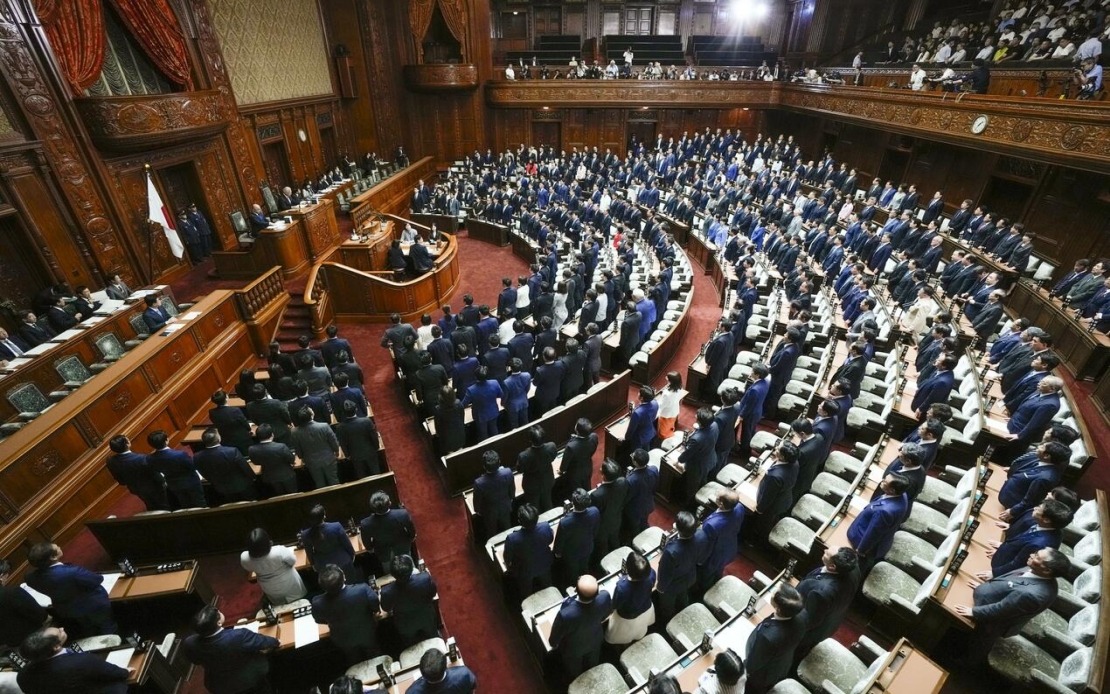
Japan's House of Representatives has advanced a historic revision to the Imperial House Law following a compressed single-day deliberation process that underscores the urgency surrounding succession challenges within the imperial institution. The bill's passage represents the first substantial amendment to the foundational 1947 statute governing the imperial family, addressing demographic pressures that have progressively narrowed the pool of eligible heirs to the Chrysanthemum Throne. Prime Minister Sanae Takaichi's government, backed by a supermajority coalition comprising the Liberal Democratic Party and Japan Innovation Party, secured approval with sufficient numbers to potentially bypass upper house resistance if required, marking a significant shift in how Japan's oldest institution adapts to contemporary realities.
The legislation tackles two interconnected crises that have preoccupied Japanese constitutional scholars and policymakers for years. The imperial line has contracted dangerously as male heirs have become scarce—a pattern that intensified following the 1989 enthronement of Emperor Akihito and accelerated after his 2019 abdication in favour of Emperor Naruhito. Currently, only four individuals stand between the emperor and a succession vacuum, creating anxiety about institutional continuity that transcends ceremonial concerns to touch upon constitutional legitimacy. The dwindling family membership poses an ancillary challenge, as the imperial household requires sufficient personnel to discharge ceremonial, diplomatic, and representational duties that remain central to Japan's constitutional monarchy framework.
The bill's core provisions introduce two substantive mechanisms to stabilise the imperial succession. First, it permits adoption of males aged fifteen or above who descend patrilineally from emperors through former imperial branch families—collateral lines that were severed during post-war constitutional reforms. This represents a significant departure from contemporary Japanese adoption law, which typically restricts such arrangements. Second, the legislation enables female imperial family members to maintain their status upon marriage to commoners, reversing a century-old practice that automatically severed imperial lineage upon female members' wedlock. These modifications reflect pragmatic acknowledgement that rigid patrilineal and patrilocal systems cannot sustain institutional vitality in twenty-first-century Japan.
However, the amendment deliberately circumscribes the scope of reform by explicitly excluding certain pathways from serious consideration. The legislation categorically prevents adopted males themselves from ascending the throne, though it permits their male-line descendants to become eligible successors. This compromise shields against perceived legitimacy concerns surrounding adoption whilst acknowledging biological reality. More strikingly, the bill conspicuously omits any provision addressing female succession or maternal-line inheritance—proposals that public opinion polling has consistently shown attract substantial majorities among Japanese citizens. By foreclosing discussion of these alternatives, the government has prioritised narrower solutions that maintain patrilineal supremacy whilst addressing immediate numerical shortfalls.
The legislative framework emerged from consultative processes between parliamentary leaders that ostensibly encompassed all thirteen recognised political parties and blocs. However, the final bill incorporates provisions absent from the consensus proposal circulated during these consultations, particularly provisions allowing male descendants of adoptees to become emperor. This discrepancy has generated criticism from opposition parties, who characterise the outcome as departing from supposedly agreed parameters. The divergence illustrates tensions between expert deliberation and executive prerogative—a recurring pattern in Japanese legislative processes where initial consensus frameworks prove permeable to government modification.
The accelerated parliamentary passage must be understood within broader political dynamics that had temporarily paralysed the Diet. Opposition forces had orchestrated a boycott of deliberations since late June, protesting what they characterised as high-handed procedural tactics by the ruling coalition across multiple contentious bills. Specific grievances included proposed reductions to lower house constituencies and an ambitious scheme to establish a secondary capital infrastructure supporting Tokyo. These blockades reflected deeper frustrations with governance style and accountability mechanisms, particularly surrounding allegations that the prime minister's political organisation had orchestrated coordinated digital attacks against opposition figures. The gridlock persisted until the ruling camp made strategic concessions on Tuesday, including abandonment of plans to force the redistricting legislation through during the current parliamentary session.
The Imperial House Law revision became entangled within these broader confrontations over parliamentary procedure and executive accountability. Although the imperial succession issue transcends partisan divisions in principle, its legislative advancement became conditional upon broader negotiated settlements restoring functional parliamentary operations. The compression of substantive deliberation into a single working day reflects the prioritisation of process normalisation over exhaustive policy review. This temporal constraint raises questions about the adequacy of public engagement with fundamental constitutional implications, particularly given the opacity surrounding deliberations and the departure from initially agreed parameters.
For Southeast Asian observers, Japan's handling of this constitutional reform illuminates broader challenges facing hereditary monarchical systems navigating demographic transitions and contemporary governance expectations. Thailand, Malaysia, and other regional monarchies face analogous tensions between preserving institutional traditions and adapting institutional structures to contemporary demographic and social realities. Japan's pragmatic strategy—accepting incremental modifications to succession mechanisms whilst preserving patrilineal supremacy—offers one template for balancing continuity and reform. The deliberate exclusion of female succession options despite apparent public support also demonstrates how institutional conservatism can constrain reform even when broader constituencies prefer alternative approaches.
The legislation's trajectory toward the House of Councillors represents merely an intermediate stage in the amendment process. The government aims to secure enactment during the current parliamentary session concluding July 17, requiring upper house approval within approximately one week. Although the ruling coalition commands sufficient numbers for passage, the compressed timeline and procedural compression create potential vulnerabilities. Subsequent implementation will require establishing regulatory frameworks governing adoption procedures, imperial family member retention of status following marriage, and succession eligibility determinations—administrative dimensions that remain under-specified in the legislation itself.
The political economy surrounding this constitutional revision ultimately reflects Japan's characteristic approach to institutional change: preference for incremental adjustment over fundamental restructuring, reliance on elite-level consensus-building rather than expansive democratic deliberation, and careful calibration of reform to minimise perceived ruptures with historical practice. The imperial succession challenge demanded governmental response, but the chosen trajectory prioritises institutional stability over comprehensive reconsideration of succession principles. Whether these circumscribed modifications adequately address long-term sustainability questions remains contested, particularly as demographic trends that produced the initial succession crisis show no signs of reversal.

