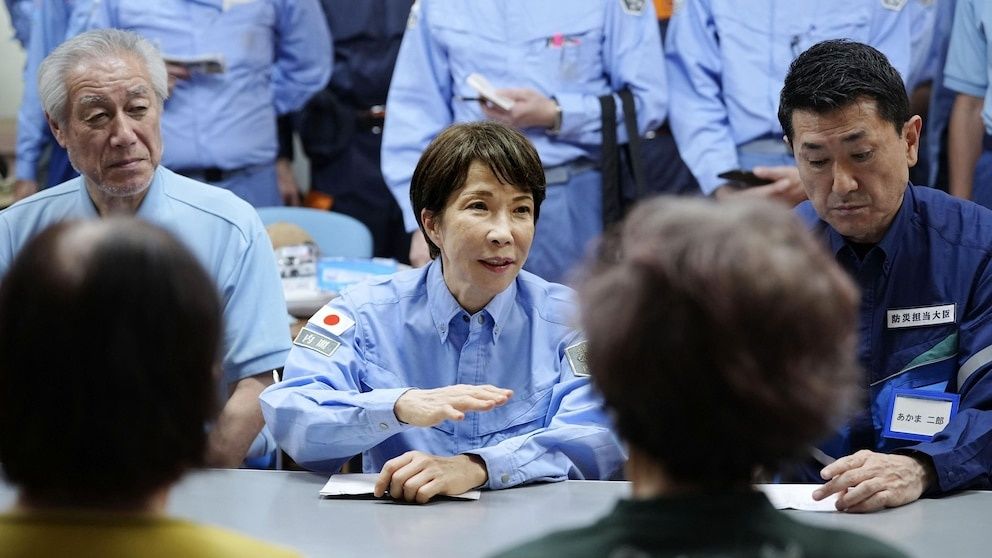
Prime Minister Sanae Takaichi has made her initial visit to Kumamoto Prefecture following a devastating magnitude 7.1 earthquake that struck Japan's southern island of Kyushu on Tuesday, August 4, as residents begin the painstaking work of clearing debris from homes and businesses across the severely affected region. The timing of the disaster has coincided with an intense heat wave that is dramatically complicating recovery operations, creating a compounding humanitarian crisis that extends far beyond the structural damage left by the initial tremor.
The death toll from the earthquake now stands at 38 people, with prefectural officials confirming that at least one person died of heat stroke while sheltering in a vehicle during the sweltering conditions that have gripped the region since the disaster struck. Another death is still under investigation. These fatalities underscore a critical challenge facing disaster response authorities: managing public safety in an environment where environmental conditions pose as serious a threat as the disaster itself. Heat-related deaths following major earthquakes are not uncommon in Japan, where emergency shelter conditions often lack adequate cooling infrastructure during summer months.
Across the prefecture, residents are now engaged in the grim work of sorting through wreckage. Streets are lined with carefully organized piles of debris, broken furniture, and damaged household appliances awaiting municipal collection. In the towns of Uki and Hikawa, construction crews have begun erecting temporary housing structures to accommodate those whose homes suffered severe damage. Several hotels and inns in the region have opened their doors to evacuees, though these facilities cannot accommodate the scale of displacement that has occurred.
The infrastructure challenges compounding the disaster are stark and immediate. More than 46,000 households across Kumamoto lack access to clean water supplies, while many residents simultaneously face fuel shortages that prevent them from traveling to obtain supplies or seek proper medical attention. The Japan Meteorological Agency has predicted temperatures near 40 degrees Celsius (104 degrees Fahrenheit), creating dangerous conditions for vulnerable populations including the elderly and very young who remain in evacuation centers. Health authorities are acutely concerned about the risk of heat stroke and dehydration spreading through shelters where proper medical monitoring is limited.
More than 8,500 people remain sheltering in emergency facilities that have been hastily converted from community centers, school gymnasiums, and classroom spaces, many of which lack air-conditioning systems necessary for survival during extreme heat conditions. Additional evacuees are sleeping in motor vehicles parked at town hall parking lots and municipal parks, or attempting to shelter outdoors near their damaged homes. Disaster management experts have repeatedly emphasized that crowded shelter conditions without adequate sanitation, privacy, or climate control create secondary health crises that can rival the primary disaster in their humanitarian impact.
During her helicopter tour of affected areas, Takaichi visited one of the region's most well-equipped emergency shelters, which features cardboard partition walls, individual bedding, and functional air-conditioning systems. This selective visibility triggered sharp criticism on social media platforms, where users argued that the prime minister's visit misrepresented the actual conditions faced by the vast majority of displaced residents languishing in far more primitive facilities. The incident highlights persistent tensions between political appearances and authentic disaster assessment in Japan's media environment.
Governor Takashi Kimura used his formal meeting with Takaichi to stress the acute dangers posed by what he termed the region's "abnormal heat." The governor explicitly requested expanded government intervention to dramatically improve living standards at evacuation centers, emphasizing that many lack clean water access and have virtually no medical care capacity. His intervention signals that local authorities view the heat crisis as potentially more immediately threatening than addressing structural damage from the initial earthquake. Takaichi responded by committing to rapid examination of potential government assistance programs and promised proactive engagement with the affected population.
Beyond the natural disaster itself, questions are emerging about corporate responsibility following a secondary explosion at a major shopping complex. Two employees of Habita, a local general merchandise operator with a storefront inside the collapsed Aeon Mall in Kashima town, were killed in an explosion that investigators believe resulted from a gas leak. Evidence has emerged suggesting that company management instructed the two victims, including 22-year-old Kurumi Otake, to return into the structurally damaged building to secure sales proceeds in a safe deposit box. The decision reflected a prioritization of financial security over personnel safety during an active emergency evacuation.
Two company executives attended the funeral of one victim, where Otake's mother confronted them with devastating directness. In a tearful exchange, Otake's mother told them simply: "I wish someone had stopped her. My daughter is not coming back." Sales manager Goji Yuse acknowledged that the company had instructed workers to attempt to secure cash inside the damaged building, an admission that has raised serious questions about corporate decision-making during emergency situations. The Aeon Mall operator maintains that the explosion occurred after approximately 3,000 shoppers had been evacuated to a parking lot, but confirms that some employees remained inside the facility.
Rescue operations at the mall recovered five survivors but also extracted the bodies of seven individuals, bringing total confirmed deaths from that single incident to seven. Beyond Kumamoto's most dramatic casualty site, official figures indicate 114 people injured across the prefecture. Structural damage assessments reveal approximately 700 homes completely destroyed and more than 11,300 additional buildings suffering varying degrees of damage, creating an unprecedented housing crisis that local authorities lack resources to address independently. The combination of immediate displacement, prolonged heat exposure, and infrastructure collapse suggests that Kumamoto's recovery will prove lengthy and challenging, with secondary disasters potentially claiming additional lives in coming weeks if response capacity cannot be rapidly expanded.

