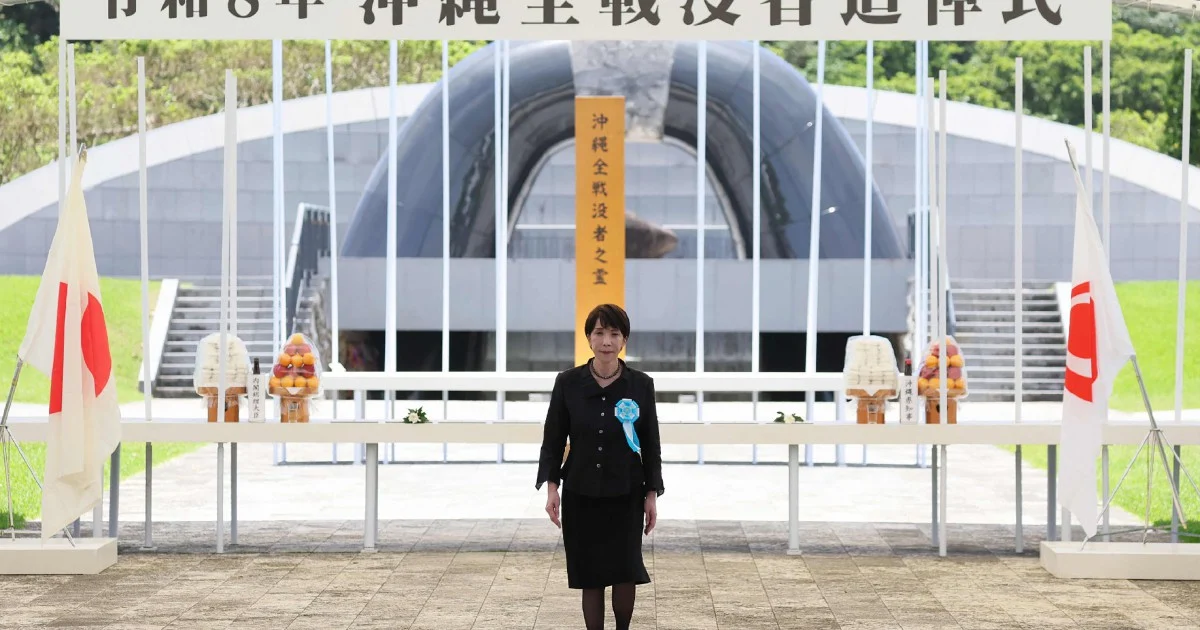
Prime Minister Sanae Takaichi faced direct confrontation from angry demonstrators at a World War II memorial event in Tokyo, as television coverage captured the tense exchange between the nation's leader and protesters objecting to Japan's increasingly assertive military posture. The incident underscores the persistent and deeply rooted tensions within Japanese society over defence policy, a debate that has intensified as regional security concerns and China's military capabilities have prompted Tokyo to fundamentally reconsider its constitutional constraints on armed forces.
The heckling at the memorial ceremony reflects broader anxieties among a segment of the Japanese population who view their nation's post-war pacifist framework, enshrined in the 1947 Constitution, as a defining achievement and moral foundation of modern Japan. For decades following World War II's devastation, Article 9 of the Constitution stood as a symbolic barrier against military remilitarisation, representing Japan's commitment to resolving disputes through peaceful means rather than military force. This constitutional commitment became woven into the national identity and earned Japan international goodwill during the Cold War and beyond.
Under Takaichi's leadership and that of previous administrations, Japan has progressively loosened restrictions on military activities and spending, a shift that has alarmed peace advocates and opposition groups who fear the nation is repeating historical mistakes. Recent years have witnessed substantial increases in defence budgets, the development of long-range strike capabilities, and expanded military cooperation with allies including the United States and Australia. These moves, while framed by government officials as necessary responses to evolving security threats, represent the most significant military expansion since the 1950s.
The geographic and strategic context driving these changes cannot be ignored by observers assessing Japanese defence policy. The rise of China as a military superpower, persistent tensions with Russia, and concerns over North Korea's nuclear weapons programme have created what security analysts describe as an increasingly volatile Indo-Pacific environment. Japan's position as an island nation dependent on sea lanes for critical resources makes it particularly vulnerable to disruptions in regional stability, a reality that government strategists emphasise when justifying military modernisation.
However, critics, including those who confronted Takaichi at the memorial, contend that military buildups carry inherent risks of escalation and that Japan should instead double down on diplomatic solutions and regional dialogue. They worry that constitutional reinterpretation and expanded military capabilities could trigger arms races or miscalculations in an already tense region. The protesters' choice to voice their objections at a World War II memorial site carries particular symbolic weight, invoking memories of Japan's wartime militarism and the catastrophic consequences that followed for the nation and the wider Asia-Pacific region.
Takaichi, who assumed the prime ministerial role following the previous administration's tenure, has been notably forthright about her willingness to challenge post-war pacifist orthodoxy. Her public advocacy for defence policy changes, combined with her administration's concrete policy initiatives, has positioned her as a catalyst for this military realignment. Within Japan's political establishment, views on defence policy remain divided, with ruling coalition members generally supportive of stronger military capabilities whilst opposition parties and civil society groups maintain reservations about moving away from pacifist principles.
The generational dimension of this debate also warrants consideration. Younger Japanese voters, many of whom have no direct memories of World War II's horrors, sometimes view military modernisation more pragmatically as a response to contemporary security challenges. Conversely, older generations and peace activists regard military expansion as a betrayal of lessons learned through wartime suffering and the post-war social contract. This generational divide increasingly shapes electoral politics and public discourse on defence matters across Japan.
Regional implications of Japan's military shift extend beyond Tokyo's immediate strategic calculations. Countries throughout Southeast Asia, including Malaysia, monitor Japanese defence developments with measured interest. Japan's enhanced military profile affects the broader balance of power in waters where Malaysian shipping and economic interests intersect, and shifts in Tokyo's military doctrine have potential ramifications for how regional security challenges are managed. Japan's defence partnerships and military capabilities influence calculations made by other regional powers regarding their own strategic posture.
The incident involving Takaichi at the memorial site demonstrates that despite government determination to reshape defence policy, substantial domestic opposition persists. Public opinion remains divided, with surveys indicating continued support for pacifist principles amongst segments of the population, even as security threats mount. This domestic contestation means that future defence policy evolution in Japan will likely continue to involve public debate and protests, complicating the government's ability to implement its strategic agenda without facing periodic challenges.
Looking forward, Japan faces the complex task of balancing legitimate security concerns against constitutional commitments and post-war identity. How the nation navigates this tension will influence not only its own trajectory but also broader regional stability and the nature of international relations across the Indo-Pacific. The heckling of Prime Minister Takaichi serves as a reminder that despite the seeming inexorability of Japan's military reorientation, considerable opinion within the country continues to question whether this path represents the most prudent response to contemporary challenges.