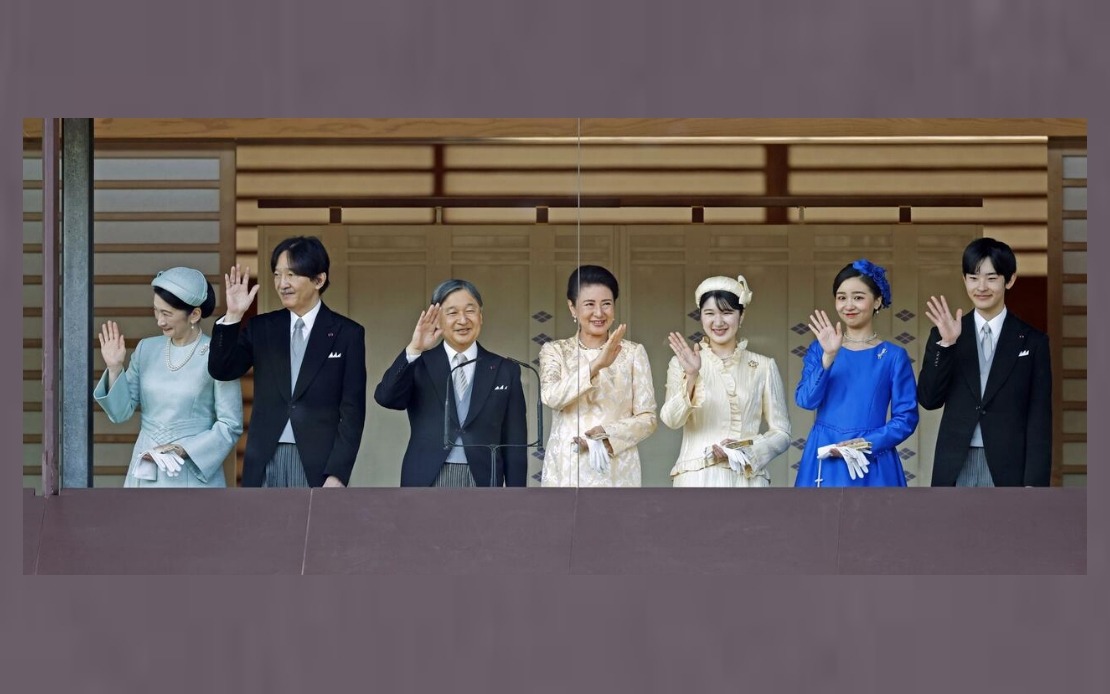
Japan's parliament has taken decisive steps to address the fragility of the world's oldest continuous hereditary monarchy by approving substantial revisions to the Imperial House Law, though the changes fall short of what many Japanese citizens desire. The parliament voted on Friday in favour of amendments that represent the first meaningful updates to the 1947 legislation, introducing provisions designed to stabilize a royal family facing demographic pressures while maintaining the centuries-old principle that only male descendants can occupy the Chrysanthemum Throne. Prime Minister Sanae Takaichi, who holds the distinction of being Japan's first female premier, has championed these revisions as essential to preserving imperial continuity, though her administration's approach has drawn scrutiny from political opponents who argue the reforms do not go far enough to modernize the institution.
The two central pillars of the revised law address distinct challenges confronting Japan's imperial succession framework. The legislation now permits the adoption of unmarried males aged 15 and above who descend through the male line from the 11 former branch imperial families that were stripped of their royal status following World War II. This provision potentially expands the pool of male heirs available to assume the throne, a critical matter given that Emperor Naruhito currently has only three male successors in the direct line. Additionally, the law allows female members of the imperial family to retain their royal status and associated privileges even after marrying individuals outside the imperial system, reversing a long-standing practice that effectively removed women from the institution upon marriage to commoners. These measures represent a pragmatic acknowledgment of contemporary demographic realities.
The historical context of Japan's imperial succession law illuminates why these reforms carry such significance. The original 1947 Imperial House Law was established during the American occupation following World War II, when Japan underwent fundamental constitutional and institutional restructuring. At that time, the legislation simultaneously expelled 51 members belonging to the 11 former branch families from the imperial system, radically reducing the size of the eligible succession pool. The law's core principle—that the throne "shall be succeeded to by a male offspring in the male line belonging to the Imperial Lineage"—has endured unchanged for over seven decades despite substantial shifts in Japanese society, gender relations, and practical governance challenges.
The revision process itself highlights the tensions between institutional conservatism and modernization pressures within Japanese politics. The ruling coalition, comprising the long-dominant Liberal Democratic Party and its junior partner, the Japan Innovation Party, faced considerable criticism from opposition figures who contended that parliamentary deliberations were rushed and insufficient. Opposition lawmakers particularly objected to what they characterized as an evident determination to preserve patrilineal succession regardless of alternative approaches that might better serve the institution's long-term interests. The government's formation of cross-party consensus involving 13 parliamentary parties and groups produced a general framework for reform, yet this consensus notably sidestepped the more controversial succession question entirely, leaving the fundamental male-line restriction untouched.
The permissibility of imperial adoptions, while seemingly straightforward, represents a significant departure from historical practice and traditional understandings of imperial legitimacy in Japan. Such adoptions were previously considered conceptually incompatible with the notion of authentic imperial lineage, reflecting deep-rooted cultural assumptions about blood, patrimonial descent, and dynastic continuity. The legal innovation that now permits unmarried male descendants of the 11 formerly expelled branch families to rejoin the imperial institution effectively acknowledges that maintaining direct biological descent through unbroken male lines has become practically untenable. With the current imperial family numbering only 16 members, including just three males under the age of 40, the adoption pathway offers a mechanism to prevent the scenario where no eligible male heir exists when succession becomes necessary.
Yet the most striking disconnect between policy outcomes and public opinion concerns female imperial succession. A Kyodo News poll conducted in May revealed that 83 percent of Japanese respondents supported permitting women to ascend the throne, with only 13.1 percent opposing the concept. This substantial alignment of public opinion reflects broader transformations in Japanese society regarding gender roles, professional advancement, and family structures. That such overwhelming support exists for female emperors, yet the revised law contains no provisions enabling or even discussing this possibility, underscores how deeply conservative institutional resistance runs within Japan's political and bureaucratic establishments. The refusal to address female succession even in the face of near-universal popular endorsement suggests that considerations of tradition and symbolic continuity outweigh pragmatic acknowledgment of public preferences and demographic necessity.
For Southeast Asian observers, this Japanese deliberation carries instructive lessons about how established monarchies navigate institutional reform in the modern era. Japan's approach—incremental, conservative adjustments paired with careful preservation of patrilineal principle—contrasts with alternative models pursued elsewhere. The determination to maintain gendered succession rules despite demographic pressure and public support highlights how deeply embedded such traditions remain within certain political and cultural frameworks, even in technologically advanced democracies. The Japanese case demonstrates that constitutional and institutional conservatism can persist even when reform advocates include prominent political figures and when practical necessity suggests change.
The adoption mechanism, though presented as a technical legal solution, carries symbolic weight extending beyond practical succession considerations. By explicitly permitting the restoration of former branch family males to imperial status, the law acknowledges that imperial legitimacy need not derive exclusively from the direct male line of the current reigning family. This implicit concession that alternative genealogical pathways can sustain imperial authenticity creates logical space for questioning why female descent through the male line—or indeed female succession itself—cannot similarly qualify. Yet the Takaichi administration has declined to pursue this reasoning, instead treating the adoption provision as a sufficient long-term solution.
The timing of these reforms reflects urgency surrounding imperial succession logistics. Japan's imperial institution faces a genuine numerical crisis that cannot be indefinitely postponed through institutional inaction or procedural delay. With Emperor Naruhito's son, Crown Prince Akishino, representing the single direct heir, and Crown Prince Akishino's son Hisahito as the only male grandchild in the current generation, the system faces potential exhaustion within decades absent intervention. The revised law's enabling of adoptions from former branch families provides a mechanism to address this impending succession difficulty, though demographers and observers question whether such measures will prove sufficient should the pool of available male heirs continue diminishing.
The political dynamics surrounding Takaichi's leadership of this reform effort deserve closer examination, particularly given her status as Japan's first female prime minister navigating an institution fundamentally constructed around male prerogatives. Her administration's choice to enhance female status rights while declining to address female succession creates an internal contradiction that opposition politicians have exploited. The apparent logic—that women deserve retention of imperial status upon marriage to commoners, yet remain ineligible to reign—exposes the essentially symbolic rather than functional character of Japanese resistance to female imperial succession. Conservative voices within Takaichi's own coalition may have constrained her personal preferences regarding these reforms, or alternatively, she may genuinely subscribe to traditional succession principles despite her groundbreaking status as the first woman to hold the premiership.
Looking forward, Japan's imperial succession challenge will likely resurface within 20 to 30 years unless either the adoption mechanism proves unexpectedly generative of eligible heirs or political conditions shift sufficiently to enable reconsideration of female succession. The 1947 law has now been revised once, establishing a precedent for periodic updating rather than treating imperial legislation as immutable constitutional bedrock. This incrementalist approach may eventually accommodate female succession as successive generations grow more comfortable with such change and practical necessity becomes impossible to defer. Southeast Asian monarchies, some of which have also confronted succession complexities and gender-related institutional questions, may find Japan's cautious, tradition-preserving reform strategy either instructive or cautionary depending on their own institutional values and contemporary pressures.

