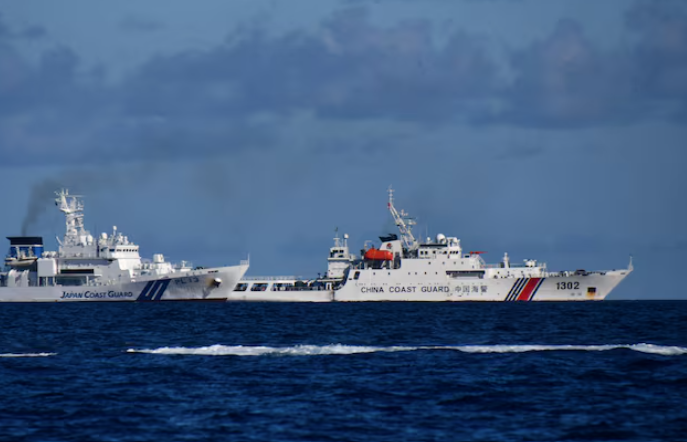
Japan's coast guard forcibly removed two Chinese vessels from waters surrounding the Senkaku Islands on Tuesday morning, according to official statements from Tokyo. The expulsion, which occurred at approximately 9:20am local time, represents the latest in an ongoing series of maritime confrontations in one of Asia's most sensitive geopolitical zones. The Chinese ships had been observed approaching a Japanese fishing vessel operating in the contested waters, prompting the Japanese coast guard to intervene and establish a protective perimeter around the commercial boat.
The Senkaku Islands, referred to as Diaoyu by China, sit in strategically important waters between Taiwan and Japan's Okinawa Prefecture. For decades, these eight uninhabited islands have been a flashpoint for bilateral friction, with both nations asserting sovereignty claims backed by historical and legal arguments. The dispute extends beyond mere territorial pride; the surrounding waters are believed to contain potentially significant energy reserves, making control over the area economically as well as politically consequential. Japan administers the islands and considers them an integral part of its territory, whilst China has never accepted Tokyo's claim and routinely challenges Japanese jurisdiction through coast guard operations.
Tuesday's incident occurred against a backdrop of deteriorating relations between the two nations. In November of the previous year, Japanese Prime Minister Sanae Takaichi delivered remarks concerning Taiwan that proved deeply inflammatory to Beijing. Takaichi stated that Japan could potentially engage in military intervention should Taiwan face an armed assault, a position that fundamentally contradicts China's long-standing claims over the self-governing island. Beijing views such statements as interference in its internal affairs and has responded with a series of countermeasures designed to impose economic and diplomatic costs on Tokyo.
Chinese coast guard vessels had previously entered the waters that Japan claims as its territorial domain on June 10, but direct approaches towards Japanese fishing operations remain comparatively uncommon. The deliberate positioning near the fishing vessel suggests a calculated message rather than accidental proximity, signalling China's willingness to challenge Japanese activities in disputed waters. The Japanese coast guard's swift response, which involved issuing formal departure orders and physically positioning vessels around the fishing boat, underscores the increasingly military character of these maritime interactions, even when no shots are fired.
According to Japan's coast guard statement, four Chinese ships were initially detected operating in the vicinity before two of them entered what Tokyo defines as Japanese territorial waters. The presence of multiple vessels suggests coordinated operations rather than isolated incidents, indicating higher-level decision-making within China's maritime enforcement apparatus. Japan characterised the actions of these Chinese coast guard ships as constituting a deliberate violation of international law, a formal accusation that places the dispute within a legal framework whilst signalling that further escalation carries diplomatic consequences.
The broader pattern of Chinese maritime activity extends well beyond the Senkaku Islands. China has systematically deployed coast guard vessels throughout disputed areas of the East China Sea, creating recurring dangerous standoffs with Japanese maritime authorities. These confrontations have occasionally resulted in close calls and near-misses that could easily spiral into unintended military conflict. The frequency of such encounters has normalised tension in waters where miscalculation or aggressive manoeuvring could have catastrophic consequences for both nations and regional stability.
Beijing's response to Takaichi's Taiwan comments has been multifaceted and economically punitive. Beyond the diplomatic posturing reflected in coast guard operations, China has discouraged its citizens from travelling to Japan and imposed trade restrictions on selected Japanese firms. These measures signal an attempt to create tangible economic pain that might influence Tokyo's policy calculations regarding Taiwan. For Malaysian and Southeast Asian observers, the pattern reveals how great power competition increasingly weaponises economic relationships and explores non-military avenues for coercion.
The Japanese coast guard has committed to maintaining calm yet resolute responses, pledging to continue protecting its territorial waters through measures aligned with both international and domestic law. This language reflects Tokyo's desire to avoid escalation whilst simultaneously refusing to concede ground on sovereignty. Japan recognises that any perceived weakness in defending claimed territories could invite further incursions and embolden Chinese operations across the region's contested waters. The delicate balancing act between firmness and restraint has become the operational norm for Japanese maritime forces.
For the broader Indo-Pacific region, these recurring incidents demonstrate how unresolved territorial disputes create chronic friction points susceptible to accidental escalation. Malaysia and other Southeast Asian nations with maritime claims in disputed areas observe these Japan-China interactions closely, seeking lessons about how larger powers might respond to challenges against territorial assertions. The Senkaku Islands dispute also illustrates how Taiwan remains an underlying driver of East China Sea tensions, with military intervention questions directly connected to maritime security in waters where multiple claimants operate.
The sustainability of the current management approach remains uncertain. Repeated expulsions and mutual accusations of international law violations establish precedent and normalise confrontation without resolving the underlying dispute. China shows no indication of abandoning its coast guard operations or ceasing to challenge Japanese administration of the islands. Meanwhile, Japan continues to strengthen its maritime capabilities and deepen security partnerships, particularly with the United States, in preparation for potential future crises. Without diplomatic progress on the fundamental territorial question, these maritime standoffs will likely persist as recurring features of East Asian geopolitics, periodically threatening to breach the fragile boundaries between peaceful competition and open conflict.

