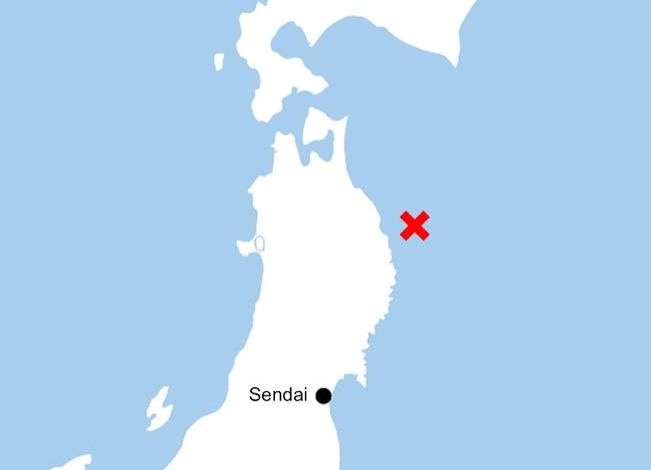
A powerful 7.2-magnitude earthquake rumbled through northern Japan on Thursday morning, sending tremors across hundreds of kilometres and disrupting daily life in several prefectures, though investigators found no deaths or major structural damage in the aftermath. The undersea quake struck at 7:30 am local time off Iwate prefecture on Honshu's Pacific coast, with its epicentre positioned 44 kilometres below the ocean surface. Residents in Tokyo, located several hundred kilometres away, reported feeling the tremors, while the Japan Meteorological Agency initially measured the magnitude at 6.9 before revising the figure upward to 7.2 following further analysis. Notably, authorities determined that no tsunami threat existed from this particular event, allowing most residents to return to normal routines more quickly than might otherwise have occurred.
The physical disruptions, though scattered and contained, illustrated the considerable force unleashed by the seismic event. Television footage captured kitchen cupboards in homes bursting open and scattering cookware across countertops and floors, while shop shelves similarly discharged their contents onto the ground in jarring displays of the quake's raw power. In Aomori prefecture, located in Japan's far north, the tremors registered at the upper sixth level on Japan's seven-point Shindo intensity scale, a threshold at which individuals typically find it difficult to maintain their balance without support and can be forcibly knocked to the ground. At such intensity levels, unsecured furniture commonly overturns, windows frequently fracture, and structural strain becomes apparent in many buildings, yet the relative depth of this quake appears to have mitigated more serious consequences.
Mutsumi Shimohata, a 61-year-old food processing company employee based in Hashikami in Aomori prefecture, described her personal experience of the earthquake as a moment of genuine surprise despite the absence of household damage beyond a fallen picture frame. She recalled that a smartphone alarm activated almost instantaneously following the initial tremor, providing the rapid warning system that modern technology affords Japanese residents. Although her own residence emerged unscathed, the company where she works sustained more substantial effects, with the building's automatic entrance doors malfunctioning and portions of the ceiling giving way, prompting management to instruct employees to remain home on standby while damage assessment proceeded.
Transportation networks experienced measurable disruption across the affected region. Several services operated by Japan's celebrated shinkansen bullet train network were temporarily suspended, disrupting schedules for thousands of commuters and requiring operators to conduct safety inspections before resuming operations. A primary school in Hashikami closed temporarily as a precautionary measure, and the school's principal reported the closure to Japan's national broadcaster NHK. Emergency services received at least four calls from residents in Hashikami and the adjacent city of Hachinohe, with reports indicating that individuals became trapped within an elevator during the quake. Additional incidents included stuck doors in various buildings and an overturned tanker truck, though none of these incidents resulted in fatalities or severe injuries.
Government responses moved swiftly to address the situation and maintain public confidence. Chief Cabinet Secretary Minoru Kihara issued statements confirming that no human casualties had been identified up to that point while acknowledging the ongoing assessment of potential damage across the affected prefectures. Prime Minister Sanae Takaichi directed ministries and relevant government agencies to coordinate closely with local authorities in evaluating the situation and implementing any necessary response measures. Through her official social media account, Takaichi urged residents in areas that experienced significant shaking to remain vigilant for possible aftershocks of comparable or greater magnitude, a standard precaution following seismic events of this scale.
The nuclear sector escaped without incident, providing considerable relief given Japan's historical trauma surrounding atomic facilities. The Nuclear Regulation Authority confirmed through official channels reported by Kyodo News that nuclear power stations operating across the region showed no abnormalities or safety concerns following the earthquake. This represented a particularly significant assurance, given the persistent shadow cast by the catastrophic 2011 Fukushima nuclear disaster, which followed a devastating 9.0-magnitude undersea quake and subsequent tsunami.
Japan's position within the global seismic environment makes such earthquakes commonplace rather than aberrant occurrences. The island nation sits precariously atop four major tectonic plates along the western boundary of the Pacific Ring of Fire, a geological reality that renders it one of Earth's most seismically active regions. The country's approximately 125 million inhabitants experience roughly hundreds of detectable earthquakes annually, and Japan accounts for approximately eighteen percent of all seismic activity recorded worldwide. The vast majority of these tremors remain mild, though their ultimate impact depends heavily upon variables including epicentre location, depth beneath the surface, and proximity to population centres.
The historical memory of catastrophic seismic events continues to shape Japanese emergency preparedness and public consciousness regarding earthquake risks. The 9.0-magnitude undersea earthquake of 2011 remains seared into national memory, having triggered a tsunami that killed or left unaccounted nearly 18,500 people while simultaneously destroying the Fukushima Daiichi nuclear generating station, precipitating one of modern history's worst nuclear accidents. More recently, on April 20 of this year, a 7.7-magnitude tremor struck the country's northern regions, injuring at least ten people and shaking high-rise buildings in Tokyo with sufficient force that authorities issued a rare special advisory warning residents of an elevated risk for earthquakes measuring magnitude 8.0 or stronger. That advisory remained in effect for one week before being lifted, reflecting the continuous assessment processes that Japanese seismic monitoring agencies employ.
The Thursday earthquake's relatively favourable outcome should not obscure the fundamental vulnerability that characterises Japan's relationship with seismic hazards, a reality that shapes everything from building codes to disaster protocols to public education curricula. The country's sophisticated early warning systems and stringent construction standards for earthquake resistance have demonstrably saved countless lives and prevented catastrophic property damage on numerous occasions. Each significant seismic event serves as a reminder of both the effectiveness of Japan's preparedness infrastructure and the unpredictable nature of tectonic forces that govern life in one of the world's most geologically dynamic regions. For Malaysia and the wider Southeast Asian region, Japan's experience underscores the importance of robust earthquake monitoring capabilities and building standards in countries like Indonesia and the Philippines that occupy similarly tectonically active zones.

