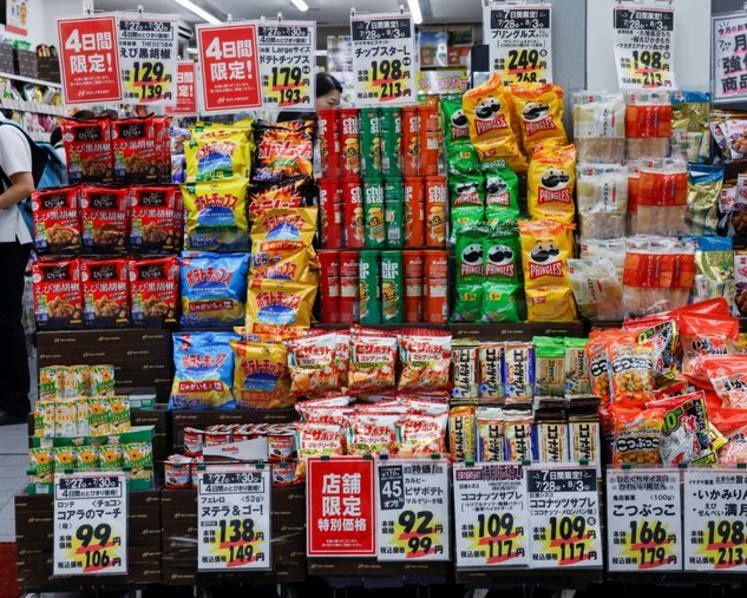
Japan is taking an unprecedented step to ease the financial strain on households by cutting the consumption tax on food to one percent starting next April, Prime Minister Sanae Takaichi announced on Thursday. The reduction from the current eight percent rate represents the first downward adjustment to the tax since its introduction in 1989, underscoring the severity of inflation pressures now gripping the world's fourth-largest economy. The temporary measure will remain in effect for two years before reverting to the standard eight percent rate in 2029, at which point the government plans to introduce more targeted support mechanisms for lower-income families.
The policy reflects mounting public frustration over rising costs for everyday essentials. Japanese households have faced persistent price pressures stemming from multiple sources: the conflict in the Middle East has disrupted global energy supplies and driven up fuel costs, while the weakness of the yen against major currencies has made imported goods significantly more expensive. Food prices, in particular, have become a visible flashpoint in public discontent, making them an obvious target for government relief efforts. By dramatically slashing the tax burden on groceries and other food items, Takaichi's administration hopes to provide immediate relief at the supermarket checkout.
This fiscal intervention carries considerable political significance. Takaichi pledged during her recent election campaign to eliminate the sales tax on food entirely—a bold promise that resonated with voters and contributed to her resounding victory in lower house elections earlier this year. The current policy represents a partial fulfillment of that manifesto commitment, delivering a substantial reduction that still falls short of complete elimination. The two-year timeframe appears calibrated to allow the government to assess economic conditions and revenue impacts before making permanent changes to the tax structure.
The budgetary implications are staggering. Official estimates suggest the food tax cut will result in approximately 10 trillion yen (roughly $61 billion) in foregone tax revenue over the two-year implementation period. This represents a significant hole in the government budget at a time when Japan faces mounting fiscal challenges. The country's debt burden already exceeds twice its gross domestic product—the highest ratio among developed economies—leaving policymakers with limited room to absorb revenue losses without careful fiscal management.
Recognising these constraints, the government has committed to finding offsetting savings elsewhere in the tax and spending system. Officials have indicated they will pursue a multi-pronged approach, including reassessment of existing tax relief measures, subsidy programme reductions, and potentially reprioritisation of government expenditure. Takaichi emphasised that the administration intends to secure this funding without resorting to special government bonds—a declaration aimed at reassuring international and domestic financial markets that Japan is not simply mortgaging its future to fund current consumption.
The two-year sunset clause in the policy creates an intentional connection to broader social welfare reforms scheduled to take effect in 2029. Rather than simply reinstating the previous eight percent tax rate without accompanying measures, the government plans to introduce more sophisticated, income-targeted subsidies designed to protect lower-income households from the burden of rising social insurance premiums. This coordinated approach suggests policymakers view the food tax cut as a temporary expedient while more comprehensive, means-tested support structures are developed and implemented.
For Malaysian observers, Japan's approach offers instructive lessons about managing inflation's distributive effects. While Malaysia's fiscal situation differs significantly from Japan's, both nations grapple with how to protect vulnerable populations from cost-of-living pressures while maintaining fiscal responsibility. Japan's willingness to use direct tax relief on essential goods, rather than relying solely on monetary policy or general subsidies, demonstrates one available policy tool—though the scale of Japan's revenue sacrifice would be proportionally larger for a developing economy with less fiscal capacity.
The regional dimension merits attention as well. Japan's food tax cut may have spillover effects across Southeast Asia. As a major regional investor and trading partner, changes to Japanese consumer purchasing patterns could influence import demand from ASEAN nations. Additionally, if the policy successfully moderates inflation in Japan without undermining fiscal stability, neighbouring governments may view it as validation for similar measures in their own jurisdictions, particularly given rising food insecurity concerns across the region.
The success of this initiative will ultimately depend on whether the one percent tax rate actually translates into measurable price reductions for consumers or whether retailers simply pocket the tax savings as margin improvement. Past experience with tax changes suggests the transmission mechanism between changes in tax rates and actual retail prices is not automatic. Takaichi's administration will need to monitor retail pricing carefully and may require public pressure or regulatory guidance to ensure consumers genuinely benefit from the tax reduction rather than seeing margins simply widen for distributors and retailers.

