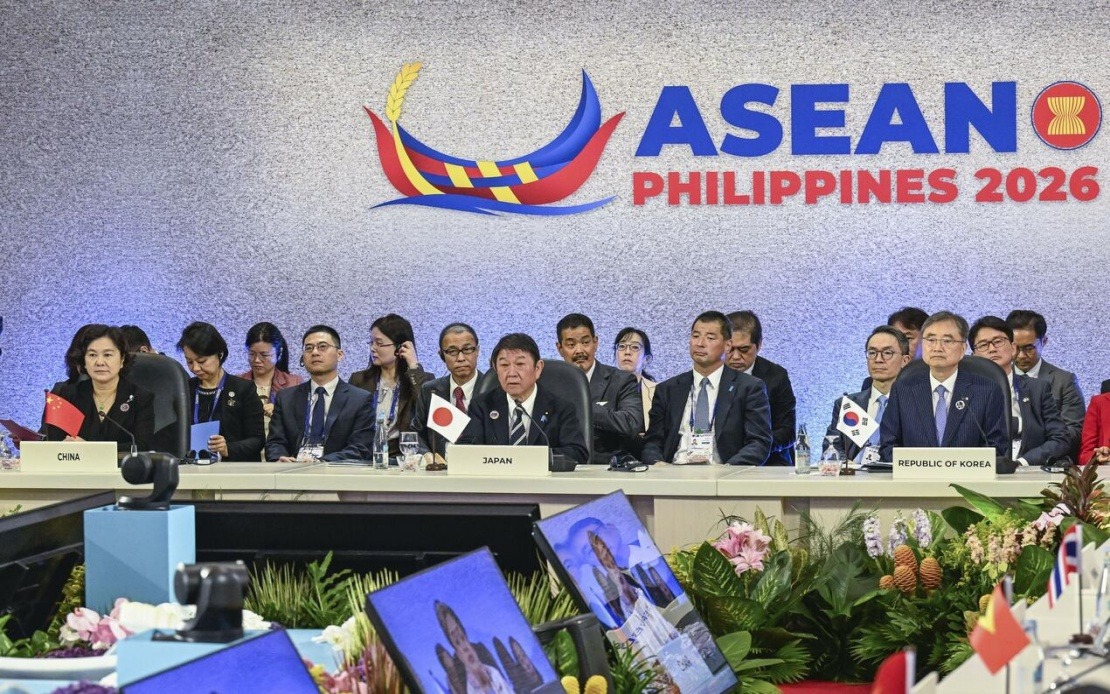
Japan has signalled its determination to deepen cooperation with Southeast Asia, China and South Korea on two critical regional challenges: energy security and the fight against online fraud. Foreign Minister Toshimitsu Motegi made the pledges during a ministerial gathering in Manila attended by counterparts from across the ASEAN-plus-three bloc, a framework that has served as a cornerstone of regional dialogue and practical collaboration since its establishment following the 1997 Asian financial crisis.
The composition of China's delegation underscored Beijing's ongoing diplomatic protocols, with Vice Foreign Minister Hua Chunying attending in place of Foreign Minister Wang Yi. This substitution, while not unusual in diplomatic practice, reflected the significance China placed on the engagement despite higher-level absences. Japan seized the opportunity to articulate its vision for regional cooperation, with Motegi emphasising that the combined economic weight of ASEAN-plus-three nations now represents more than a quarter of global GDP, a figure that carries profound implications for how these countries collectively shape international norms and responses to transnational challenges.
Motegi's opening remarks centred on Japan's commitment to preserving ASEAN's centrality in regional architecture, a principle that has gained increasing resonance as major powers compete for influence across Southeast Asia. He reiterated Tokyo's support for the ASEAN Outlook on the Indo-Pacific (AOIP), an initiative designed to safeguard regional peace, freedom and economic opportunity amid rising geopolitical tensions. This alignment reflects Japan's broader strategic calculus: by endorsing ASEAN-led frameworks, Tokyo positions itself as a responsible stakeholder that respects regional autonomy while advancing its own vision of a rules-based order.
Crucially, Motegi stressed that Japan's conception of a free and open Indo-Pacific shares fundamental principles with AOIP, and that Tokyo intends to work with both China and South Korea to promote this vision through ASEAN-plus-three mechanisms. This framing is significant for Malaysian and Southeast Asian observers because it suggests Japan is willing to engage with China constructively on regional architecture rather than pursuing purely competitive strategies. Such diplomatic messaging carries weight in a region where countries often seek to balance relationships with major powers rather than choosing sides in broader strategic competitions.
The energy security dimension of Japan's commitment responds directly to mounting regional anxieties about supply chain vulnerabilities. Participants at the Manila meeting highlighted the imperative of strengthening energy networks across Southeast Asia in response to developments in West Asia, a transparent reference to Middle Eastern tensions and their potential to disrupt global energy flows. For Malaysia and other ASEAN members with substantial import dependencies and refinery operations, such discussions translate into practical considerations about diversifying suppliers, investing in renewable infrastructure, and developing regional mechanisms that can buffer external shocks.
The online scams challenge, meanwhile, reflects the increasingly transnational character of cybercriminal networks that operate with relative impunity across borders. Digital fraud targeting individuals and businesses has proliferated throughout Asia in recent years, with perpetrators often operating from jurisdictions difficult for law enforcement to access. Japan's elevation of this issue to the level of high-level diplomatic engagement signals that major economies recognise online crime as a genuine national security concern rather than a minor law enforcement matter. For Malaysian authorities already grappling with sophisticated scam operations, international coordination frameworks could prove valuable in intelligence-sharing and coordinated enforcement.
The ASEAN-plus-three framework itself warrants closer examination for readers seeking to understand regional dynamics. Established in the aftermath of the 1997 Asian financial crisis, the grouping was designed to foster practical cooperation across finance, trade, environmental protection and other domains. Its longevity testifies to the utility these countries find in multilateral forums, even as bilateral relationships experience friction. The last summit-level meeting occurred in Malaysia during October, demonstrating continued commitment to the mechanism despite broader geopolitical turbulence.
Japan's simultaneous bilateral engagement during the Manila meetings further illustrates Tokyo's multi-track diplomacy strategy. Motegi's separate conversation with newly appointed British Foreign Secretary Ed Miliband, following the recent change in UK government leadership, reveals Japan's determination to strengthen partnerships beyond the immediate Asia-Pacific region. Japan's expression of hope that Tokyo and London would collaborate on addressing global challenges reflects Tokyo's positioning as a quintessentially globalist power comfortable engaging across continents and seeking partnerships with like-minded democracies.
The convergence of energy security and cybercrime on the agenda of a major regional diplomatic forum indicates how 21st-century geopolitics extends well beyond traditional military and territorial concerns. Both challenges possess characteristics that render them unsuitable for unilateral resolution: energy markets operate on regional and global scales, requiring coordinated policy responses, while cybercriminals leverage the borderless nature of digital networks to evade detection. Japan's willingness to champion these issues signals recognition that regional stability increasingly depends on addressing non-traditional security threats alongside conventional concerns.
For Malaysian policymakers and observers, the significance of this diplomatic moment lies in what it reveals about Japan's strategic priorities and commitment to ASEAN-centred regionalism. Tokyo's insistence on ASEAN centrality and its agreement to coordinate with China on these initiatives suggest that Japan views Southeast Asia not merely as a geopolitical battleground but as a legitimate locus of regional leadership. This validation of ASEAN's role potentially strengthens the grouping's negotiating position as it navigates relationships with more powerful neighbours.
The energy security commitments carry particular resonance for Southeast Asian economies that remain heavily dependent on fossil fuel imports and possess strategic refinery capacity. Strengthening regional supply networks could yield multiple benefits: reducing vulnerability to external supply shocks, improving price competitiveness, and creating infrastructure that serves both economic and strategic interests. Japan's technological expertise and investment capacity could facilitate such developments, though the precise mechanisms for implementation remained unspecified in ministerial statements.
Moving forward, the real test of these pledges will arrive in implementation. Diplomatic commitments constitute important statements of intent, yet translating them into concrete policies and mechanisms requires sustained bureaucratic coordination, resource allocation, and political will across multiple governments. The ASEAN-plus-three framework offers an institutional structure for such work, though observers should monitor whether working groups or task forces emerge to operationalise Japan's commitments on energy and cybercrime.

