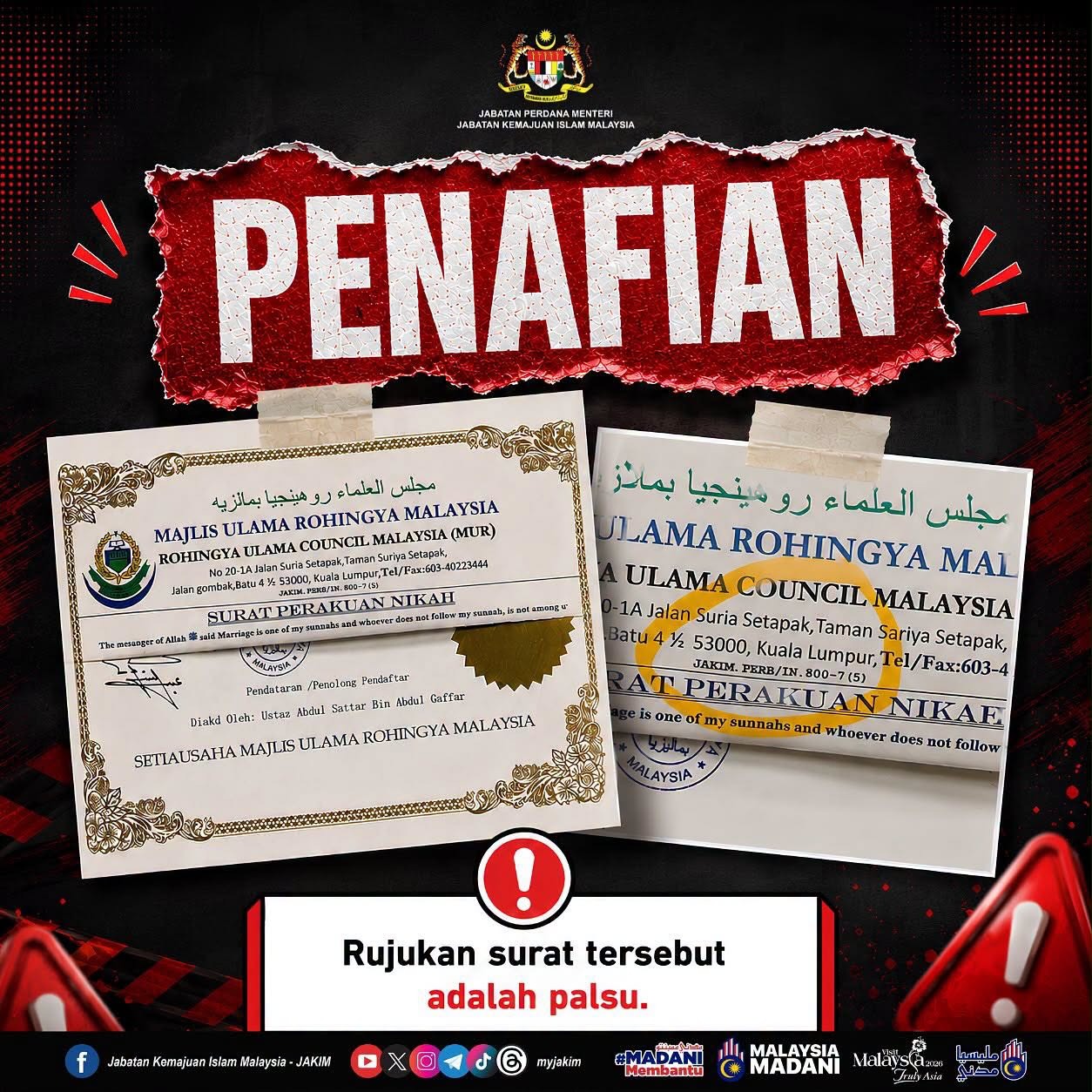
The Department of Islamic Development Malaysia (JAKIM) has moved swiftly to address a growing concern over forged documentation circulating on social media, with the agency confirming on July 15 that a purported marriage declaration letter bearing its reference number is completely fabricated. The department's public statement, released through its official Facebook channel, categorically stated that no such document exists within JAKIM's records, nor has the organisation referenced in the viral letter been granted any official capacity to manage marriage-related certification matters.
The fraudulent document in question allegedly originated from the Malaysia Rohingya Ulama Council and prominently displayed what appeared to be an official JAKIM reference number formatted as "JAKIM.PERH/LN.800-7(5)". This seemingly authentic designation gave the document superficial credibility that would deceive casual observers unfamiliar with proper Malaysian Islamic administrative procedures. The virus-like spread of this letter across social media platforms underscores a broader vulnerability within digital spaces where forged official documents can rapidly gain traction without proper verification mechanisms in place.
JAKIM's response emphasised that the reference number itself is entirely fabricated, a crucial detail for the public to understand when evaluating suspicious documents. The department clarified its institutional boundaries, making plain that neither JAKIM nor any of the state Islamic religious councils or departments across Malaysia have authorised any external organisation to undertake marriage certification duties. This distinction matters considerably because Malaysia's Islamic administrative framework is deliberately decentralised, with state-level religious authorities maintaining significant autonomy in managing religious affairs within their jurisdictions.
The implications of such forgery extend beyond simple deception. In Malaysia's context, where Islamic law and civil law operate in parallel for matters involving Muslims, fraudulent documents purporting to validate marriage arrangements could create serious legal complications for individuals who rely upon them. Couples might inadvertently believe they possess legitimate marriage recognition when their union holds no standing in either religious or civil registers, potentially affecting inheritance rights, spousal benefits, guardianship arrangements, and property claims.
Minister in the Prime Minister's Department (Religious Affairs) Dr Zulkifli Hasan acknowledged the seriousness of the matter by confirming that a full investigation would be conducted once comprehensive details were compiled. This administrative commitment reflects the government's recognition that document forgery involving religious authorities represents a threat not merely to individual victims but to institutional integrity and public confidence in official channels. The investigation will likely examine how the fraudulent letter was created, through which networks it proliferated, and whether organised criminal elements are involved.
JAKIM's advisory to the public to independently verify questionable religious documents represents both a practical safeguard and an implicit acknowledgement that their institutional branding and reference number formats may be difficult for ordinary citizens to distinguish from authentic documentation. The department's recommendation to consult directly with JAKIM or relevant state Islamic authorities before accepting any marriage-related certificates places responsibility on individuals to take protective steps, though this places considerable burden on ordinary Malaysians navigating bureaucratic systems.
The emergence of this fake document highlights vulnerabilities within Malaysia's digital information ecosystem, particularly regarding authentication of official materials. Unlike many government documents now available through secure digital portals or verified databases, marriage-related Islamic certification may still rely on physical documents that sophisticated fraudsters can relatively easily replicate. The absence of widely publicised authentication standards or publicly accessible databases of legitimate JAKIM reference numbers makes it easier for fakes to circulate unchallenged.
For the Malaysia Rohingya Ulama Council, whose name was apparently invoked without authorisation, the situation raises questions about their institutional oversight and whether they have security protocols to prevent their name and identity being misused in fraudulent schemes. The association of an ethnic or religious minority organisation with document forgery could unfairly damage community reputation and trust, making the investigation's findings particularly consequential for affected communities.
The broader pattern evident here reflects challenges facing Malaysian authorities in maintaining document integrity and preventing fraud in an increasingly digital and decentralised information environment. As social media enables rapid distribution of potentially harmful materials, the gap between official institutions and public access to verification mechanisms grows wider. This particular incident serves as a cautionary reminder that Islamic administrative matters, while perhaps appearing technical or obscure to general audiences, carry substantial legal weight and should never be handled through informal channels or unverified sources.

