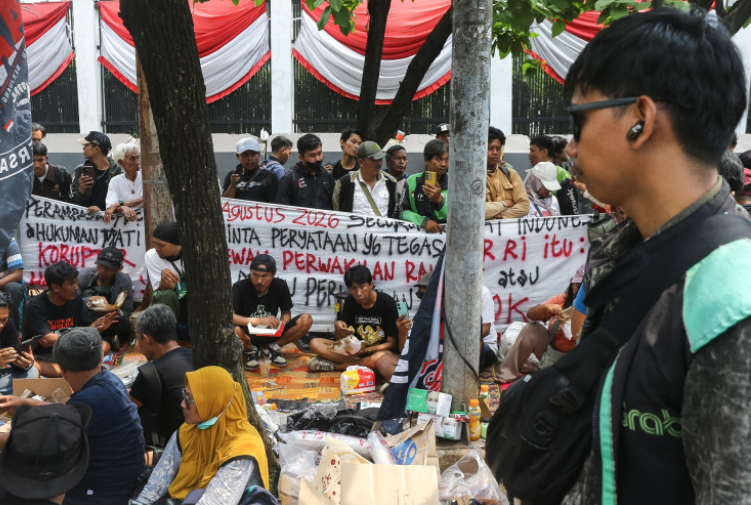
Thousands of Indonesians descended upon the Senayan Legislative Complex in central Jakarta on Thursday morning, intensifying public pressure on lawmakers to accelerate passage of a landmark anti-corruption measure while simultaneously demanding action on cost-of-living concerns. The demonstration represented a significant escalation in civil society's push for legislative reform, with organized contingents arriving from multiple provinces to make their voices heard at the seat of parliamentary power. The convergence underscored growing public frustration with what many perceive as inadequate government efforts to combat entrenched corruption and address everyday economic hardships facing ordinary citizens.
The United Pati People's Alliance, a coalition based in Pati, Central Java, orchestrated much of the mobilization effort, bussing supporters to the capital throughout the preceding week to build momentum for Thursday's action. The group's coordinator, Supriyono, revealed that five additional buses transported fresh contingents of protesters to Jakarta, funded through public donations that accumulated despite attempts by state authorities to obstruct the movement. This financing mechanism highlighted the grassroots character of the initiative, drawing support from ordinary Indonesians frustrated by the slow pace of institutional reform. The determination to participate persisted even after police stopped several transport vehicles en route and Bank Mandiri froze a bank account associated with the coalition's leadership, actions that sparked public backlash and calls for boycotts against the state-owned financial institution.
The security apparatus responded to anticipated crowd levels by implementing extensive traffic management protocols across central Jakarta. Police cordoned off multiple thoroughfares, including both directions of Jl. Gatot Subroto stretching from Senayan Park toward the legislative complex entrance, while deploying dozens of uniformed personnel throughout the vicinity. Jakarta Police spokesperson Sr. Comr. Budi Hermanto indicated that authorities anticipated at least five hundred protesters, with expectations that numbers could swell as organizations from beyond Pati joined the demonstrations. Despite the heavy police presence, officials emphasized their commitment to facilitating peaceful protest while maintaining public order and allowing routine commercial and educational activities to proceed uninterrupted.
At the heart of the demonstrators' agenda lay the asset forfeiture bill, a legislative proposal that has languished in parliamentary limbo since its initial presentation in 2008. The measure would empower the state to seize assets suspected of deriving from criminal activity prior to securing actual criminal convictions, potentially accelerating the recovery of illicit wealth. The House of Representatives, which commenced formal drafting procedures in January, has compressed the timeline considerably under political pressure. Gerindra Party lawmaker Habiburokhman, who chairs the parliamentary commission overseeing legal affairs, declared that deliberations would require approximately eight additional weeks, positioning December as the realistic deadline for legislative passage. This compressed schedule reflected both the political sensitivity surrounding anti-corruption sentiment and the genuine legislative momentum that public agitation had generated within Parliament.
The Prabowo Subianto administration explicitly aligned itself with accelerated passage, with Government Communications Agency head Muhammad Qodari signaling presidential support for the initiative. Qodari's statement effectively transferred responsibility to the legislature, suggesting that executive branch enthusiasm no longer represented the impediment to reform. This alignment between executive and popular pressure created a narrowing window for parliamentary deliberation, with the House facing significant political cost should lawmakers appear reluctant to deliver legislation that the president and mobilized citizenry both favored. The administrative positioning subtly elevated stakes for parliamentary dilatoriness, framing further delays as incompatible with national anti-corruption commitments.
However, the proposed legislation carries significant complexities that extend beyond its apparent anti-corruption rationale. Legal experts have articulated substantial concerns that asset forfeiture mechanisms could be weaponized against political opponents or deployed as instruments of extortion by unscrupulous officials. The absence of requisite criminal convictions introduces scope for prosecutorial overreach, potentially allowing authorities to seize property based on accusation alone. These cautionary perspectives highlight the distinction between popular demand for anti-corruption action and the technical requirements for constructing legislation that simultaneously maximizes legitimate asset recovery while minimizing potential for authoritarian abuse. Drafting such measures demands careful attention to procedural safeguards and judicial oversight mechanisms that can prove elusive in developing democracies.
The timing of these demonstrations reflected broader anxieties within Indonesian society regarding corruption's intersection with material hardship. Protesters articulated demands spanning the death penalty for corrupt officials to the reduction of basic commodity prices, linking institutional malfeasance to the economic squeeze facing working Indonesians. Many citizens perceive corruption as a direct mechanism through which elite theft fuels inflation and reduces resources available for public services benefiting ordinary populations. This framing connects anti-corruption advocacy to immediate material concerns, potentially broadening the coalition supporting legislative reform beyond typically engaged civil society actors to include individuals primarily motivated by economic distress.
The blockade of Supriyono's bank account by Bank Mandiri represented a particularly instructive incident, illustrating how state attempts to suppress protest can backfire politically. The action generated public outrage and sparked organized calls for depositor boycotts, effectively mobilizing additional constituencies against both the financial institution and the governmental authorities perceived as orchestrating the financial freeze. Such counterproductive security measures demonstrate how heavy-handed suppression tactics can amplify protest movements by converting peripheral supporters into active sympathizers, ultimately magnifying the political pressure that authorities sought to contain. The incident underscored the unpredictability of state responses to civil society mobilization in contemporary Indonesia.
From a Malaysian perspective, Jakarta's anti-corruption demonstrations carry instructive implications regarding mechanisms through which civil society pressure influences legislative action in Southeast Asia's most populous nation. The convergence of grassroots activism, administrative support, and parliamentary receptiveness suggests that systematic institutional reform remains possible even within complex political environments characterized by competing interests and historical corruption. Malaysia's own ongoing struggles with asset recovery and institutional accountability mirror Indonesia's challenges, making the progress or failure of Jakarta's asset forfeiture initiative relevant to regional conversations regarding anti-corruption effectiveness.
The compressed parliamentary timeline and projected December passage would represent a notable institutional victory for sustained civil society mobilization, validating protest strategies that combine geographic dispersion of activism with concentrated legislative pressure. Conversely, failure to meet the deadline would signal that genuine institutional change remains subordinate to political convenience and bureaucratic inertia, potentially dampening future civil society mobilization efforts. The coming weeks would prove determinative regarding both Indonesia's anti-corruption trajectory and the broader capacity of Southeast Asian democracies to translate popular demands into substantive institutional reform.

