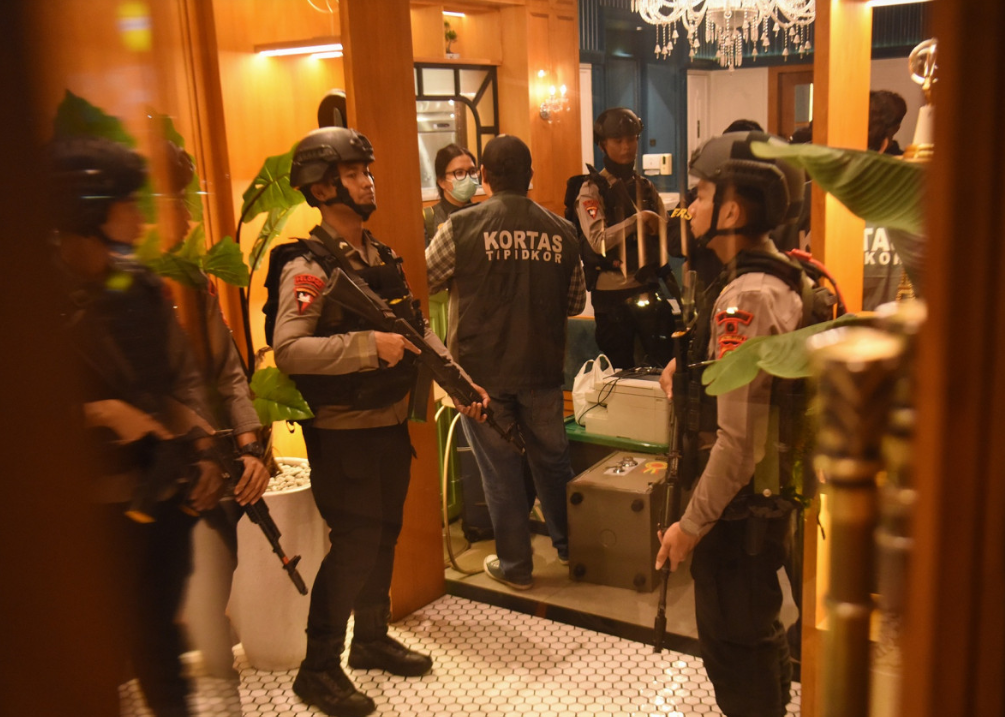
Armed police units converged on an upscale Jakarta restaurant in the Cipete district last week in what would become one of Indonesia's most dramatic law-enforcement operations in recent memory. Officers from the National Police's anti-corruption division, backed by heavily armed Mobile Brigade personnel, descended on de'Clan Signature and neighbouring establishments as curious diners observed the tactical deployment unfold. The operation marked the beginning of a coordinated series of searches that would ultimately shake Indonesia's legal establishment and raise uncomfortable questions about institutional oversight at the highest levels.
The restaurant raid yielded substantial cash holdings in multiple currencies worth millions of dollars, hidden within a concealed safe installed behind a cabinet. The discovery prompted immediate action at an adjacent money-changing business, Koin Money Changer, where authorities uncovered additional stacks of rupiah notes representing hundreds of thousands of dollars more. These initial findings, while significant, paled in comparison to what investigators would uncover elsewhere during the overnight operation that extended into the early morning hours of Thursday.
The most substantial discovery came at a residential property located in Sentul, an affluent suburban enclave situated approximately one hour south of the capital. Police opened seven suitcases at the high-end home containing 74 kilograms of gold bars alongside cash denominated in various foreign currencies. The combined estimated value of assets seized across all raid locations totalled US$26.3 million, a figure that immediately captured public attention and dominated discussion in Jakarta's political and legal circles.
The property belongs to Febrie Adriansyah, who had occupied the position of deputy attorney general for special crimes throughout the preceding four-year period. Adriansyah stepped down from his role immediately following the raids, citing unspecified personal reasons in his initial statement. Subsequently named as a suspect in both corruption and money-laundering investigations, he has not been detained but faces serious legal exposure. In response to allegations, Adriansyah acknowledged ownership of the Sentul residence while categorically denying that the seized materials constituted his personal assets, suggesting that clarity regarding their origins would emerge through judicial proceedings.
The visual presentation of the recovered assets—rows of gleaming gold bars and thick bundles of currency displayed before media photographers—rapidly became the dominant imagery associated with the scandal. Images distributed by authorities conveyed the sheer scale of the operation and reinforced public perception of sophisticated financial misconduct at the institutional apex. Beyond the two initial locations, investigators expanded their search parameters to encompass at least ten additional sites throughout Jakarta and surrounding areas, including the Pacific Place apartment complex near the financial district and various commercial offices.
Investigators also targeted residential properties in the Gandaria district of South Jakarta connected to Don Ritto, a lawyer who emerged as a second suspect in the unfolding investigation. Ritto, who has been detained according to local reporting, maintained business connections with entities linked to both the restaurant and the money changer subjected to raids. Corporate records examined by journalists revealed these interconnections, suggesting a coordinated network rather than isolated instances of impropriety. The expanding scope of the investigation indicated authorities suspected more extensive institutional involvement than initially apparent.
By midweek, speculation consumed Jakarta's political establishment regarding the investigation's trajectory and broader implications. The discoveries prompted fundamental debate about whether Indonesia's anti-corruption mechanisms were functioning effectively or whether the succession of high-profile scandals reflected systemic institutional decay. Some observers argued the raids demonstrated effective enforcement capacity, whilst others questioned whether such seizures represented exceptions or symptoms of deeper structural problems within the legal system.
Mahfud MD, a distinguished constitutional scholar and former chief justice of Indonesia's Constitutional Court, emerged as a prominent critical voice examining the procedural aspects of the investigation. Mahfud utilised his YouTube platform to publicly challenge the legal foundations for transferring Adriansyah's case from police jurisdiction to the Attorney General's Office, asserting the transfer lacked statutory authority under Indonesia's criminal procedure code. He warned that such procedural irregularities could expose the prosecution to pretrial legal challenges that might jeopardise the case's viability. Mahfud specifically advocated for the Corruption Eradication Commission, the independent anti-corruption body, to assume investigative control and ensure procedurally sound progression.
The controversy surrounding investigative jurisdiction reflected broader patterns in Indonesian law enforcement where institutional conflicts and competing authorities frequently complicated prosecutions of high-ranking officials. The transfer of Adriansyah's case between agencies raised questions about whether prosecutorial decisions reflected genuine investigative logic or institutional political dynamics. For Malaysian observers, the Jakarta scandal illustrated challenges facing neighbouring regional democracies attempting to establish effective anti-corruption frameworks whilst navigating entrenched institutional interests and political pressures.
The timing of Adriansyah's resignation and the immediate commencement of raids suggested a coordinated operation with possible advance intelligence rather than spontaneous discovery. The sophistication of the asset concealment—multiple suitcases at residences, concealed safes behind furniture—indicated deliberate preparation to obscure wealth origins. These operational details pointed toward either a comprehensive investigation conducted over extended periods or remarkably efficient intelligence gathering that enabled rapid tactical deployment.
The investigation's outcomes could substantially reshape Indonesia's law-enforcement institutions and legal processes governing special crimes prosecution. The sheer financial magnitude of the seized assets—comparable to annual government agency budgets—underscored the scale of potential institutional compromise. For Southeast Asia broadly, the Jakarta scandal represented a concerning reminder that corruption susceptibility penetrates even supposedly specialist institutions responsible for combating financial crime.
The Febrie Adriansyah investigation will likely become a precedent-setting case influencing how Indonesian authorities pursue future high-level corruption allegations and institutional reform efforts. The procedural disputes already emerging suggest protracted legal contestation before conclusions are reached. Whether Mahfud's concerns prove determinative, and whether the Corruption Eradication Commission ultimately assumes investigative responsibility, remains uncertain—but the case has already established that even senior legal officials remain within prosecutorial reach.

