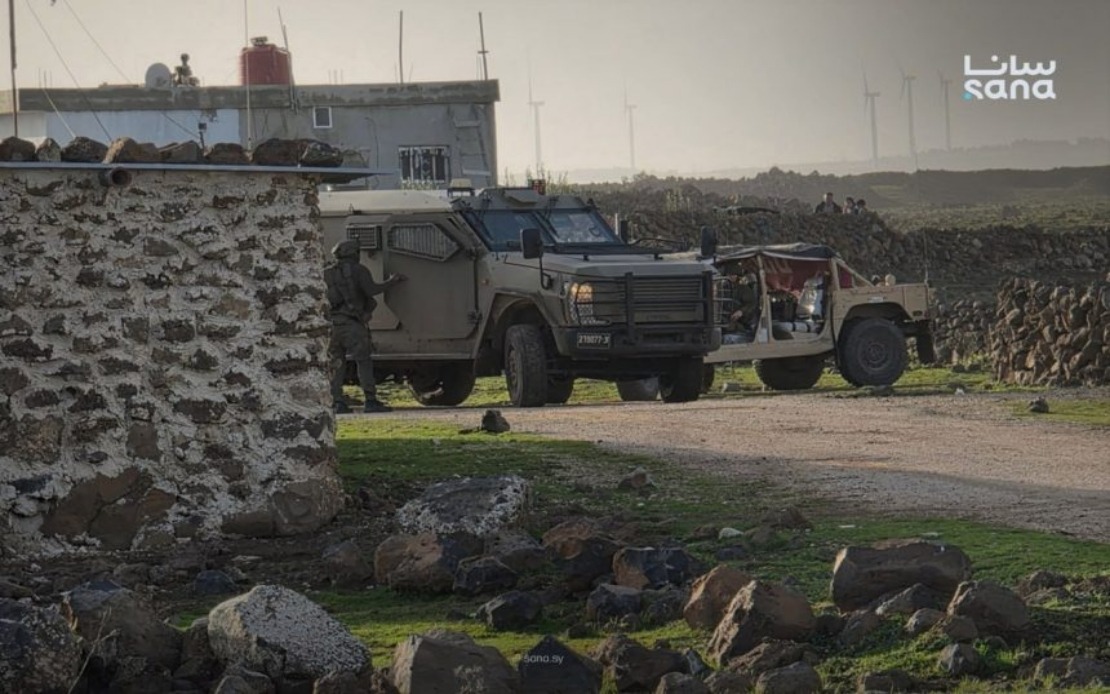
Six Israeli military vehicles crossed into Syria's southwestern Quneitra province on Saturday, according to reports from the Syrian Arab News Agency (SANA), underlining the volatile security situation unfolding along the Israeli-Syrian frontier in the wake of the Assad regime's collapse. The vehicles, accompanied by reconnaissance drones, advanced towards the Kudna Dam in the central Quneitra countryside, demonstrating the extent to which Israel is reasserting military presence in areas previously under Assad's nominal control.
The incursion represents a continuation of intensifying Israeli military activity across southern Syria since December 2024, when Bashar al-Assad's government fell after thirteen years of civil war. This development marks a fundamental shift in regional dynamics, as Israel has effectively repositioned itself to exert direct control over strategic border territories rather than relying on the negotiated disengagement framework that has governed Israeli-Syrian relations since the 1973 Yom Kippur War.
For decades, the 1974 disengagement agreement served as the cornerstone of Israeli-Syrian military separation, with United Nations peacekeepers maintaining a buffer zone in the Golan Heights and surrounding areas. However, the Assad regime's collapse has rendered this internationally-brokered arrangement obsolete in Israel's view. The Israeli government formally declared the agreement null following al-Assad's departure, signalling its intention to pursue unilateral security measures across the demilitarized zone without the constraints previously imposed by Syria's state apparatus or international oversight mechanisms.
The pattern of Israeli operations over recent months reveals a systematic approach to establishing military dominance across southern Syria. Beyond the vehicle incursions documented this past Saturday, Israel has conducted repeated raids targeting Syrian military installations, established armed checkpoints at strategic locations, and carried out arrest operations within the Quneitra region. These activities collectively suggest a deliberate strategy to prevent any consolidation of power by successor groups whilst simultaneously securing Israeli security interests across territory Israel has long viewed as essential to its strategic defence.
For Malaysian and Southeast Asian observers, these developments carry significant implications regarding broader questions of regional sovereignty, the legitimacy of international agreements in the absence of effective state authority, and the precedent being set for how powerful nations respond to state collapse in neighbouring territories. The Israeli actions challenge fundamental principles enshrined in the United Nations Charter regarding territorial integrity and non-interference, raising concerns about similar dynamics potentially unfolding elsewhere should weak or collapsing states become attractive targets for military interventions by stronger neighbours.
The security vacuum created by al-Assad's departure has proven particularly destabilizing for Syria's southwestern regions, where competing armed factions, Syrian insurgent groups, and Israeli forces now operate with minimal coordinating mechanisms. Unlike the predictable, if tense, status quo that existed under Assad's authoritarian control, the current environment presents unpredictable flashpoints where miscalculation or escalation could rapidly destabilize the wider eastern Mediterranean region.
International humanitarian organisations have raised alarms about the impact of Israeli operations on Syrian civilian populations in border areas. The combination of vehicle incursions, drone surveillance, checkpoints, and arrest operations has disrupted normal economic activity, displaced vulnerable populations, and created chronic insecurity that prevents reconstruction efforts in areas devastated by Syria's prolonged conflict. These humanitarian consequences extend beyond immediate border regions, as Syrian refugees throughout Lebanon, Turkey, and Jordan face uncertain futures with their country increasingly fragmented and subject to external military control.
The broader geopolitical context reveals competing international interests converging in Syria's post-Assad landscape. Whilst Israel pursues security consolidation along its northern frontier, other regional actors including Turkey, Iran-backed militias, and various Syrian opposition groups manoeuvre for influence. The absence of a legitimate central authority has transformed Syria into a contested space where outside powers can pursue objectives with limited accountability or coordination, fundamentally altering the balance of power that governed Middle Eastern affairs throughout Assad's tenure.
For Malaysian policymakers and regional security analysts, the Quneitra incursions underscore the dangers of state collapse and the opportunism that powerful neighbours may exercise when governance structures disintegrate. The precedent of unilateral military operations across international borders in the absence of functional counterparts raises uncomfortable questions about how international law functions when traditional state structures vanish. As Southeast Asia confronts its own vulnerabilities—including maritime disputes, weak governance in border regions, and powerful neighbours—the Syrian case offers cautionary lessons about the costs of allowing state authority to erode.
The duration and scope of Israeli military presence in Quneitra remain uncertain. Whether these operations represent temporary adjustments to the new post-Assad reality or the foundation for sustained Israeli military administration across southern Syria will likely determine whether international diplomatic efforts succeed in establishing new frameworks for Israeli-Syrian relations. Current indications suggest Israel intends to maintain substantial military capabilities throughout the region indefinitely, effectively establishing a security sphere that extends well beyond Israel's internationally recognised borders.

