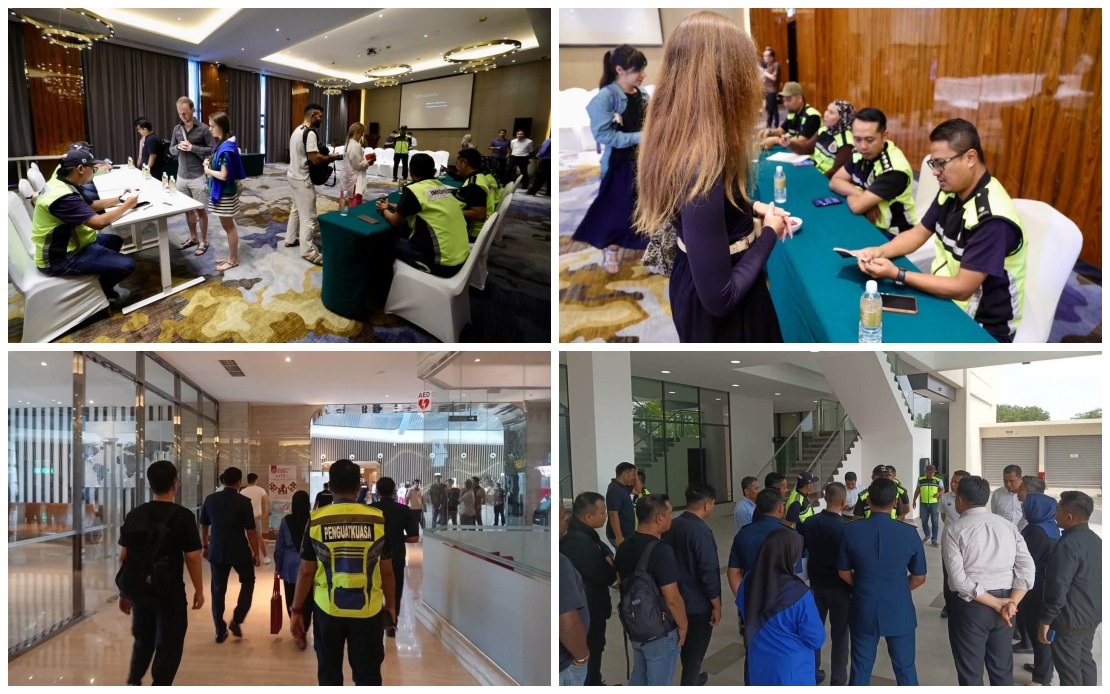
Johor's Iskandar Puteri City Council (MBIP) has moved to shut down a Network School operation in Forest City after discovering multiple violations of business licensing requirements and the improper use of commercially zoned premises. The enforcement action represents an escalation in regulatory scrutiny of the facility, which had become the subject of online speculation regarding its ownership and educational mandate.
Menteri Besar Datuk Onn Hafiz Ghazi announced the Stop-Business Notice in a statement, explaining that the council's investigation uncovered a pattern of non-compliance spanning two separate locations. The findings revealed that while one premises operated with valid office business licensing, the second location functioned entirely without proper MBIP authorization, despite being registered to a Malaysian citizen. This dual-site arrangement suggests a deliberate strategy to distribute operations across multiple addresses, potentially to distribute regulatory oversight or limit scrutiny of individual locations.
The core infringement involves what regulators term a breach of the permitted business category. The company had secured office business licenses for its premises but then converted these spaces into functional classrooms and conducted educational activities from them. This categorical misuse violated the fundamental conditions attached to the original licensing approval, which explicitly restricted usage to administrative and office functions. The company neither sought nor obtained a modified license that would have permitted educational programming at either location.
Further compounding the violations, Network School displayed signage and advertisements that deviated from the conditions stipulated in its original advertising license. The signboards failed to comply with established licensing protocols and were inconsistent with the approved permit parameters. In response, MBIP issued a formal Advertisement Licence Notice under Section 107(2) of the Local Government Act 1976, adding an administrative layer to the enforcement action already underway.
Onn Hafiz characterized the state government's response as reflecting a serious commitment to regulatory compliance, signaling that MBIP possesses both the authority and the determination to pursue additional enforcement measures where violations are discovered. The Menteri Besar's public statement carries implicit warning to other educational institutions and businesses operating within Johor's jurisdiction that similar scrutiny awaits any operator found circumventing licensing frameworks or operating beyond the scope of approved activities.
A significant dimension of the case involves the status of foreign nationals connected with the school's operations. Rather than addressing this aspect directly, Onn Hafiz deferred jurisdiction to Malaysia's Home Ministry, arguing that questions concerning the immigration status, work permits, and residency credentials of individuals associated with the institution fall squarely within federal authority. The state government publicly urged the ministry to render a swift and definitive determination regarding both the affected individuals and the institution's broader operational legitimacy.
The enforcement action occurred against a backdrop of viral social media commentary that alleged the school represented an Israeli initiative to establish a covert presence in Malaysia through investment-related educational programming. These online allegations remained substantively unverified and circulated primarily through unconfirmed posts lacking official corroboration. Nevertheless, the social media narrative appears to have prompted heightened official attention to the facility's actual operations and compliance status, demonstrating how public discourse can trigger regulatory investigation even when underlying claims remain unproven.
For Malaysia's broader regulatory environment, the case illustrates the tension between preserving Malaysia's openness to legitimate international educational initiatives and protecting the integrity of local licensing systems. Educational institutions offering specialized programming, particularly those with international dimensions or foreign personnel, face an increasingly complex compliance landscape. The requirement that such operations maintain precise alignment between licensed activities and actual premises usage reflects a fundamental principle of Malaysian municipal governance: that licensed premises must operate strictly within their designated categories unless explicit approval for modification has been obtained.
The enforcement action carries implications for other foreign-linked educational ventures operating across Malaysia, particularly in high-profile developments like Forest City. Regulators have demonstrated willingness to act decisively when they identify categorical mismatches between licensing authorizations and actual operational activities. This creates a compliance imperative for all international schools, language centers, and specialized educational providers to ensure that their physical premises, documented activities, and operational personnel align precisely with the conditions of their respective licenses and approvals.
The case also underscores the compartmentalization of regulatory authority in Malaysia's federal system. While Johor's state government and local councils maintain jurisdiction over business licensing and premises usage compliance, matters involving foreign nationals remain the preserve of the Home Ministry. This division means that even where local authorities identify apparent violations, addressing questions about the individuals involved requires parallel federal-level investigation and decision-making, potentially prolonging the resolution process and creating gaps in accountability.
Moving forward, the outcome will likely depend on how thoroughly the Home Ministry investigates the status claims and work authorization of individuals connected with Network School. Should the ministry identify immigration violations or unauthorized employment, those findings could reinforce and accelerate the closure action already initiated by MBIP. Conversely, if the ministry determines that all individuals possess proper authorization, Network School might theoretically seek to remedy its local licensing violations and resume operations—though the reputational damage sustained through the enforcement action and subsequent public controversy may prove commercially irreversible.

