Malaysia's digital regulatory landscape entered a critical phase today as the International Regulatory Conference 2026 opened in Kuala Lumpur, convening policymakers, industry executives, and international experts to navigate the complexities of rapid technological change. Organised by the Malaysian Communications and Multimedia Commission (MCMC), the two-day gathering brings together stakeholders from more than seven countries to grapple with governance frameworks that balance innovation with consumer protection and national interests in an increasingly complex digital environment.
The conference, themed 'Shaping the Next Digital Era: Regulation, Resilience and Trust,' arrives at a pivotal moment for Malaysia's digital governance agenda. The nation has moved decisively to establish its own regulatory instruments, most notably through the Online Safety Act 2025 (ONSA), which commenced operations on January 1 this year. This legislation represents a watershed shift in how Malaysia approaches digital governance, moving away from reliance on international standards to developing homegrown frameworks that reflect local values and concerns while positioning the country as a thought leader within Southeast Asia on digital policy.
Communications Minister Datuk Seri Fahmi Fadzil is scheduled to open the conference this morning, followed by a keynote from MCMC Commission member Derek John Fernandez. The government's high-profile participation underscores the strategic importance of digital regulation to Malaysia's broader economic and social development agenda, signalling that these issues transcend technical matters to touch on fundamental aspects of national policy and international positioning.
The conference's opening substantive session tackled a concern that resonates across Malaysia and the region: the vulnerability of children and marginalised groups in digital spaces. Titled 'Online Safety by Design: Platform Accountability and Child Protection in an Age of User Vulnerability,' the discussion brought together experts including the Human Rights Commission of Malaysia (SUHAKAM) children's commissioner Dr Farah Nini Dusuki, UNICEF Malaysia's chief of child protection Saskia Blume, and Australian High Commissioner to Malaysia Danielle Heinecke. The participation of both international bodies and Malaysian human rights institutions reflects growing recognition that online harms affecting children require coordinated approaches that combine regulatory pressure on platforms with stronger international cooperation and capacity building within the region.
A subsequent session examined data sovereignty and privacy protection, themes of particular urgency for Malaysia as it deepens its transition toward a digital economy. The discussion, moderated by MCMC's chief of National Sovereign AI Cloud Che Juhan Che Mat, featured industry figures including Maxis, T&G Digital, and Ericsson representatives. These conversations carry weight beyond Malaysia's borders; Southeast Asian nations collectively grapple with ensuring their citizens' data remains under regional control while technology platforms headquartered in the United States, China, and Europe maintain dominant market positions. Malaysia's emphasis on data sovereignty reflects anxiety shared across the bloc about technological dependence and the flow of sensitive information across borders.
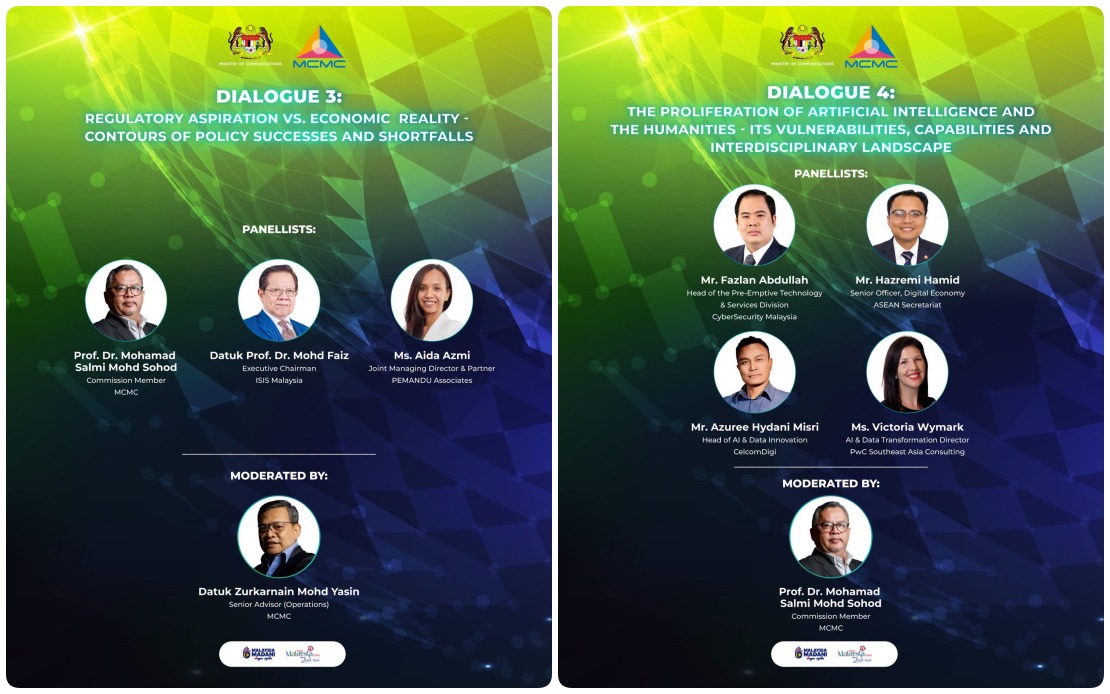
The afternoon agenda progressed toward examining the inherent tensions regulators face between promoting innovation and protecting citizens through effective oversight. A session addressing 'Regulatory Aspiration vs Economic Reality: Contours of Policy Successes and Shortfalls' brought in expertise from the Institute of Strategic & International Studies (ISIS) Malaysia and PEMANDU Associates, organisations deeply embedded in Malaysia's policy development machinery. This forum acknowledges that regulatory ambition must contend with practical implementation challenges, resource constraints, and the genuine difficulty of governing technology that evolves faster than bureaucratic processes can typically respond.
The conference also devoted serious attention to artificial intelligence's societal implications through a session titled 'AI and the Humanities: Its Vulnerabilities, Capabilities and Interdisciplinary Landscape.' This framing reveals a sophisticated understanding that AI governance cannot be purely technical; it requires input from humanists, social scientists, and ethicists alongside engineers. Participants included representatives from the ASEAN Secretariat, indicating that Malaysia is helping shape coordinated regional approaches to AI policy rather than operating in isolation, a significant consideration given ASEAN's history of limited policy harmonisation in technology matters.
The conference's second day shifts focus toward emerging technologies with sessions on quantum computing and robotics regulation. A discussion on 'Quantum Technology and Communication Architecture and Innovation: A Forward Approach' will feature IBM Quantum representatives and academic leaders from Malaysia's major universities, reflecting the nation's effort to build domestic expertise in frontier technologies rather than remaining perpetually dependent on foreign providers. Similarly, sessions on 'Regulating the Robotics Revolution' and 'Innovation-Driven Autonomous Ecosystems and Industry Transformation' position Malaysia within international conversations about governing technologies that remain nascent globally, potentially allowing the country to influence standards rather than merely adopting them after the fact.
IRC 2026 represents the third iteration of the conference since its inception in 2024, demonstrating the MCMC's commitment to establishing a recurring forum for digital governance dialogue. This cadence suggests Malaysia intends to host regular platform for the region to deliberate on digital policy, potentially positioning itself as a convening authority on technology regulation in Southeast Asia. The conference's international participation, drawing regulators and policymakers from beyond the region, creates opportunities for Malaysia to learn from other jurisdictions' regulatory experiments while showcasing its own approaches.
The timing and substance of IRC 2026 underscore how quickly digital governance has ascended Malaysia's political agenda. The ONSA's implementation just months earlier provided the legislative foundation upon which these conference discussions now build. Yet the breadth of topics—from child protection to quantum computing, from data sovereignty to mental health impacts of constant connectivity—indicates that Malaysian policymakers recognise digital governance extends far beyond law enforcement or platform regulation. Instead, they are articulating a holistic vision encompassing economic competitiveness, social wellbeing, national sovereignty, and technological self-determination.
Deputy Communications Minister Teo Nie Ching will formally close the conference tomorrow afternoon, marking the conclusion of deliberations that will likely inform Malaysia's regulatory priorities for the coming year. The challenge facing Malaysian policymakers now involves translating these high-level discussions into concrete regulatory adjustments, enforcement actions, and international coordination mechanisms that operationalise the principles articulated at IRC 2026. Success requires not only political will but also institutional capacity and sustained international cooperation—elements that remain unevenly distributed across the Southeast Asian region.

