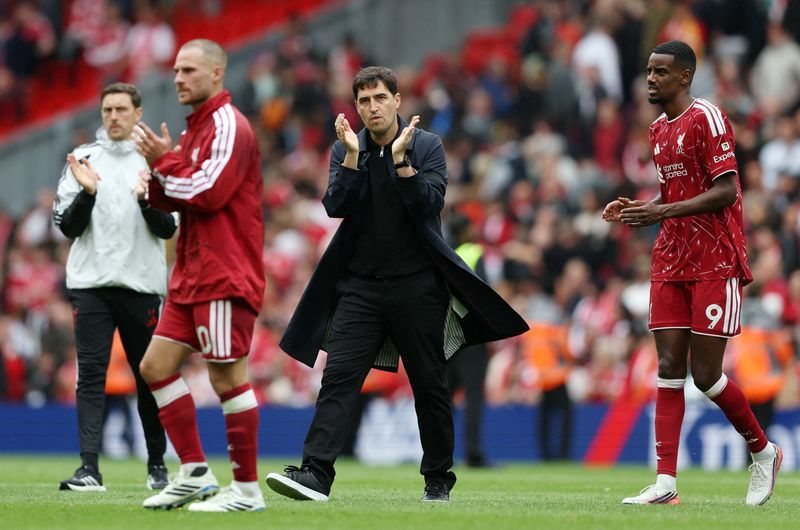
Andoni Iraola has arrived at Liverpool during a period of significant transition for the historic club, and despite failing to secure a victory in his opening matches, the Spanish manager remains convinced that his revamped side is progressing in the right direction. Liverpool's 2-2 draw with Nottingham Forest on Saturday represents a solid platform from which to build, particularly given how the team responded to adversity after falling behind, and Iraola's measured optimism reflects a manager who believes he can restore the Merseyside club to its former glory.
The appointment of Iraola this summer came at a critical juncture for Liverpool, whose preceding campaign was marked by both financial investment and sporting disappointment. Despite spending an unprecedented £446 million on new players in the Premier League, the Reds tumbled from their position as defending champions to fifth place, a collapse that exposed fundamental issues within the squad and tactical approach. The club's ownership and sporting director recognised that change was necessary, and Iraola's hire signals a decisive shift in philosophy and playing methodology.
Iraola's mandate extends far beyond simply restoring Liverpool to winning form; he has been tasked with recapturing the intensity and commanding presence that once made Anfield a fortress where visiting teams feared to tread. Under Juergen Klopp, Liverpool developed a reputation for aggressive, relentless football—what fans and analysts termed "heavy-metal football"—that energised the supporters and destabilised opponents. During Arne Slot's two-year tenure, the club adopted a more calculated, possession-based approach, yet results proved insufficient. Iraola's arrival promises a return to that high-pressing, counter-attacking style that once defined the club's identity.
The Spaniard's football philosophy emphasises attacking urgency and constant pressure without the ball, a demanding system that requires all outfield players to contribute in both phases. Rather than adopting a defensive mindset, Iraola instructs his players to push forward consistently, seek immediate transitions, and press opposition defenders aggressively throughout matches. This approach demands tactical discipline and physical conditioning, elements that cannot be implemented instantaneously across a squad containing several new recruits still acclimatising to their surroundings.
While the Forest encounter showcased glimpses of Iraola's intended football, particularly in the second half when Liverpool demonstrated superior intensity and tempo, the opening period highlighted the work still required. Nottingham Forest capitalised on Liverpool's sluggish defending to score through Dan Ndoye via a direct counterattack, a goal that underscored the defensive vulnerabilities that plagued the previous campaign. Iraola was visibly frustrated by his team's passive approach early on, with defensive positioning lax and pressing scattered, conditions that allowed Forest undue opportunities to exploit.
The transformation after half-time proved instructive for Iraola's assessment of his players' capabilities and mentality. Alexander Isak's equaliser shortly past the hour mark signalled a renewed intensity, while new recruit Victor Munoz sealed a commendable draw with a late strike. These second-half performances suggest that Iraola's tactical instructions are beginning to register with the squad, even if consistency remains elusive. The manager praised Munoz's commitment and threat in both attacking and defensive phases, indicating that the new winger possesses the athletic and technical attributes suited to his demanding system.
This represented Liverpool's second consecutive draw from a losing position, a demonstration of character and resilience that offers Iraola encouragement despite the absence of three-point hauls. Six days previously, Munoz had contributed crucially to a 2-2 stalemate with Newcastle United in the season opener, suggesting the Spanish winger's direct running and pressing instincts align perfectly with the manager's requirements. However, Iraola's primary concern remains Liverpool's chronic tendency to start matches poorly, a pattern that persisted throughout the previous season and threatens to undermine their campaign.
Iraola has pinpointed the root cause of Liverpool's sluggish starts as a defensive passivity that allows opponents to dictate possession and tempo. When Liverpool lack intensity off the ball, they cede control, permit excessive defensive spacing, and invite teams to establish dominance in midfield. Conversely, when the team elevates their pressing intensity, they regain duels, compress space, and transition attacks more efficiently. This fundamental diagnostic reveals that Iraola's primary challenge involves instilling consistency in his players' defensive work rate and pressing triggers, a cultural and physical adjustment that requires sustained effort over several weeks.
Significantly, Liverpool have moved decisively in the transfer market to accelerate their transition toward Iraola's tactical blueprint. British media reports confirm that the club has finalised terms with Paris Saint-Germain to acquire French winger Bradley Barcola, a 23-year-old whose exceptional pace and direct running style perfectly complement Iraola's high-tempo system. Barcola's arrival would further reinforce the manager's attacking philosophy and provide additional firepower in transitions, potentially addressing the goalscoring inconsistency that hampered the previous season.
The current situation encapsulates a familiar narrative in modern football: a newly appointed manager implementing significant tactical changes while managing stakeholder expectations and squad integration. Liverpool supporters, accustomed to Klopp's entertaining attacking football yet disappointed by recent underperformance, eagerly anticipate tangible improvements. Iraola understands that entertainment value and aesthetic football must ultimately translate into victories and accumulating points; otherwise, philosophical reorientation becomes merely architectural ambition without substantive outcomes.
Despite legitimate frustration at drawing matches that Liverpool arguably should have won, Iraola has publicly acknowledged that the tactical evolution will demand patience and persistence. The foundation stones are being laid—new players are integrating, pressing principles are embedding, and intensity is gradually increasing—yet premature judgement would be unfair given the magnitude of structural change. As Bradley Barcola completes his transfer and the squad gains additional experience in Iraola's system, Liverpool's prospects should improve markedly, suggesting that this early-season frustration may prove temporary rather than prophetic of systemic decline.

