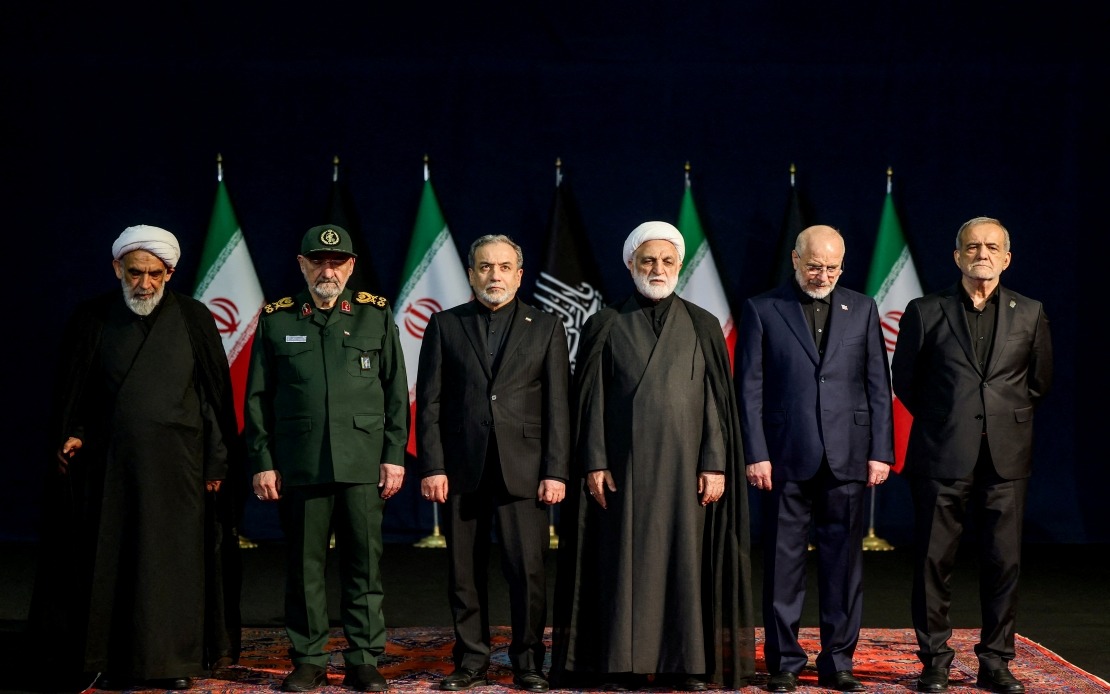
A solemn gathering of international dignitaries and Iranian state officials converged in Tehran on Friday to honour Iran's late Supreme Leader Ayatollah Ali Khamenei, underscoring the pivotal role his leadership played in regional geopolitics and Iran's domestic governance structure. The respect shown by delegations spanning from South Asia to the Caucasus and Middle East reflects both the complexity of Iran's diplomatic relationships and the international implications of the leadership transition taking place within the Islamic Republic.
The ceremony commenced at Imam Khomeini's Mosalla prayer hall in central Tehran during the morning hours and maintained its solemn proceedings throughout the day as officials arrived to pay their condolences. The choice of venue, a site of significant religious and political symbolism in Iran's capital, underscored the importance the Iranian state accorded to this moment of transition and collective remembrance.
Domestic representation at the ceremony demonstrated the full breadth of Iran's state apparatus and political hierarchy. President Masoud Pezeshkian led the civilian leadership delegation, while Parliament Speaker Mohammad Baqer Qalibaf, Judiciary Chief Gholamhossein Mohseni-Ejei, and Sadeq Amoli Larijani, who chairs the influential Expediency Discernment Council, all attended to mark the occasion. This gathering of Iran's top institutional leaders symbolised a moment of continuity at a critical juncture for the country's governance.
The international representation proved particularly noteworthy in revealing Tehran's diplomatic network and strategic partnerships. Pakistan dispatched a high-level delegation including Prime Minister Shehbaz Sharif and Chief of Army Staff Field Marshal Syed Asim Munir, signalling the importance Pakistan places on its relationship with Iran despite occasional bilateral tensions. The attendance of both figures demonstrated Pakistan's recognition of military dimensions to Iran's strategic posture alongside civilian governance.
Central Asian and Caucasian leaders, including Armenian Prime Minister Nikol Pashinyan, Georgian President Mikheil Kavelashvili, and Tajik President Emomali Rahmon, emphasised Iran's significance as a stabilising force in its immediate neighbourhood. Iraq's representation through both President Nizar Amedi and Kurdish Regional Government President Nechirvan Barzani illustrated the depth of Iranian influence in Iraqi affairs, where Tehran maintains extensive political, military and economic leverage. This dual representation also highlighted the complex balance Iran must maintain between central Iraqi authorities and the semi-autonomous Kurdish region.
Beyond the formal state delegations, senior officials from major powers including China and Russia attended, reflecting their respective strategic interests in Iran's stability and ongoing geopolitical positioning. Religious scholars, tribal leaders, and other cultural figures rounded out the gathering, reflecting the multifaceted nature of Khamenei's authority within Iran's theocratic system, which combined religious legitimacy with political control.
The planned scope of commemorative activities extended far beyond the initial Friday ceremony. Funeral rites are scheduled to continue through July 9, with processions planned across three major Iranian cities—Tehran, Qom, and Mashhad—each serving as significant religious and political centres. The inclusion of rites in Iraq reflected Khamenei's profound influence over Iranian interests in that neighbouring country, particularly regarding Shia religious sites and militia groups operating under Iranian strategic direction.
The Iranian government implemented substantial administrative and security measures surrounding the events. Public closures and airspace restrictions were declared for Tehran and Mashhad on designated dates, with Thursday formally proclaimed a national day of mourning. Such measures underscored the sensitivity and perceived risk around the transition period, as well as the symbolic importance the regime assigned to managing the succession process under controlled circumstances.
Khamenei's death on February 28 in a military strike that Iran attributed to joint United States and Israeli operations marked a dramatic disruption to Iran's leadership continuity. Within weeks, Iran's institutional structures moved to designate Mojtaba Khamenei, the late leader's son, as his successor in March, attempting to preserve the family's grip on supreme authority. This transition, completed by the time of the tribute ceremony, represented a consolidation of dynastic control over Iran's highest office.
For regional observers and particularly for Southeast Asian analysts tracking Middle Eastern developments, the ceremony illustrated the enduring centralisation of power in Iran's Supreme Leader position despite the country's republican institutions and apparent democratic processes. The ability to rapidly transition power while maintaining international diplomatic engagement suggested institutional resilience, though questions persisted about the legitimacy of hereditary succession within a revolutionary framework.
The international attendance also signalled that despite international sanctions and geopolitical isolation in some quarters, Iran maintained robust relationships with key regional and extra-regional partners. For Malaysia and ASEAN nations maintaining non-aligned stances, Iran's demonstrated capacity to convene such high-level international gatherings reflected its continued importance in Middle Eastern calculations and its relevance to broader Asian geopolitics.
The transition from Ayatollah Ali Khamenei to his son Mojtaba represents a test of Iran's institutional stability and its ability to navigate succession while maintaining both domestic cohesion and international standing. How the new leadership manages Iran's regional ambitions, nuclear programme negotiations, and relationships with both allies and adversaries will significantly influence regional stability and potentially affect global energy markets and Asian geopolitical dynamics in coming years.

