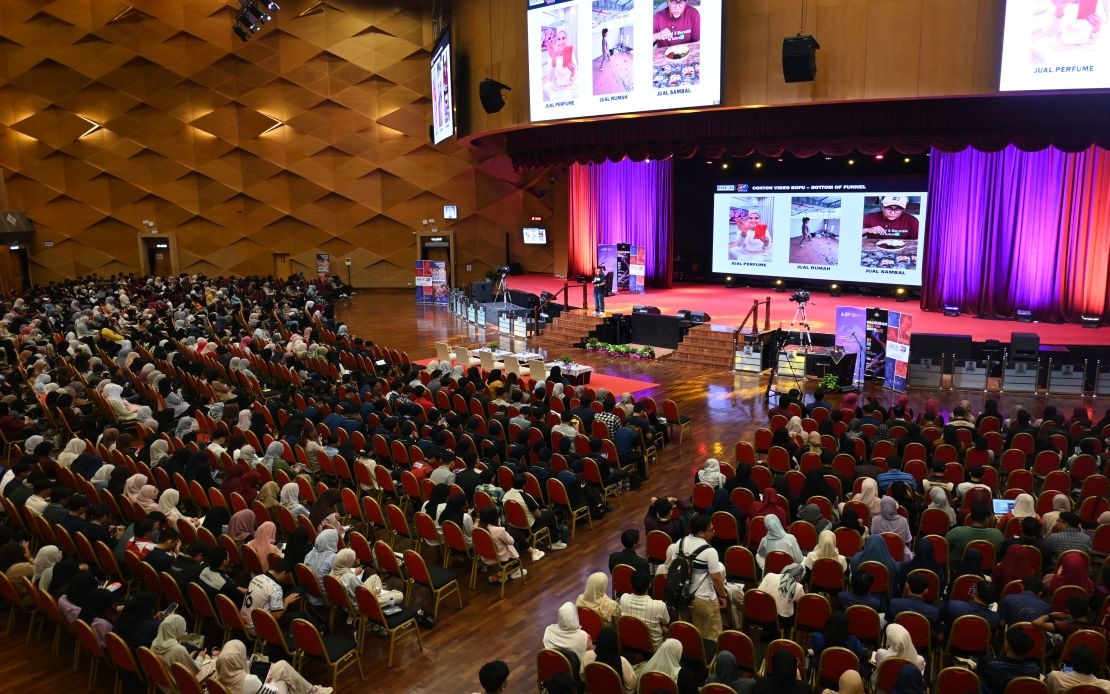
The Usahawan MADANI Mega (SUM MEGA) 2026 entrepreneurship seminar has made history by drawing 6,877 participants across physical and online platforms, securing a Malaysia Book of Records citation for the largest student participation in an entrepreneurship seminar. The achievement underscores a fundamental shift in how Malaysia's younger generation is embracing business creation as a serious career trajectory rather than viewing it as an unconventional path.
Held at Dewan Agung Tuanku Canselor at UiTM Shah Alam, the event was orchestrated by the National Entrepreneurship Institute (INSKEN) alongside the Malaysian Academy of SME and Entrepreneurship Development (MASMED) and Universiti Teknologi MARA (UiTM). The partnership leveraged the university's nationwide reach to mobilise students across multiple campuses, creating a coordinated knowledge-transfer initiative that blended live sessions with digital participation to maximise accessibility across Malaysia's geographic spread.
The record attendance carries symbolic weight within Malaysia's economic policy landscape. Datuk Mohamad Alamin, deputy minister of Entrepreneur and Cooperatives Development, framed the gathering as evidence of entrepreneurship's growing currency among young Malaysians. Rather than positioning business ownership purely as an individual advancement strategy, he articulated it as part of the nation's broader economic resilience narrative. In an era of labour market uncertainty and structural economic shifts, entrepreneurship represents both an employment solution and a wealth-creation mechanism that extends beyond individual gain.
Mohamad Alamin emphasised that the MADANI government—through the Ministry of Entrepreneur and Cooperatives Development (KUSKOP)—remains committed to constructing an entrepreneurial ecosystem that prioritises inclusivity, sustainability, and measurable economic impact. This requires multi-faceted intervention: capacity-building programmes that equip aspiring entrepreneurs with foundational skills; financing mechanisms that address capital constraints for young business founders; market access initiatives that connect startups to buyers and supply chains; digitalisation support that helps small enterprises navigate e-commerce and digital tools; and business development guidance that reduces early-stage failure rates. The statement signals that government facilitation extends beyond rhetoric into resource allocation and institutional support.
Datuk Mustaffa Kamil Ayub, INSKEN Board of Trustees chairman and UiTM board member, reframed entrepreneurship as more than occupational choice—characterising it as a cultural movement capable of reshaping Malaysia's economic trajectory. This distinction matters: a culture of entrepreneurship implies not merely individual business creation but systemic normalisation of risk-taking, innovation, problem-solving through enterprise, and community-wide celebration of founder narratives. When entrepreneurship becomes culturally embedded rather than countercultural, it influences how young people evaluate career options, how universities structure curricula, and how capital flows toward early-stage ventures.
The seminar's practical curriculum relied on the MOFA methodology, which systematically addresses marketing, operations, finance, and business administration. This framework acknowledges that entrepreneurial success depends not on inspiration alone but on mastery of operational disciplines. Marketing ensures customer awareness and revenue generation; operations optimise production or service delivery efficiency; finance manages cash flow, profitability, and funding; business administration establishes governance structures that enable scaling. By exposing students to this integrated approach, SUM MEGA 2026 positioned entrepreneurship as a learnable skillset rather than an innate talent reserved for natural-born founders.
INSKEN's broader portfolio—including the INSKEN Masterclass, BANGKIT, and PROTÉGÉ programmes—represents a scaffolded approach to entrepreneurial development. Rather than assuming a single intervention suffices, this architecture recognises that different career stages require different support mechanisms. Early-stage ideation requires mentorship; scaling requires access to capital and market intelligence; mature ventures require sophisticated business strategy and governance. By offering multiple entry points, INSKEN widens the funnel of potential entrepreneurs and increases the likelihood that talented individuals find appropriate support regardless of their starting position.
The event's significance extends beyond participation metrics to institutional collaboration patterns. By convening government ministries, higher education institutions, financial institutions, and industry participants, SUM MEGA 2026 operated as a coordination mechanism addressing a fundamental market failure: information asymmetries between aspiring entrepreneurs and the ecosystem actors who support them. Banks may not know which graduates possess viable business ideas; industry mentors may lack visibility into university talent pools; graduates may not understand financing options available to them. Large-scale convenings create market-making opportunities by facilitating these connections.
The timing of such an initiative intersects with Malaysia's National Entrepreneurship Policy 2030, which establishes entrepreneurship as a strategic pillar of economic development. Rather than hoping entrepreneurship emerges organically, this policy framework treats it as a deliberately cultivated national capability requiring coordinated government action, institutional partnerships, and sustained investment. The policy legitimises entrepreneurship support spending as development infrastructure rather than subsidy.
For Southeast Asian context, Malaysia's investment in youth entrepreneurship reflects regional trends: across the bloc, governments increasingly recognise that demographic dividend benefits only materialise when young populations possess viable employment options. As manufacturing competitiveness shifts toward higher-wage economies and service sectors professionalise, self-employment through entrepreneurship becomes an essential economic valve. Countries that successfully cultivate entrepreneurial capability among youth populations—through institutional support, cultural normalisation, and capital access—build more resilient labour markets less vulnerable to external economic shocks.
The record attendance also signals demand-side momentum. Six thousand eight hundred seventy-seven students representing themselves across Malaysia's university system suggests genuine interest in entrepreneurship rather than obligatory attendance. This organic pull reduces the marketing burden on institutions promoting entrepreneurship and indicates that the framing resonates with young Malaysians' aspirations and economic anxieties.
Moving forward, sustaining this momentum requires translating seminar attendance into venture formation and business survival. Attendance records measure awareness-building; economic impact derives from how many participants actually establish businesses, how many succeed beyond early stages, and how much employment and wealth their ventures create. INSKEN's continued programming suggests institutionalised commitment to this longer journey, though tracking conversion rates from seminar participation to functioning enterprises would reveal the true programme efficacy.