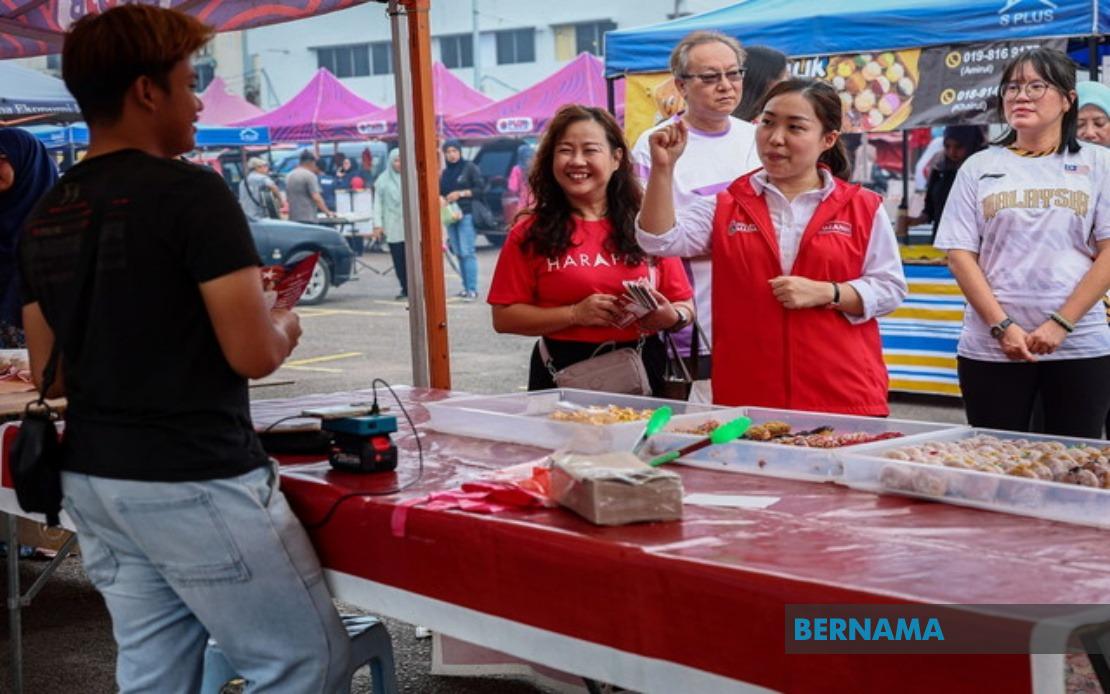
Chu Poh Yee, a practising lawyer and Pakatan Harapan nominee for the Mengkibol state seat, has crystallised her campaign platform around three interconnected pillars designed to address immediate community needs and long-term prosperity. Speaking ahead of Johor's state election scheduled for July 11, the candidate articulated how infrastructure development, economic revitalisation, and enhanced welfare services would form the backbone of her representation if voters grant her the mandate.
The Mengkibol constituency, one of 14 experiencing a direct two-way contest in this election cycle, represents a microcosm of suburban and semi-rural Johor dynamics. Chu's infrastructure focus reflects widespread frustration over deteriorating road conditions that constrain movement of goods, services, and people across the district. Her commitment to systematic upgrading extends beyond mere pothole repairs—she frames the infrastructure agenda as foundational to attracting investment and improving residents' daily quality of life. Enhanced connectivity between residential areas and commercial hubs could catalyse broader economic participation while reducing isolation in peripheral communities.
Economic stagnation and youth outmigration remain persistent challenges across many Malaysian towns, and Kluang is no exception. Chu's second plank addresses this by promoting open entrepreneurship platforms and formal employment creation tailored to local conditions. Rather than importing generic solutions, she highlights how existing assets like the Kluang Rail Festival demonstrate latent capacity for community-driven economic activity. Creative tourism initiatives generate multiplier effects throughout the local economy—food vendors, accommodation providers, transport operators, and artisans all benefit from visitor spending. By scaling such models through deliberate policy support, Mengkibol could retain younger residents while attracting skilled workers seeking affordable living with cultural vitality.
What distinguishes Chu's economic messaging is her emphasis on inclusion rather than top-down development mandates. She advocates for conditions enabling small traders and microentrepreneurs to thrive, recognising that grassroots business creation often proves more resilient and locally rooted than large external investments. This aligns with broader Malaysian concerns about equitable wealth distribution and the marginalisation of informal sector workers during structural economic transitions.
The third component—community welfare—signals recognition of changing household structures and workplace dynamics. Chu's particular focus on childcare infrastructure and enabling women's workforce participation addresses a genuine gap affecting many Malaysian families. Professional women often face impossible choices between career advancement and childcare responsibilities, particularly in districts lacking adequate formal childcare facilities. By championing well-resourced childcare centres, Chu targets both immediate hardship and systemic inefficiency. She acknowledges that workforce participation among women remains suppressed partly due to infrastructure deficits rather than preference or capability, and that rectifying this serves both individual aspirations and broader economic productivity.
Her emphasis on balanced work environments and family-friendly policies resonates with growing Malaysian professional class concerns about work-life integration. This messaging extends beyond gender politics into questions about how towns transition toward knowledge economies while maintaining liveable communities—issues increasingly salient as remote work normalises and urbanisation patterns shift.
The campaign itself has encountered resistance, with several instances of vandalism targeting Pakatan Harapan materials across Mengkibol. Such incidents, while concerning for democratic discourse, appear to have steeled rather than discouraged Chu's team. Her public response emphasising determination rather than playing victimhood suggests political maturity and focus on substantive messaging rather than conflict escalation—a notable positioning in an electoral environment sometimes dominated by personal acrimony.
Chu faces competition from Barisan Nasional's Yap Zhi Peng in what represents one of the July 11 election's 56 contested state seats. The broader Johor state election involves 172 candidates overall, with early voting occurring July 7. For Mengkibol voters, the choice between candidates reflects different approaches to local governance—whether prioritising incremental infrastructure improvements and business facilitation under established political structures, or pursuing more activist economic democratisation and welfare state expansion.
The Mengkibol contest carries broader significance for Pakatan Harapan's positioning in Johor, historically a Barisan Nasional stronghold. Younger, professionally credentialed candidates like Chu represent the coalition's effort to appeal beyond traditional support bases, positioning itself as forward-thinking and competent on technocratic grounds rather than purely ideological. Her specific policy agenda—infrastructure, jobs, childcare—reflects polling data suggesting these issues genuinely motivate middle-class voters across Malaysia's political spectrum.
For regional observers, Mengkibol exemplifies how Malaysian electoral politics increasingly turns on quality-of-life concerns rather than existential identity questions. Candidates addressing practical governance failures and economic opportunity gaps gain traction regardless of coalition affiliation. Chu's three-pronged agenda, while necessarily simplified for campaign purposes, acknowledges this voter sophistication and attempts to offer concrete improvements across multiple life domains simultaneously.

