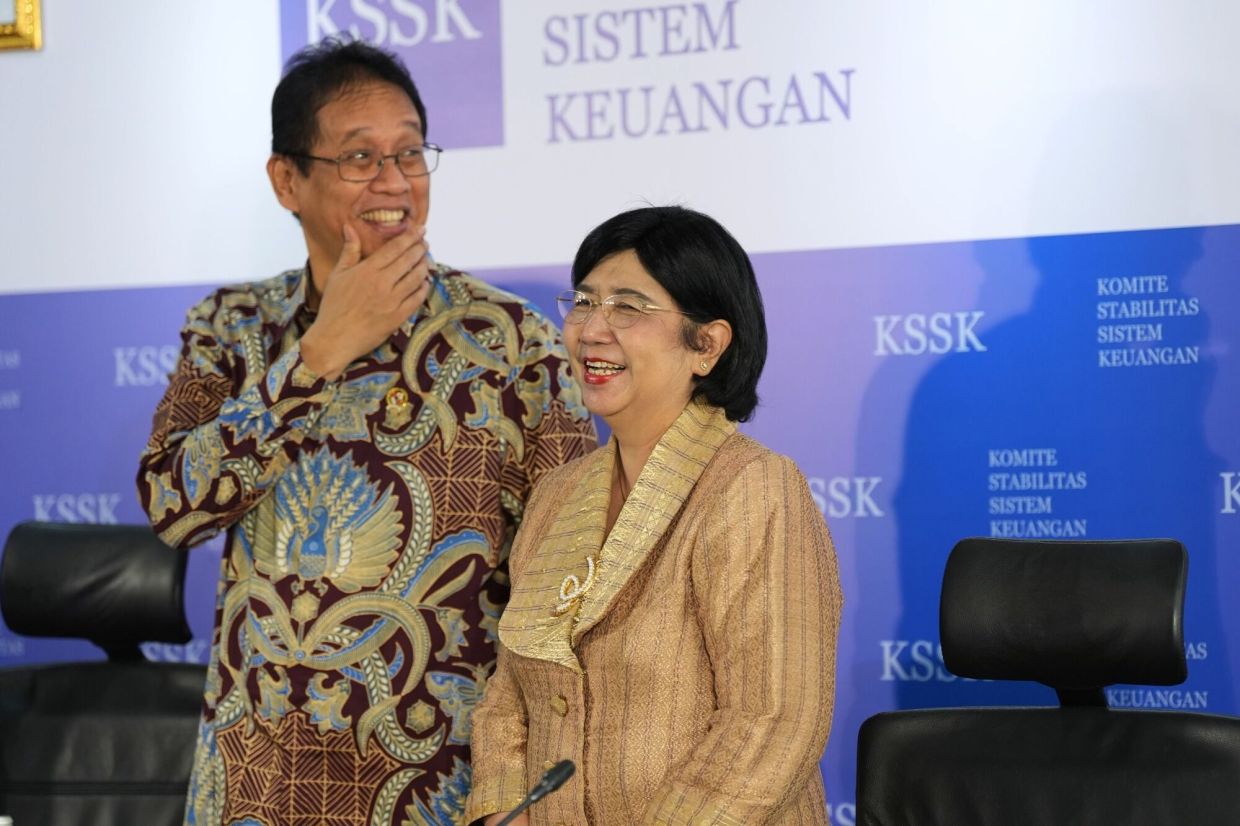
Destry Damayanti's first week as acting governor of Bank Indonesia carried a carefully calibrated message. Within hours of her appointment two weeks ago, she visited Finance Minister Purbaya Yudhi Sadewa's office before proceeding to meet President Prabowo Subianto, signalling her intention to forge a collaborative relationship with the government's fiscal leadership. The two subsequently appeared together at a public press briefing, presenting a unified front that represented a significant shift in tone from her predecessor's more formal approach to official dealings.
This openness toward coordination contrasts sharply with the tenure of Perry Warjiyo, the outgoing governor whose interactions with the finance ministry typically occurred in formal settings such as the presidential palace or regulatory committees. The relationship between Warjiyo and Purbaya rarely extended to private one-on-one meetings, with only a single publicly documented bilateral encounter taking place at the central bank's headquarters in September 2025. The departure from this more guarded posture has already become a focal point of investor and analyst discussion about what Destry's leadership will mean for Indonesia's monetary framework.
Prabowo has formally nominated Destry, who served as Warjiyo's deputy since 2019, as the sole candidate for the permanent governor position, pending parliamentary confirmation. Her selection reflects an attempt to reconcile two seemingly competing priorities: installing a market-oriented professional capable of commanding investor confidence while simultaneously aligning the central bank with the administration's ambitious economic objectives. Prabowo's stated vision includes accelerating growth toward eight percent by 2029, a target that could intensify pressure on monetary policymakers to prioritise expansion over inflation management.
The market's initial reaction to Destry's appointment provided some reassurance to observers concerned about institutional credibility. The rupiah strengthened to its highest level in a month when the nomination was announced on Monday, with the currency outperforming most other Asian peers during the immediate aftermath. Broader economic conditions, however, present a more concerning backdrop. The rupiah has depreciated roughly six percent against the dollar throughout 2025, marking Asia's weakest performance and reflecting investor anxiety about Prabowo's populist policy measures over the preceding twelve months, including substantial expenditure on free school meals and expanded state involvement in commodity production.
This currency weakness has prompted heightened scrutiny from international credit agencies. Fitch Ratings and Moody's Ratings have both placed Indonesia's sovereign credit rating under negative watch, citing policy uncertainty as the primary driver of their cautious stance. S&P Global Ratings has maintained its stable outlook for the nation, though even this assessment comes with underlying wariness about medium-term economic direction. These rating actions underscore the delicate position that Destry inherits, where every decision carries implications for Indonesia's international borrowing costs and capital market access.
Economists and market analysts have generally expressed optimism about continuity under Destry's leadership, particularly regarding the central bank's commitment to currency stability and the preservation of existing policy frameworks. Helmi Arman, an economist at Citigroup, has suggested that improved communication between the central bank and government represents a genuine upside to the new arrangement, while cautioning that broader conditions affecting institutional credibility remain volatile and subject to rapid change. This duality—acknowledging both positive signals and lingering uncertainties—characterises much professional commentary on the transition.
Under Warjiyo's stewardship, Bank Indonesia deployed a multifaceted toolkit to manage competing economic objectives. The institution has raised its policy interest rates on three separate occasions since May and intervened directly in foreign exchange markets to support the rupiah's value, while simultaneously employing non-rate instruments such as liquidity measures to sustain credit growth and economic momentum. Whether Destry will maintain this balance or tilt toward accommodative policies that prioritise growth remains the critical question for investor confidence. Irman Faiz, chief economist at PT Bank Danamon, has emphasised that investors will closely monitor whether the central bank proves willing to increase rates when circumstances demand such action and whether liquidity decisions continue to be driven by assessment of inflation, currency dynamics and financial stability rather than short-term growth considerations.
Destry enters the role with substantial professional credentials that should appeal to investor and analyst communities. She holds bachelor-level training in economics from the University of Indonesia and completed advanced regional science studies at Cornell University. Her pre-central bank career included serving as chief economist at PT Bank Mandiri, one of Indonesia's largest financial institutions, and holding a commissioner position at the Indonesia Deposit Insurance Corporation, an agency previously led by Finance Minister Purbaya. Her existing relationships within investor and analyst circles, built through regular engagement on monetary policy matters, position her well for managing market expectations during her tenure.
The central challenge confronting Destry extends beyond merely sustaining the stability achieved by her predecessor. Fakhrul Fulvian, chief economist at PT Trimegah Sekuritas Indonesia, has articulated that the next phase of Bank Indonesia's mission requires translating currency stability into improved liquidity conditions, restoration of a more normalised yield curve, strengthened transmission of monetary policy to the real economy, and renewed confidence among private-sector borrowers and investors. This forward-looking agenda demands both policy skillfulness and institutional independence.
The pressure from rising global interest rates and a persistently strong dollar will compound Destry's difficulties, as these external forces continue buffeting the rupiah downward despite relatively contained domestic inflation. Simultaneously, Prabowo's explicit commitment to reaching eight percent growth by 2029 creates implicit expectations that the central bank will support such expansion through accommodative monetary conditions. This tension between external constraints, domestic growth objectives and inflation management represents the substantive policy problem underlying discussions of Destry's leadership.
The critical principle articulated by analysts involves maintaining what Irman Faiz terms a distinction between beneficial coordination and problematic subordination. Close working relationships between monetary and fiscal authorities can enhance policy effectiveness, but only when the central bank retains genuine authority to prioritise inflation control, currency stability and financial system resilience over short-term growth preferences. Whether Destry can sustain this distinction while demonstrating responsiveness to the administration's economic vision will determine whether her appointment ultimately enhances or undermines Indonesia's medium-term economic credibility with international investors and rating agencies. Her nomination still requires parliamentary approval, which could provide an opportunity for formal reaffirmation of the central bank's institutional independence.

