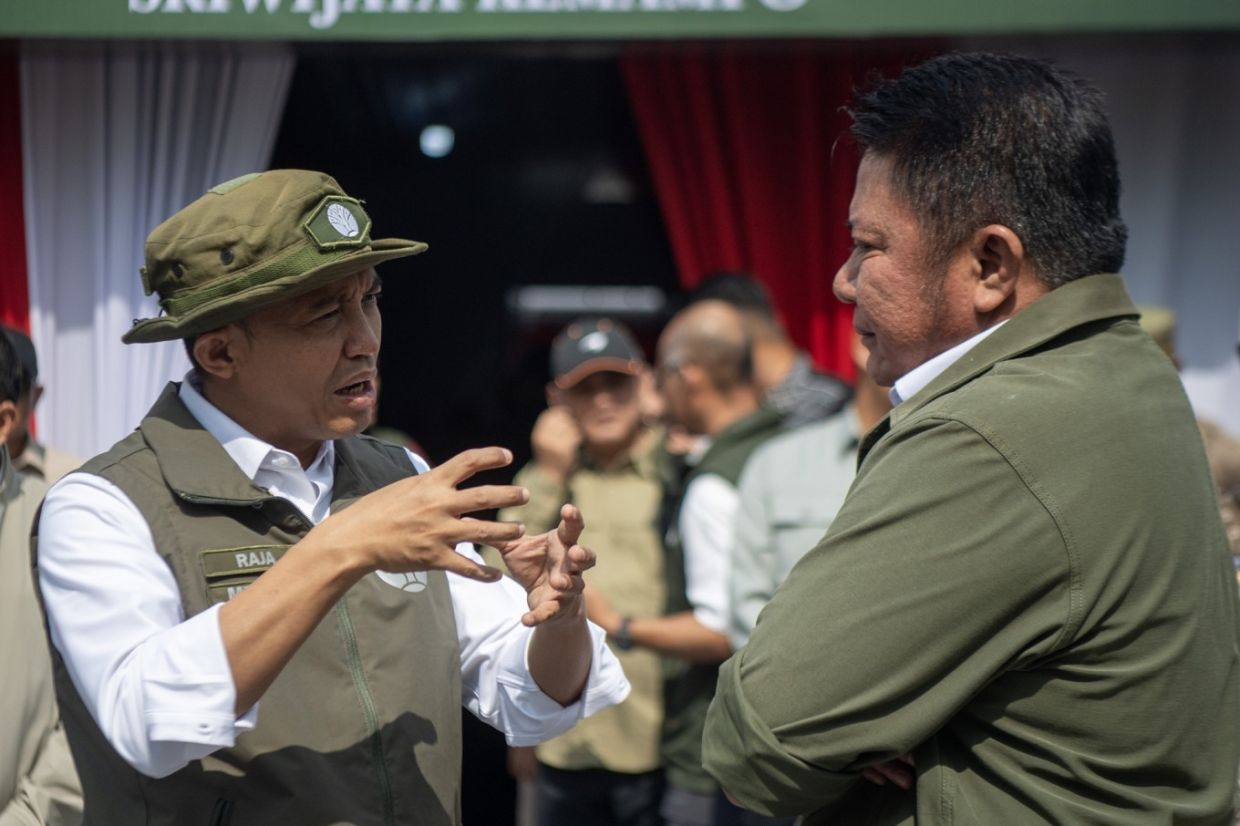
Indonesia's Corruption Eradication Commission (KPK) has reopened its investigation into Forestry Minister Raja Juli Antoni, focusing on discrepancies between the amount of illicit money the minister initially reported receiving and what he claims to have returned. The antigraft body suspects the difference may indicate the minister has not fully disgorged bribes allegedly offered by Suhardiman Amby, the regent of Kuantan Singingi in Riau province, raising fresh questions about the handling of the corruption case and the minister's role in it.
According to KPK spokesperson Budi Prasetyo, investigators are meticulously examining the gap between the total funds that allegedly changed hands during a June 2 meeting between ministry officials and Kuantan Singingi administration representatives, and the sums the minister subsequently reported returning. The core allegation involves an envelope containing S$14,000 (US$10,919) in Singapore dollars that Suhardiman purportedly handed to Raja Juli during their encounter at the ministry. Beyond this primary transaction, other officials within the forestry department are said to have received an additional S$12,500 from various representatives of the Kuantan Singingi administration, broadening the scope of the investigation and suggesting a coordinated effort to influence ministry decisions.
Raja Juli's account of events centres on his claim that he rejected the bribe and promptly returned the envelope. The minister reported the incident to the KPK on July 3, stating he had handed the money back to authorities at Kuantan Singingi Police headquarters on June 12, a full ten days after receiving it. By this version of events, he acted swiftly and properly once presented with the improper gift, returning it without delay and notifying the antigraft commission of the incident. However, the KPK's renewed scrutiny suggests investigators have identified inconsistencies in this narrative that warrant closer examination, particularly regarding whether all funds received were accounted for in the return.
Central to the investigation is the question of whether the alleged bribes were connected to forest reclassification proposals submitted by the Kuantan Singingi administration to the Forestry Ministry. The regency sought to convert more than 1,800 hectares of limited production forest (HPT) to other land-use classifications, a decision that falls squarely within the ministry's authority. Under Indonesian law, improper gifts received by public officials must be reported to the KPK, not police authorities, within 30 days of acceptance. Failure to do so carries serious consequences, with convictions potentially resulting in up to 20 years imprisonment and fines reaching Rp 1 billion (US$55,867). The procedural violation Raja Juli may have committed—reporting to police rather than directly to the KPK—compounds the investigation's complexity and raises doubts about his understanding of his obligations as a senior government official.
The pattern of contact between Raja Juli and Suhardiman extends beyond the single June 2 meeting at the centre of the bribery allegations. Budi revealed that the minister and regent had met on at least three separate occasions across April, May, and June, though investigators have not yet publicly clarified whether these additional meetings were coordinated with the alleged bribe transfer or pursued independent objectives. This frequency of high-level contact during the precise period when the Kuantan Singingi administration was advancing its forest conversion requests suggests the relationships may have been deliberately cultivated to facilitate the regency's regulatory goals, adding weight to suspicions of systematic impropriety.
Suhardiman himself faces serious criminal exposure in what has become a sprawling corruption investigation. The regent, who belongs to President Prabowo Subianto's Gerindra Party alongside Raja Juli, was arrested and designated a suspect by the KPK in late June on separate allegations of receiving kickbacks from Zulkarnain, the regency's secretary, in exchange for approving his appointment to that administrative position. The KPK subsequently expanded the case to encompass the alleged kickbacks directed at the Forestry Ministry regarding forest conversion permits, transforming what appeared initially to be a localized corruption matter into a multi-layered scheme involving both personnel appointments and regulatory decisions with significant environmental and commercial implications. This expansion reveals how corruption investigations in Indonesia frequently uncover interconnected webs of impropriety once initial threads are pulled.
The case has intensified scrutiny of Raja Juli within both parliament and the broader public sphere. Members of the House of Representatives Commission IV, which oversees forestry planning and policy, have demanded the minister appear before them to provide clarification and answer questions about his involvement with the Kuantan Singingi administration's proposals. The political stakes for Raja Juli are particularly acute given his dual role as secretary-general of the Indonesian Solidarity Party (PSI), a party that has positioned itself as reform-minded and anti-corruption in its public messaging. Any substantive findings against him could damage the party's credibility and complicate its coalition positioning within Indonesia's complex political landscape.
The minister's absence from a scheduled July 14 meeting with House Commission IV further raised eyebrows within parliament and among observers monitoring the case. Commission IV deputy chair Alex Indra Lukman from the opposition Indonesian Democratic Party of Struggle (PDI-P) attributed the absence to Raja Juli's participation in an umrah (minor haj) pilgrimage, suggesting the minister prioritized religious observance over parliamentary accountability during a period when public and legislative confidence in his conduct had visibly eroded. Whether this was a matter of genuine scheduling conflict or strategic avoidance remained subject to interpretation, but the optics of a senior minister sidestepping legislative questioning during an active corruption investigation proved damaging to his credibility.
In response to the rekindled investigation, the Forestry Ministry issued a statement reaffirming its commitment to cooperating fully with the KPK and respecting the antigraft body's independent investigative authority. The ministry emphasized that it had not approved any of Kuantan Singingi's forest reclassification proposals to date, with the most recent submissions having been either rejected outright or remain pending further verification. This defensive posture reflects awareness within the ministry that its regulatory decisions will face heightened scrutiny and that any approvals granted to Kuantan Singingi in the near term would invite accusations that corruption influenced the outcomes. The ministry's statement appears designed to preemptively counter suggestions that bribery successfully swayed forest conversion decisions, though the renewed KPK investigation suggests such concerns remain far from settled.
For Malaysian observers and policymakers, this case illuminates broader patterns within Southeast Asian governance where regulatory authority over natural resources becomes a magnet for corruption. The overlap between environmental regulation, commercial interests in land-use conversion, and political patronage that characterizes this incident mirrors dynamics seen across the region, including Malaysia's own regulatory challenges. The investigation's focus on whether government officials properly reported and returned illicit gifts also underscores the importance of robust institutional mechanisms for handling official misconduct, a lesson relevant to Malaysian public administration debates. Indonesia's KPK, despite its resource constraints, continues to pursue complex corruption cases that implicate senior ministers, establishing an investigative template and political accountability standard that contrasts with enforcement patterns in some other regional jurisdictions.
The ultimate resolution of the Raja Juli case will carry implications beyond Indonesia, signalling whether Southeast Asia's major democracies can credibly investigate and prosecute corruption involving environmental regulation and ministerial-level officials. The discrepancies the KPK has identified—money allegedly given but not fully accounted for upon return—represent the type of technical forensic detail that distinguishes genuine corruption investigations from performative ones. Should investigators confirm that Raja Juli retained portions of the bribes or failed to report the incident through proper channels, the legal and political consequences will extend beyond one minister's career to encompass questions about institutional capacity for self-correction within Indonesia's government and the durability of anti-corruption mechanisms in Southeast Asia's largest democracy.

