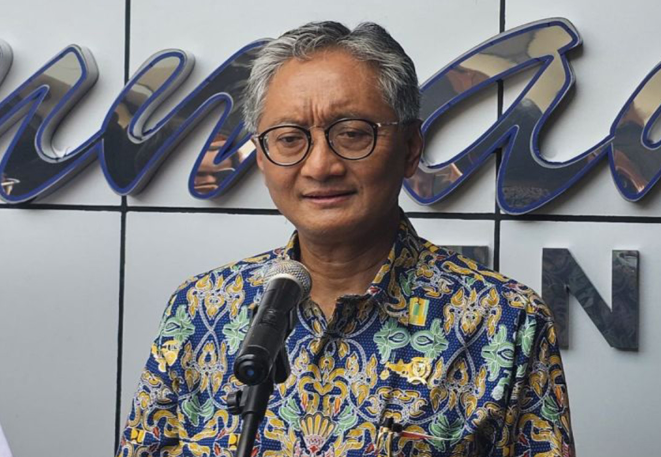
Indonesia's Public Works Ministry has descended into organisational chaos following the circulation of an internal document that listed Minister Dody Hanggodo's wife and daughter as delegates on a planned overseas work trip to New York. The leaked travel document, which detailed participation in a United Nations meeting scheduled for mid-July, has ignited allegations of impropriety and triggered a wave of internal personnel reshuffles that now threatens to destabilise operations across the sprawling infrastructure agency.
The controversy began when a ministry letter dated June 29 and signed by secretary-general Apri Artoto detailed an official delegation of eight people scheduled to travel to New York from July 13 to 19 for a United Nations body meeting on July 16 and 17. The inclusion of Dody's wife Irma Hermawati and their daughter Aurellia Tsabitha Meidirama prompted swift condemnation on social media, with critics questioning whether state resources were being diverted for personal purposes. The intensity of public disapproval forced the ministry to abandon the trip entirely, yet the damage to internal morale had already taken root.
Within days of the document going viral, social media filled with reports that Dody had ordered the reassignment of numerous officials to regional postings, predominantly in locations outside Java. These moves were widely interpreted as punitive measures against those suspected of leaking the sensitive document. The scale of the reshuffling proved substantial, with observers tracking more than 100 employees affected across various levels of the bureaucratic hierarchy. When confronted by journalists on Wednesday, Dody neither denied the transfers nor fully addressed the retaliation claims, instead offering a defensive response that highlighted the sheer scale of his workforce.
"I have 38,600 employees, why shouldn't I be allowed to reassign them?" Dody stated, as reported by Kompas.com, deflecting scrutiny through a numerical argument rather than engaging with underlying concerns about institutional stability. His response suggested frustration with oversight rather than acknowledgment of legitimate grievances within the ministry. The comment underscored a fundamental tension between ministerial prerogatives and the need for transparent governance in large public institutions serving millions of Indonesians.
Apri attempted damage control during a press briefing on July 7, justifying the family members' inclusion by claiming it was necessary to facilitate visa applications through the Foreign Ministry. He further asserted that state funds would not have financed the family's participation, though this explanation did little to satisfy critics who questioned why dependents should be listed on official ministry correspondence in the first place. The secretary-general also vowed to identify the source of the leak and threatened legal action against anyone found responsible, signalling an adversarial approach to internal accountability rather than addressing the root institutional problems.
Dody's tenure since assuming office in October 2024 has been marked by persistent institutional turbulence. The 60-year-old, whose background spans engineering and business interests in South Kalimantan connected to businessman Andi "Haji Isam" Syamsuddin Arsyad, has pursued aggressive personnel restructuring. In May alone, he appointed seven high-ranking officials, including elevating Apri to secretary-general to replace Wida Nurfaida, who had occupied the position for less than a year. This pattern of rapid turnover suggests either systemic problems requiring constant correction or a leadership approach that prioritises control over consensus-building among experienced civil servants.
The relentless reshuffling has raised alarm bells in Indonesia's parliament. During a June meeting, lawmaker Yasto Soepredjo Mokoagow of Commission V, which oversees infrastructure, warned that disciplinary actions and demotions to nonstructural positions were generating widespread fear among civil servants. The PDI-P representative specifically cited how staff anxiety could cripple program implementation at a ministry responsible for critical national infrastructure. This assessment highlights how internal political struggles at the ministerial level can eventually cascade downward, affecting citizens dependent on functional public services.
Dody has repeatedly invoked the existence of a "deep state" within the ministry to justify his aggressive restructuring campaign. Using the metaphor of termites eating away at institutional foundations, he has framed his personnel decisions as necessary preventative measures against entrenched resistance to reform. While concerns about organisational inertia merit serious consideration, the frequency and scale of his reshuffles suggest an approach that may be generating as many problems as it purports to solve.
The minister's leadership is occurring against a backdrop of serious corruption allegations involving senior ministry staff. The Jakarta High Prosecutor's Office named suspects in June connected to water resources projects, including former water resources director general Dwi Purwantoro and former irrigation and swamp director Yosiandi Radi Wicaksono. Dody stated he would cooperate fully with law enforcement and not shield subordinates from investigation, positioning himself as committed to transparency despite his combative approach to internal management.
Recent social media footage has further complicated Dody's standing within the ministry. Video from an April visit to a school construction site in East Java captured him verbally reprimanding an employee, characterising the worker's explanation as a "dumb excuse" while pointing his finger. Such interactions, when amplified through digital platforms, can undermine ministerial authority and erode trust between leadership and staff. For Malaysian and Southeast Asian observers, the situation illustrates how institutional instability at senior government levels can undermine public sector effectiveness across the region.
The unfolding crisis at Indonesia's Public Works Ministry serves as a cautionary tale about ministerial governance. The initial family travel matter, while embarrassing, might have been managed through straightforward accountability measures and policy clarification. Instead, the subsequent mass reassignments and threatened legal actions against suspected leakers have created an atmosphere of institutional fear that potentially compromises the ministry's capacity to deliver infrastructure projects essential to economic development. As Indonesia navigates post-election adjustments under current leadership, the ministry's dysfunction raises questions about whether personnel reshuffles can substitute for substantive governance reform.
Looking forward, the ministry faces a critical juncture. Restoring institutional cohesion will require Dody to move beyond confrontational management styles and security-focused personnel strategies toward rebuilding trust among the civil service. The challenge extends beyond Indonesia's borders, as infrastructure projects often involve regional partnerships and foreign investment, making internal ministerial stability a concern for neighbouring Southeast Asian nations evaluating collaboration opportunities. Until the Public Works Ministry stabilises, both domestic development agendas and regional integration efforts may face unnecessary complications stemming from preventable institutional dysfunction.

