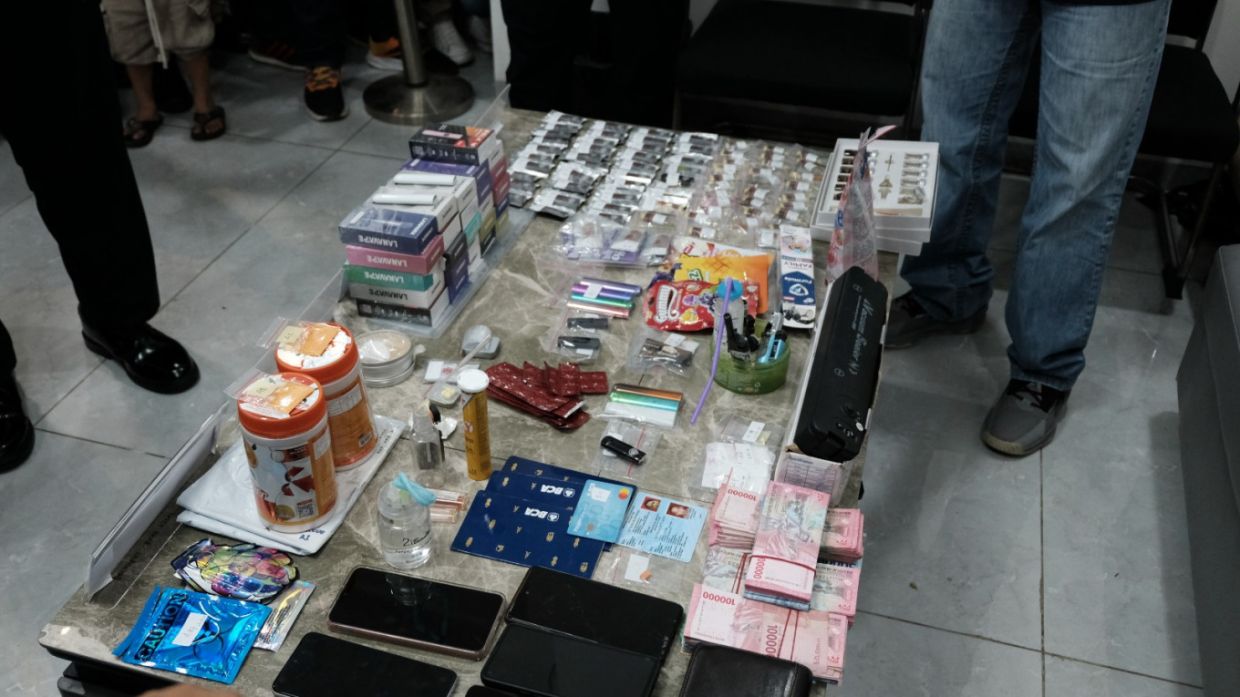
Indonesian authorities have successfully broken up an organised international drug syndicate operating from Batam in the Riau Islands, culminating in the arrests of six Indonesians and prompting a manhunt for two Malaysian nationals believed to be the operation's principal suppliers. The dismantling of this network highlights the persistent challenge of narcotics trafficking across the Malaysia-Indonesia border, where sophisticated smuggling operations continue to exploit maritime and airport vulnerabilities despite increasing enforcement efforts in the region.
The National Narcotics Agency (BNN) and Customs and Excise Directorate General launched their investigation following the interception of a suspicious parcel at Soekarno-Hatta International Airport in Jakarta. The package, ostensibly containing Orange Fiber Xtra food supplement and originating from Malaysia, underwent laboratory analysis at the Customs and Excise Laboratory where technicians identified a payload of MDMA, ketamine, and other controlled substances. This discovery triggered an intensive joint investigation that would ultimately uncover the full extent of the syndicate's operations across multiple locations in Batam.
According to Insp. Gen. Aswin Sipayung, the BNN's deputy for enforcement, the network operated with considerable sophistication, managing every stage of the criminal enterprise from initial smuggling through illegal entry points to final distribution within the Riau Islands region. The operational structure demonstrated a clear division of labour, with the Malaysian nationals occupying the apex of the supply chain while local Indonesian operatives handled lower-tier functions including packaging, warehousing, and street-level distribution. This hierarchical arrangement is typical of transnational drug syndicates operating throughout Southeast Asia, where geographic specialisation allows networks to maximise efficiency while compartmentalising risk.
The breakthrough came when customs officers apprehended a suspect identified as BAP, who was preparing to collect the intercepted shipment in Batam on Wednesday. Interrogation of BAP rapidly led to the identification and capture of three additional individuals at a hotel in Baloi—ED, who allegedly orchestrated the order; NC; and TFS. The swift progression from initial arrest to secondary captures demonstrates the value of real-time intelligence gathering and demonstrates how a single interdiction can unravel entire operational networks when investigative momentum is maintained.
Raids conducted at four distinct locations across Batam yielded substantial drug seizures and evidence of the operation's scale. Officers recovered dozens of vape cartridges containing etomidate, multiple sachets of Happy Water drinks, Happy Five tablets, methamphetamine, ketamine powder, and ecstasy pills from apartments and boarding houses in the Teluk Tering and Batu Ampar areas. The syndicate's attempted concealment strategy—embedding narcotics and drug-delivery devices within resealed food packaging to simulate legitimate commercial products—reflects an evolving tactical approach among traffickers seeking to evade detection at border checkpoints and customs facilities.
The total confiscation encompassed 1,076.18 grams of MDMA, 50 grams of methamphetamine, 25.6 grams of ketamine powder, 170 vape cartridges containing etomidate, and 12 vials of etomidate totalling 226 grams, alongside substantial quantities of finished drug products and consumption paraphernalia. Officers also seized four vehicles including a Toyota Alphard van and a Chery SUV, indicating that the operation maintained dedicated transportation infrastructure for product movement. This equipment seizure disrupts the syndicate's logistical capabilities and imposes significant financial costs on the network's reconstruction efforts.
During the same enforcement window, customs personnel at Batam Centre International Ferry Terminal intercepted a separate smuggling attempt when Malaysian passenger PS arrived from Stulang Laut International Ferry Terminal in Johor Bahru carrying 48 cartridges of etomidate. This concurrent interdiction suggests either the existence of parallel smuggling routes within the broader network or unrelated trafficking activity—a distinction that investigators are currently clarifying. The ferry terminal seizure underscores the vulnerability of maritime transport links between Malaysian and Indonesian ports, which remain critical channels for narcotics flows despite increased surveillance.
The two Malaysian nationals identified as SL and WKC remain fugitives, having been designated as the primary suppliers and architects of the importation scheme. Their placement on wanted lists initiates an international manhunt that will likely require cooperation between Malaysian and Indonesian law enforcement agencies. The identification of Malaysian nationals as key figures reflects a pattern observed throughout Southeast Asia, where traffickers from one jurisdiction leverage geographic, cultural, and linguistic advantages to establish smuggling operations in neighbouring countries with substantial demand for recreational and pharmaceutical narcotics.
The charges faced by apprehended suspects are grave. Under Indonesia's Law No. 35/2009 on Narcotics, Article 114(2) in conjunction with Article 132(1) and Article 112(2), penalties range from five years' minimum imprisonment to capital punishment, with potential fines reaching Rp10 billion. These severe sentencing frameworks reflect Indonesia's commitment to combating narcotics trafficking, though enforcement consistency and judicial application remain subjects of scrutiny among international observers monitoring the country's drug policy implementation.
Customs authorities estimated that the operation's disruption prevented potential addiction among approximately 6,770 individuals while averting Rp10.8 billion (approximately US$599,000) in projected state healthcare and rehabilitation expenditures. This quantified public health rationale underscores how drug enforcement operations generate measurable social benefits beyond simple criminological metrics, demonstrating the tangible economic burden imposed by narcotics addiction on national healthcare systems throughout the region. For Malaysian policymakers and enforcement agencies, the case reinforces the necessity of sustained intelligence sharing with Indonesian counterparts and heightened scrutiny of shipping routes and passenger movements across the Straits of Malacca.
The operation concludes a period of intensive investigation but raises unresolved questions regarding potential connections to other clandestine manufacturing facilities in Batam that law enforcement had previously targeted. Authorities are continuing to examine whether the dismantled network supplied drugs to or drew product from these other illicit production sites, suggesting that the full architecture of organised narcotics activity in the Riau Islands remains incompletely understood. As investigations proceed, the case exemplifies the dynamic, evolving nature of transnational drug trafficking in Southeast Asia, where enforcement victories invariably prompt traffickers to develop counter-measures and diversify operational structures across multiple jurisdictions.

