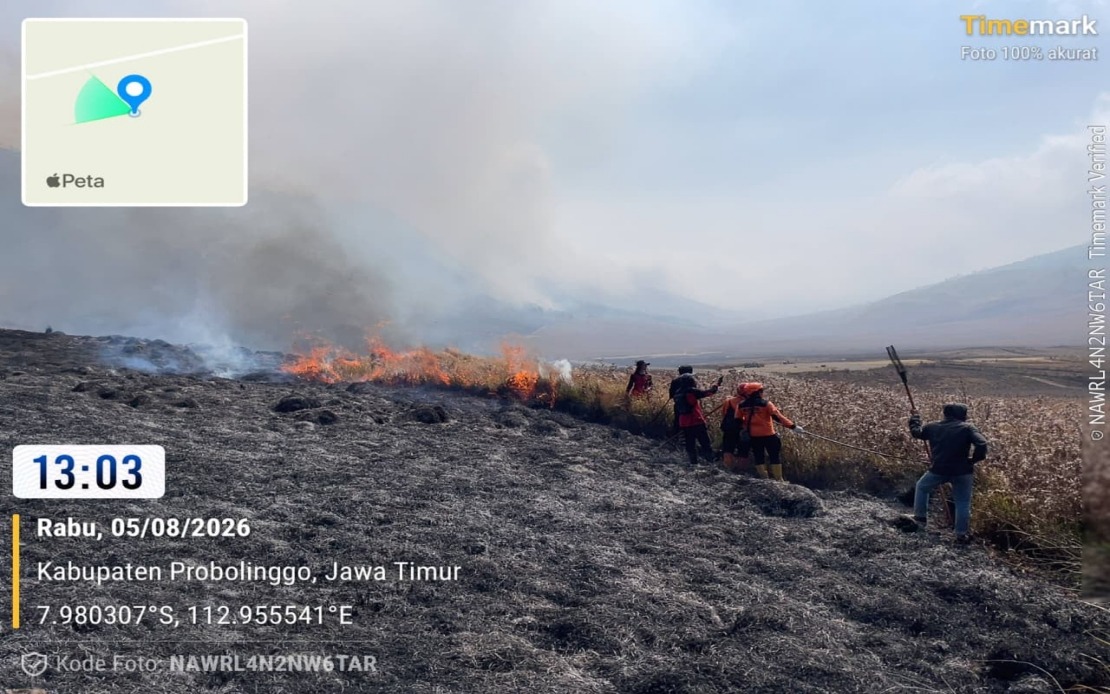
Indonesia's National Disaster Management Agency has activated two water-bombing helicopters to contain an escalating wildfire at Mount Bromo that has devastated roughly 60 hectares of terrain across East Java's Probolinggo and Malang regencies. The aerial intervention represents a significant escalation in response efforts as ground teams struggle to access the most treacherous sections of the active volcano. Officials disclosed on Thursday that the disaster agency deployed the helicopters specifically to target persistent hotspots situated on steep, inaccessible slopes where conventional ground-based firefighting operations face severe logistical constraints.
According to Abdul Muhari, the head of the National Disaster Management Agency's information division, the inferno commenced burning on Monday and has since consumed approximately 10 hectares in Probolinggo Regency alone. The remaining affected area—roughly 50 hectares—lies within the Bromo Tengger Semeru National Park located in adjacent Malang Regency. The volcano's challenging topography has complicated containment efforts considerably. While officials reported that the majority of the fire had come under control by Wednesday afternoon, several stubborn hotspots remained actively burning in particularly steep and difficult-to-navigate zones by the time aerial assets were committed to the operation.
The deployment of water-bombing helicopters signals a deliberate shift toward comprehensive firefighting approaches encompassing both ground and aerial components. The National Disaster Management Agency indicated that personnel would maintain continuous monitoring and direct engagement with remaining hotspots throughout the affected areas. Officials are simultaneously preparing to implement weather modification operations, contingent on atmospheric conditions and coordination with relevant meteorological authorities. This multi-pronged strategy reflects the complexity of battling wildfires in challenging volcanic terrain where conventional methods encounter significant limitations.
The Bromo Tengger Semeru National Park Authority has imposed a temporary closure affecting portions of the Mount Bromo tourist zone, maintaining restrictions until circumstances permit full reopening. The precautionary measure serves dual purposes—creating operational space for firefighting personnel to work unimpeded while simultaneously protecting visitors from potential exposure to smoke, flames, and hazardous air quality. Tourism represents a significant economic component for the region, making the park's closure a consequential disruption affecting local livelihoods and broader economic activity in surrounding communities that depend on visitor spending.
Investigators have focused on a particular theory regarding fire causation: officials believe hikers may have abandoned a smoldering campfire without ensuring complete extinguishment. This hypothesis remains unconfirmed pending ongoing investigation, though circumstantial evidence points toward human negligence rather than natural ignition sources. The suspected scenario underscores a persistent challenge faced by park authorities and regional officials—educating visitors about responsible fire safety practices in sensitive ecosystems. Mount Bromo attracts substantial numbers of domestic and international trekkers annually, creating elevated risks when visitors lack sufficient understanding of fire management protocols in volcanic environments.
The incident carries broader implications for Indonesia's disaster preparedness infrastructure and regional environmental management. Mount Bromo occupies significant cultural and economic importance for the region as a major tourism destination and sacred site for local Tenggerese communities. Wildfires in such protected areas generate cascading consequences—environmental degradation affects endemic flora and fauna, air quality deterioration extends across neighboring regions, and economic impacts ripple through dependent communities. The situation also highlights the vulnerability of Indonesia's extensive tropical and volcanic landscapes to fire-related hazards, particularly during periods of favorable burning conditions.
For Malaysia and broader Southeast Asia, this incident serves as an instructive reminder regarding transboundary environmental challenges inherent in the region's shared geography. While Mount Bromo's immediate impact concentrates in East Java, large-scale wildfires in Indonesia historically generate transnational atmospheric pollution affecting neighboring nations including Malaysia, Singapore, and Brunei. Air quality deterioration from Indonesian fires has repeatedly prompted health alerts and regional diplomatic discussions. The Mount Bromo situation, though currently contained regionally, demonstrates how localized environmental emergencies can rapidly escalate into cross-border concerns requiring coordinated response mechanisms.
The rapid mobilization of aerial firefighting assets reflects improvements in Indonesian disaster response capabilities developed through experience with preceding environmental crises. The country has invested in upgrading emergency management infrastructure and interagency coordination following devastating wildfires in preceding years, particularly the catastrophic 2015 fires that burned millions of hectares across Kalimantan and Sumatra. These institutional advances enable faster decision-making and more sophisticated resource deployment compared to historical responses. However, the persistent challenge of financing and maintaining sophisticated firefighting equipment in a developing nation context remains evident in selective rather than comprehensive aerial asset availability.
Community engagement and educational initiatives addressing fire prevention represent the most cost-effective long-term solutions for reducing wildfire incidents in protected areas and tourist destinations. Mount Bromo's situation—potentially triggered by visitor carelessness—illustrates how human behavior modification can substantially decrease environmental risk. Both park authorities and tourism operators have incentives to invest in comprehensive visitor education programs emphasizing fire safety protocols, waste management, and responsible recreational practices. Regional cooperation on these issues could benefit multiple nations sharing similar challenges with balancing tourism development against environmental protection.
The containment operation's success will partially determine whether damage remains confined to currently affected areas or whether the fire expands further into adjoining national park terrain. Weather patterns will significantly influence coming days' firefighting effectiveness, particularly wind speed and humidity levels affecting both aerial operations and ground crews' ability to advance containment lines. Officials' preparation of weather modification operations indicates proactive contingency planning should conditions deteriorate. The incident ultimately demonstrates how natural disasters in Southeast Asia's increasingly interconnected regional systems demand sophisticated responses combining traditional firefighting expertise, modern technological capabilities, and community cooperation.

