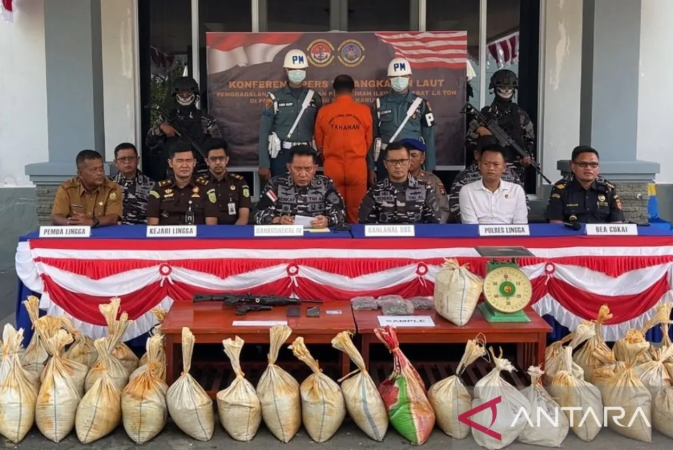
Indonesia's naval forces have successfully disrupted what authorities believe was a coordinated attempt to export roughly 75.7 tonnes of illegally extracted tin sand into Malaysia, with the confiscated material valued at approximately Rp76.04 billion or around US$79,300. The operation, which unfolded across multiple locations in the Bangka Belitung Islands archipelago situated off Sumatra's eastern coast, demonstrates the persistent challenge Southeast Asian nations face in controlling the extraction and movement of valuable mineral resources across maritime borders.
The enforcement action began on August 2 when Indonesian Navy personnel discovered a truck laden with approximately eight tonnes of tin sand at a jetty facility in East Belitung. What initially appeared to be an isolated incident quickly escalated into a broader investigation as authorities recognised the potential for a larger-scale smuggling operation. The successful interception of this initial shipment provided crucial intelligence that prompted a systematic expansion of surveillance and interdiction efforts throughout the region.
Subsequent raids conducted by naval teams uncovered additional caches of the illicit material at strategic locations throughout the islands. On August 3, authorities discovered around 50 tonnes in Lenggang village, marking a significant increase in the estimated scope of the operation. The following day brought the discovery of another 10 tonnes carefully packaged in 200 sacks, suggesting a degree of sophistication in how the contraband was being prepared for transit. A final seizure of approximately five tonnes on August 8 brought the total cumulative haul to the figure cited by enforcement officials.
Vice Admiral Denih Hendrata, who heads Indonesia's Fleet Command, revealed during a televised press conference in Tanjungpandan, Belitung, that the investigation has adopted an expansive approach designed to dismantle the entire smuggling infrastructure rather than simply confiscating isolated shipments. His statement that "we did not stop there" and that "the operation was expanded to uncover the network and other parties involved" underscores a commitment to identifying the individuals and organisations orchestrating what appears to be a sophisticated trafficking scheme. This methodology reflects international best practices in combating organised resource smuggling, where understanding supply chains and distribution networks proves essential for preventing recurrence.
The investigation has already expanded across five distinct geographical locations, indicating the geographically dispersed nature of the operation. However, authorities have not yet made any arrests or publicly identified specific suspects, suggesting the investigation remains in its early stages despite the substantial quantities already recovered. The deliberate withholding of names likely reflects standard investigative protocols designed to prevent suspects from fleeing or destroying evidence as authorities work to map the full extent of the smuggling network.
Laboratory analysis of the seized material is currently underway to establish the precise mineral content and determine the quality and market value of the tin sand. These technical assessments are crucial not only for establishing the exact scope of economic loss resulting from the illegal extraction but also for understanding whether multiple sources supplied different batches. Such analysis can reveal patterns that may help authorities identify the specific mining operations from which the material originated, ultimately leading back to the illegal extraction sites themselves.
The geographic context of this smuggling attempt is particularly significant for Malaysia, as the Bangka Belitung Islands have long been plagued by unregulated tin mining operations that contribute to both environmental degradation and cross-border resource theft. The tin trade in this region has historically attracted criminal networks due to the high value of the mineral and the relative ease with which it can be processed and exported. Malaysia's proximity makes it a natural destination market for such contraband, both for direct consumption by Malaysian industrial users and as a transit point for further distribution throughout Asia.
Vice Admiral Hendrata acknowledged that meaningful progress in disrupting this smuggling network will require international cooperation, particularly with Malaysian authorities who would oversee operations at the destination. He indicated that investigators would need to work through formal bilateral channels to trace the smuggling network's reach into Malaysia and identify the ultimate recipients and beneficiaries of the illicit tin sand. This commitment to transnational investigation reflects growing recognition among Southeast Asian maritime enforcement agencies that resource smuggling cannot be effectively countered through national efforts alone.
The incident underscores the broader challenge facing Indonesia as it attempts to regulate its vast maritime domain and control the extraction of valuable natural resources. Despite considerable investment in naval capabilities and enforcement infrastructure, the sheer expanse of waters within Indonesia's jurisdiction and the financial incentives driving smuggling operations continue to create vulnerabilities. The Bangka Belitung Islands remain particularly problematic given their position along established maritime routes and the historical concentration of mining activity in the region.
For Malaysian policymakers and industry stakeholders, this seizure serves as a reminder of the ongoing threat posed by smuggled minerals entering the supply chain. Ensuring the legitimacy of tin sand and other mineral sources has become increasingly important as global buyers and manufacturers face pressure to demonstrate compliance with responsible sourcing standards. The involvement of Malaysian port facilities or distributors in receiving smuggled materials could expose legitimate businesses to reputational damage and potential legal consequences under international trade regulations.
The success of this particular operation, whilst significant in scale, likely represents only a fraction of the total smuggling activity occurring in the region. Industry observers and law enforcement officials acknowledge that many shipments successfully transit maritime borders undetected, particularly those utilising smaller vessels and isolated landing points. The interception of 75.7 tonnes thus reflects both the effectiveness of heightened vigilance and the underlying scale of the problem facing authorities across the region.
As investigations continue and the network's structure becomes clearer, the results will likely inform future enforcement strategies for both Indonesian and Malaysian authorities. The precedent established through this operation, including the commitment to pursue international cooperation, may encourage similar joint efforts to address resource smuggling and other transnational crimes that affect both nations' economic and environmental interests.

