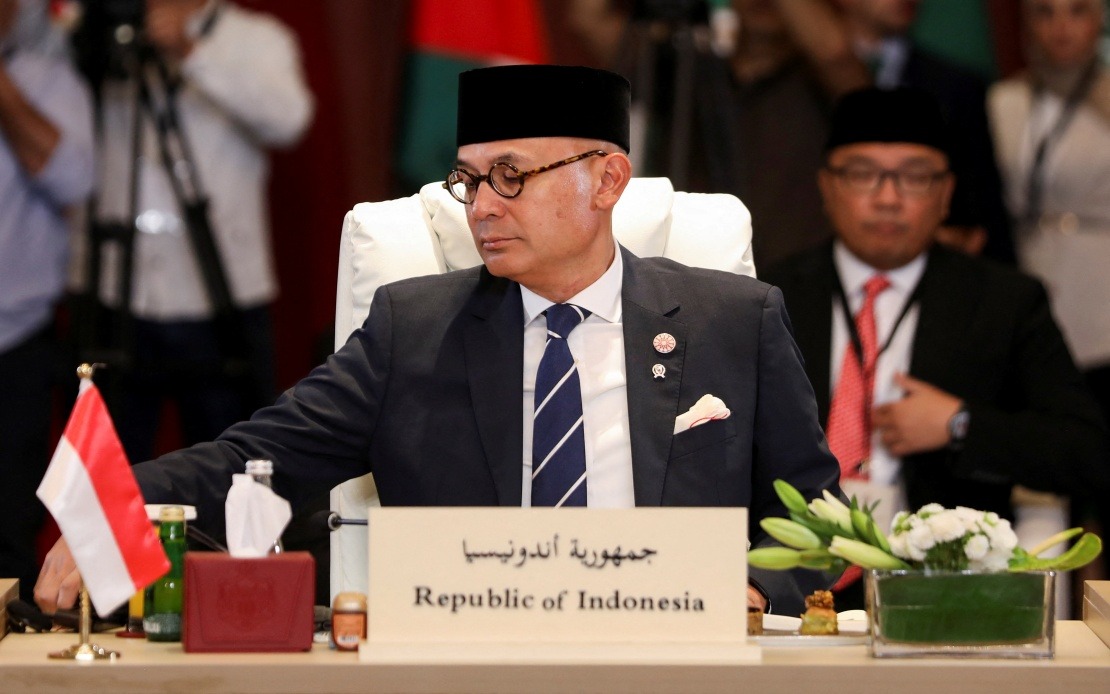
Indonesia is pressing the international community to move beyond isolated diplomatic efforts and construct a comprehensive coalition backing the Palestinian cause, signalling that support for this issue transcends religious boundaries and represents a universal commitment to international law and human rights. Speaking at the Ministerial Meeting on Jerusalem in Amman, Jordan, Deputy Foreign Minister Arrmanatha Nasir—representing Foreign Minister Sugiono—emphasised that the current piecemeal approach to addressing Israeli actions has proven ineffective, allowing Tel Aviv to continue policies that violate international norms without meaningful coordinated consequences.
Arrmanatha's central thesis challenged the international community to recognise that disunity among nations opposing Israeli violations has historically been exploited by Israel as a strategic advantage. By fragmenting responses across multiple bilateral channels and uncoordinated statements, the global response has lacked the collective force necessary to compel policy changes or enforce accountability. Indonesia's intervention signals Jakarta's concern that the Palestinian issue demands the same diplomatic rigour and unified approach typically reserved for other major geopolitical crises, rather than remaining compartmentalised as primarily a regional or religious matter.
To operationalise this vision, Indonesia advanced a detailed five-point framework addressing both immediate humanitarian concerns and longer-term political solutions. The first measure centres on establishing a shared strategic approach anchored in solidarity, moving away from ad hoc statements toward institutionalised coordination. The second pillar emphasises strict adherence to international legal mechanisms, particularly compliance with International Court of Justice rulings that have addressed Palestinian rights and Israeli obligations. This reflects Indonesia's investment in multilateral legal frameworks as tools for enforcing accountability in asymmetric conflicts.
The remaining three components focus on tangible outcomes: expanding the number of nations officially recognising Palestinian statehood, thereby increasing diplomatic pressure on Israel and strengthening Palestine's international standing; intensifying protection of the Al Aqsa Mosque compound, which remains a flashpoint for both religious significance and political dispute; and mobilising resources and international commitment toward reconstructing Gaza's devastated infrastructure. Indonesia also advocated for reinforcing Palestinian internal unity mechanisms, recognising that divisions within Palestinian governance have undermined negotiating positions, and defending the mandate of UNRWA, which provides essential services to Palestinian refugees across the region.
Arrmanatha contextualised Indonesia's appeal within a dramatically shifting regional security landscape. The expansion of Israeli settlements in the West Bank, military operations extending into Gaza, Syria, and Lebanon, combined with escalating US-Iran tensions, has created what Jakarta perceives as an increasingly destabilised West Asia. These developments have collapsed distinctions between isolated conflicts into an interconnected security crisis where Palestinian issues intersect with broader regional competition and strategic interests. Indonesia's framing suggests that ignoring Palestinian grievances risks compounding regional instability and creating environments where extremist narratives gain traction.
Indonesia reaffirmed its principled positions on two key issues: support for Jordan's Hashemite Custodianship over Jerusalem's holy sites, including Al Haram Al Sharif, and backing for Palestinian statehood consistent with international law and UN resolutions. These positions reflect Indonesia's commitment to existing international agreements and respect for religious authority over sacred spaces, positioning Jakarta as a defender of established legal frameworks rather than as a revisionist power. By linking Palestinian independence to international law rather than religious nationalism, Indonesia attempts to broaden the coalition's appeal to secular and Western nations that might otherwise view this as primarily an Islamic concern.
The ministerial gathering itself represented significant diplomatic representation, attracting senior officials from Malaysia, Algeria, Saudi Arabia, Iraq, Egypt, Türkiye, Tunisia, Somalia, Pakistan, Morocco, Palestine, and Qatar, alongside the Arab League Secretary-General. This roster underscores the Palestinian cause's centrality to Arab and Muslim-majority nations' foreign policy agendas, yet also reveals the structural challenge Indonesia seeks to address: these nations, despite shared interests, have historically struggled to maintain unified diplomatic and economic pressure on Israel. The diversity of attendees—spanning North Africa, the Levant, the Arabian Peninsula, and South Asia—suggests potential for broader coalitions extending beyond traditional Middle Eastern actors.
The meeting's joint statement reflected consensus on three strategic interventions: strengthening Palestinian institutional capacity specifically in Jerusalem, thereby attempting to entrench Palestinian presence in the disputed capital; categorically rejecting unilateral relocation of embassies to Jerusalem as violations of international law, a rebuke to the United States and other nations that have recognised Jerusalem as Israel's capital; and launching coordinated media campaigns to raise global awareness of Israeli actions and their consequences for regional stability. This emphasis on institutional building and strategic communications indicates a shift toward longer-term engagement rather than crisis-management, acknowledging that diplomatic breakthroughs remain distant and that maintaining international focus requires sustained narrative strategies.
For Malaysia and Southeast Asian nations, Indonesia's leadership on this issue carries particular significance. As ASEAN's largest Muslim-majority nation and a influential voice in regional diplomacy, Indonesia's coalition-building efforts create space for other Southeast Asian democracies to engage substantively with Palestinian questions without appearing to prioritise religious affiliation over universal principles. The emphasis on international law, ICJ rulings, and UN mechanisms provides secular frameworks through which nations of diverse religious compositions can participate in addressing Palestinian rights. This approach potentially broadens support beyond traditional Arab and Muslim blocs toward progressive nations concerned with international law's credibility and great-power restraint in regional conflicts.
The practical challenge facing Indonesia's proposed coalition lies in enforcement mechanisms and economic leverage. International law means little without consequences, and coordinated statements lack impact without coordinated sanctions, trade restrictions, or security measures. Indonesia has not detailed how its coalition would overcome the structural advantages Israel enjoys through Western military and economic support, nor how nations with competing interests in West Asian security architecture would subordinate those interests to Palestinian solidarity. The success of Indonesia's initiative ultimately depends on whether member states can translate rhetorical commitment into sustained diplomatic, economic, and political pressure capable of altering calculations in Jerusalem and among Israel's strategic partners.

