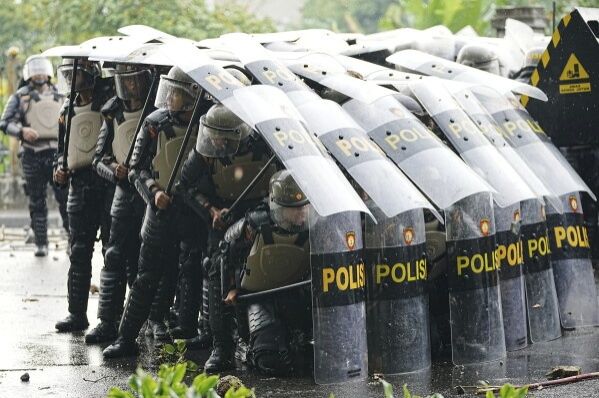
Indonesia's security establishment is struggling to contain escalating tensions between its police and military forces, triggered by a series of high-profile anti-corruption raids across Jakarta that have exposed deep institutional rifts at a sensitive moment for the country's law enforcement credibility. The dramatic operations, conducted throughout the week, resulted in the seizure of tens of millions of dollars in gold, cash, and foreign currencies linked to at least three separate graft and money-laundering investigations, yet the subsequent military deployment to protect a senior prosecutor has sparked warnings from rights groups and analysts about the corrosion of civilian authority in Southeast Asia's largest economy.
Police operations yielded substantial recoveries that underscore the scale of alleged financial misconduct within government circles. In South Jakarta, investigators found more than $3 million in rupiah and foreign currency hidden within an elaborate two-meter-tall vault concealed at a restaurant and an adjacent money changer, according to state news agency Antara. The seizures extended beyond the capital region, with the most contentious discovery occurring at a residential property owned by Deputy Attorney General for Special Crimes Febrie Adriansyah, where officers reported finding 74 kilograms of gold bars alongside substantial quantities of cash and foreign currency distributed across seven locked suitcases within a secure safe. Authorities valued the combined haul from Febrie's residence at approximately $26.3 million, a figure that immediately thrust the prosecutor into an unprecedented public controversy.
Febrie occupies one of Indonesia's most strategically important positions within the law enforcement hierarchy, overseeing the Attorney General's Office division responsible for investigating major corruption cases. His portfolio encompasses complex probes involving prominent state enterprises including coal-dependent power supplier Pertamina, aviation company Garuda Indonesia, and state-owned miner Timah. The prosecutor has also supervised investigations touching directly on high-level political figures, managing inquiries into former education minister Nadiem Makarim's tenure and extending to the anti-graft dimensions of President Prabowo Subianto's ambitious free-meals initiative. This concentration of authority over sensitive cases means that any institutional weakness or compromise in Febrie's office carries implications far beyond individual prosecutions.
The police have categorized their enforcement actions within three distinct investigative streams, each addressing serious institutional vulnerabilities within Indonesia's economic management apparatus. The first investigation concerns alleged irregularities in coal procurement and distribution arrangements to electricity-generating plants, a connection that takes on particular urgency given recent rolling blackouts that disrupted economic activity and residential services across major population centers. The second line of inquiry focuses on potential misconduct in the administration of legal matters involving state-owned insurance providers Asabri and Jiwasraya, both of which have faced previous scandals related to misappropriation. The third stream addresses the financial restructuring of obligations involving enterprises with connections to Krakatau Steel, demonstrating that the raids touched upon multiple sectors where state assets faced potential diversion or mismanagement.
The deployment of armed military personnel to Febrie's Jakarta residence marked a critical inflection point, transforming what might have remained a contained police investigation into a visible institutional confrontation that has alarmed governance observers across the region. The Attorney General's Office justified the military presence by citing protective protocols applicable to prosecutors, framing the deployment as a standard security measure rather than an institutional intervention. Yet the timing and optics of armed forces surrounding a senior judicial official whose residence had just been searched by police inevitably suggested to observers and analysts that institutional boundaries were blurring in concerning ways.
Military officials moved quickly to contain the narrative damage, issuing statements emphasizing harmony between security branches rather than acknowledging underlying friction. A military spokesman asserted that the security arrangements had no bearing on ongoing law enforcement processes and explicitly denied any institutional conflict, while reaffirming the armed forces' commitment to supporting all legal investigations without interference. These carefully calibrated denials, however, require context: such emphatic reassurances typically emerge only when underlying tensions have become sufficiently visible to warrant preemptive damage control. President Prabowo himself appeared to weigh in on Friday through indirect language delivered during a dam inauguration ceremony on Lombok island, calling upon officials, military personnel, police officers, and prosecutors to engage in collective self-reflection about their obligations to the public, framing authority as a delegation of responsibility rather than personal entitlement.
Febrie responded to the raids by acknowledging his ownership of the residence but categorically denying any connection to the seized valuables, a distinction that may carry limited persuasive weight given the physical proximity of assets found within his property. He emphasized that the Attorney General's Office respects investigative processes and awaits police findings, while urging caution against premature public judgments based on incomplete information circulating through social media and conventional news outlets. His invocation of the presumption of innocence, while legally sound, occurred within a context where his institutional authority over other corruption cases now faces potential delegitimation should the investigation determine that assets within his residence were acquired or concealed through improper channels.
The unfolding situation has triggered warnings from international human rights monitors and domestic governance specialists who perceive in these events harbingers of broader institutional deterioration. Amnesty International Indonesia cautioned that the military deployment threatens the principle of civilian supremacy and could undermine confidence in law enforcement institutions themselves, while calling for guarantees that the investigation will proceed free from obstruction or intimidation. Nicky Fahrizal, a researcher at Jakarta's Center for Strategic and International Studies, has articulated a more systemic concern, arguing that the apparent standoff between security agencies reflects profound institutional dysfunction and risks accelerating what he characterizes as a creeping militarization of civilian law enforcement functions.
Fahrizal's analytical framework suggests that permitting this escalatory trajectory to continue unchecked carries consequences extending far beyond immediate institutional relationships. He contends that sustained erosion of Indonesia's rule-of-law foundations would trigger cascading loss of confidence among both the public and international investor communities, undermining economic stability and governance legitimacy simultaneously. This assessment carries particular weight given Indonesia's role as a major emerging market within Southeast Asia, where institutional reliability directly influences capital flows, foreign direct investment decisions, and the regional confidence in Indonesia's capacity to manage complex economic challenges.
The coordination between police and military operations remains officially characterized as unproblematic, yet the defensive tenor of official statements and the visible positioning of armed forces suggest that underlying tensions run deeper than public acknowledgments indicate. The sequence of events—the raids, the seizures, the military deployment, the rapid denials of institutional conflict—follows a pattern familiar to observers of institutional crises in which public reassurances mask substantive disagreements about authority, jurisdiction, and the proper distribution of investigative and protective powers among competing agencies.
For Malaysian observers and policymakers, these developments in Indonesia carry instructive dimensions regarding the fragility of institutional equilibrium when corruption investigations touch upon senior officials and when security agencies operate without clearly established protocols governing their respective domains. The case demonstrates how high-profile enforcement actions, while necessary for addressing systemic graft, can inadvertently destabilize the very institutions tasked with maintaining public trust in government. The coming weeks will reveal whether Indonesia's leadership can establish clear procedural frameworks limiting military involvement in civilian law enforcement and whether the investigation into Febrie's assets will maintain sufficient independence and transparency to preserve institutional credibility across the region's largest economy.

