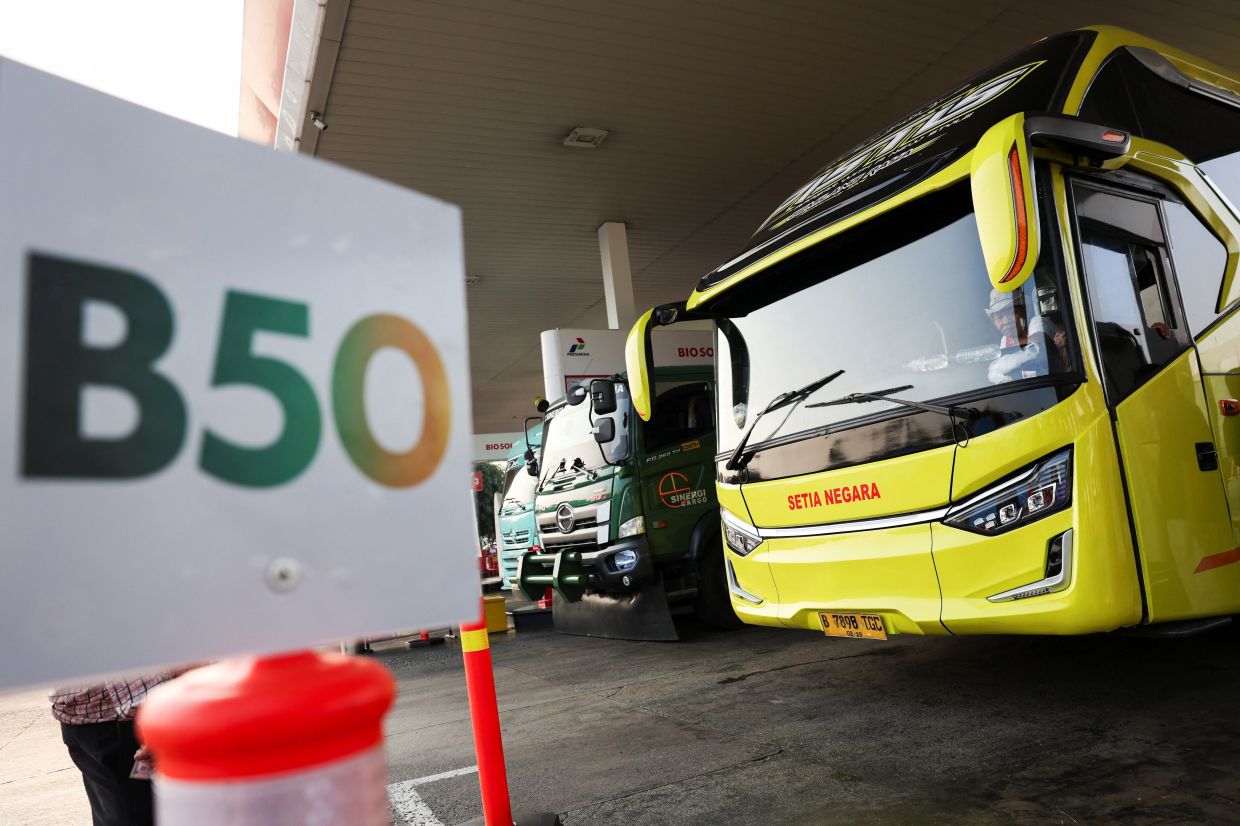
Indonesia has formally activated its B50 biodiesel programme, a landmark policy shift that will substantially deepen the country's reliance on domestically produced palm oil to meet transportation fuel demand. The new mandatory blending requirement, which raises the proportion of palm oil-based fuel from the existing 40% threshold to 50%, was unveiled at a ceremony in Karawang, West Java, with President Prabowo Subianto in attendance. Energy Minister Bahlil Lahadalia revealed that implementing this higher blend will drive crude palm oil consumption upward to between 16.3 million and 17 million metric tons annually, compared with the current 15.2 million tons—a significant expansion for a commodity sector that already dominates Indonesia's agricultural economy.
The B50 initiative represents one of the world's most aggressive mandatory biodiesel blending programmes and sits at the centre of Jakarta's broader strategy to insulate itself from volatile global diesel markets. By channelling more domestically produced palm oil into fuel production, policymakers intend to trim the nation's reliance on imported petroleum products, a persistent drag on the balance of payments. The anticipated fiscal relief is substantial: the energy ministry projects that elevating the blend this year alone will save approximately 170 trillion rupiah (US$9.41 billion) in import expenditure, a reduction that underscores the government's commitment to this approach, though this figure must be weighed against previous savings of roughly 133 trillion rupiah achieved under the existing B40 framework.
President Prabowo seized on the Karawang event to position Indonesia as a champion in global carbon emissions reduction, a narrative that frames the biodiesel expansion as an environmental initiative rather than purely a protectionist trade measure. However, his remarks also disclosed internal deliberation within the cabinet: Prabowo disclosed that he had advocated internally for an even more ambitious B100 mandate—requiring pure palm oil fuel—but ministerial advisers counselled restraint, suggesting that a 50% blend would suffice to eliminate diesel imports entirely. The president indicated that the government should continue exploring a 60% blend as a medium-term target, signalling that the policy pathway remains unsettled and subject to further adjustment.
The logistics of the transition remain partially unresolved. The energy ministry has not yet issued final allocation quotas for producers operating under the new B50 framework, leaving industry participants in a state of uncertainty as they plan production schedules and investment decisions. Energy Ministry officials indicated that Indonesia will require between 16.7 million and 18 million kilolitres of fatty acid methyl ester (FAME)—the technical term for biodiesel—to service the new mandate, a consumption band that reflects the inherent variability in national fuel demand forecasting. Businesses have been granted a transition period extending to the end of September to deplete remaining stockpiles accumulated under the previous B40 regime, a grace period designed to prevent costly inventory write-downs.
The policy reflects Indonesia's strategic calculation that its vast palm oil sector—the country produces roughly 60% of global supply—constitutes a comparative advantage that should be exploited to strengthen energy independence. Under the B40 programme currently in effect, the government allocated 15.64 million kilolitres of biodiesel this year, a figure representing a 4.68% increase over last year's actual consumption of 14.94 million kilolitres. This baseline consumption pattern provides the foundation for estimating future demand under the higher blend requirement, though actual uptake will hinge on diesel price movements, economic growth rates, and the energy intensity of industrial activity.
For Malaysian observers, the Indonesian biodiesel expansion carries several implications. First, it demonstrates how a major regional producer is leveraging commodity advantages to reshape energy policy in ways that protect domestic interests—a strategy that may inspire comparable thinking among policymakers in Kuala Lumpur as they contemplate Malaysia's own biofuel frameworks and palm oil utilisation strategies. Second, the scale of Indonesia's palm oil consumption increase could exert downward pressure on global palm oil prices, benefiting importing nations and consumers but potentially squeezing profit margins for producers across the region. Third, Indonesia's environmental framing of the biodiesel initiative—despite scepticism from some climate experts about the true carbon footprint of palm-based biofuels—illustrates how governments strategically deploy sustainability narratives to justify commodity-driven policies.
The broader geopolitical context matters as well. Indonesia's determination to reduce fuel imports aligns with wider Southeast Asian efforts to enhance energy sovereignty in an era of supply chain fragility and energy price volatility. The policy also reflects Jakarta's confidence in its institutional capacity to manage a large-scale industrial transition, even as it confronts the reality that achieving full import elimination through biofuels alone may prove technically or economically infeasible at certain price thresholds.
Minister Bahlil's announcement that the government intends to commission research into a 60% blend suggests that the B50 programme is itself positioned as an intermediate step rather than an endpoint. This phased approach may reflect a pragmatic acknowledgment that extremely high biodiesel blends pose technical challenges for engine performance and fuel distribution infrastructure, necessitating gradual implementation. The ministry's hesitation in releasing final quotas for the B50 system also hints at underlying tensions between government targets and the operational constraints facing refineries and biodiesel producers.
For the palm oil industry, the B50 mandate represents a substantial demand stimulus. Producers can expect sustained, government-guaranteed offtake of increasing volumes, providing revenue visibility and justifying capital expenditure on processing capacity. However, this guaranteed demand also locks producers into a commodity supply relationship where pricing may be influenced by government cost-benefit calculations rather than market dynamics, potentially limiting upside potential during periods of strong global demand.
The timing of the B50 launch, occurring under the Prabowo administration, reflects a policy continuity with his predecessors while also signalling his administration's commitment to channelling resource wealth toward industrial and energy self-sufficiency objectives. Whether this biodiesel strategy ultimately succeeds in substantially reducing import bills—or merely redistributes the fiscal burden toward higher domestic production costs—will become evident as the programme matures and market dynamics interact with government targets. The willingness of Prabowo to publicly advocate for even more aggressive targets suggests that biodiesel policy may continue to evolve, potentially creating additional opportunities and uncertainties for industry stakeholders and trading partners throughout Southeast Asia.

