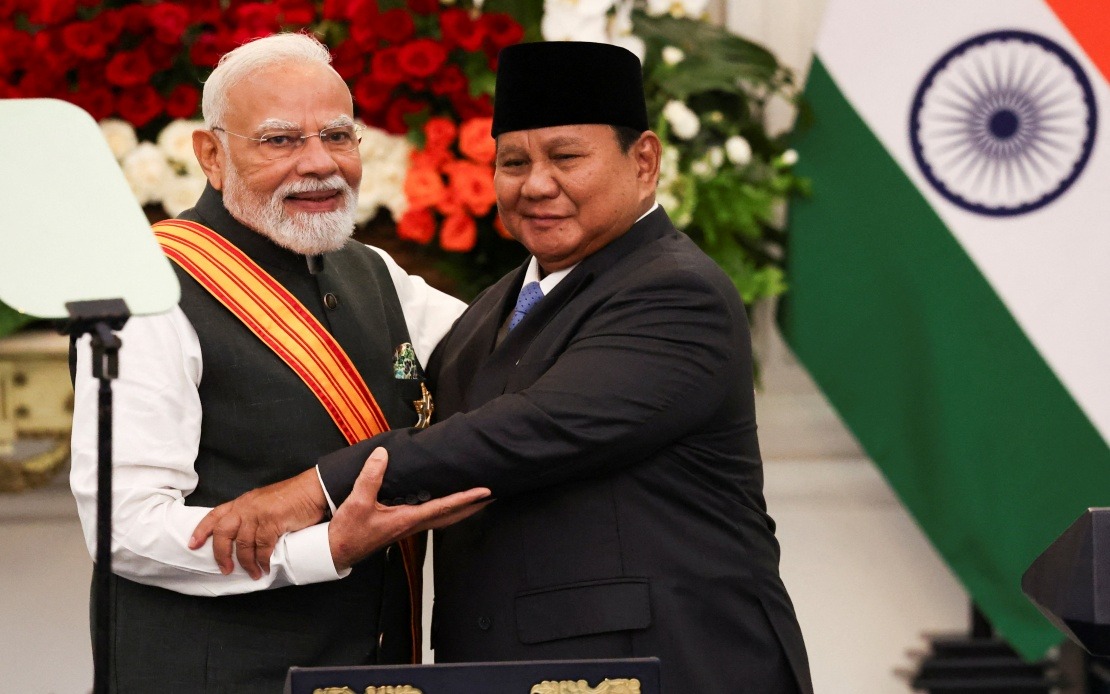
Indonesia has presented its highest state honour to Indian Prime Minister Narendra Modi, marking a significant moment in the deepening relationship between the two regional powers. The award, presented by President Prabowo Subianto on July 7 at the Merdeka Palace in Jakarta, underscores the two nations' commitment to advancing strategic cooperation and represents a rare diplomatic recognition reserved for leaders who have substantially influenced bilateral and regional affairs.
President Prabowo explained that the honour reflects Modi's leadership and tangible contributions toward strengthening the Indonesia-India partnership, which has evolved into a Comprehensive Strategic Partnership. The decoration also acknowledges Modi's consistent efforts to foster greater collaboration across multiple sectors and his backing of various development initiatives that have benefited Indonesia's economy and infrastructure. Prabowo emphasised during the joint press statement that the award recognises both Modi's vision for regional connectivity and his role in supporting programmes that align with Indonesia's development priorities.
The historical significance of this gesture cannot be overstated for Southeast Asian observers. Prabowo noted that only one other Indian leader has previously received this distinction—Jawaharlal Nehru, India's first prime minister, who was similarly honoured for his pivotal role in strengthening bilateral relations and his foundational contributions to the Non-Aligned Movement. This parallel underscores how both Modi and Nehru have been viewed as transformative figures in shaping the trajectory of Indonesia-India ties across vastly different historical periods.
Modi's visit to Jakarta constitutes a reciprocal diplomatic gesture, following Prabowo's state visit to India earlier in the year. The sequencing of these high-level meetings demonstrates the two countries' intention to sustain momentum in their strategic engagement and move beyond ceremonial exchanges toward substantive cooperation. By hosting Modi at such a prominent state occasion, Indonesia is signalling that India remains a cornerstone partner for its regional and economic ambitions, particularly as Jakarta navigates an increasingly multipolar Asian landscape.
The award ceremony also reflects Indonesia's broader strategic calculations regarding its major partnerships. Prabowo used the occasion to emphasise Indonesia's deep historical and cultural connections with India, highlighting civilisational ties that predate modern statehood. These historical bonds have provided a foundation for contemporary relations, though the modern partnership has been carefully cultivated through diplomatic engagement, economic investment, and security cooperation. For Malaysian and other Southeast Asian audiences, the strengthening of Indonesia-India ties carries implications for regional balance and the shape of emerging Asian geopolitical alignments.
A notable dimension of the visit involves India's support for Indonesia's aspirations within the BRICS framework. Prabowo expressed appreciation for New Delhi's backing of Jakarta's bid for permanent membership in the influential multilateral bloc comprising Brazil, Russia, India, China, and South Africa. Indonesia's inclusion in BRICS would represent a significant expansion of the organisation's footprint into Southeast Asia and would grant Jakarta greater influence in shaping global governance discussions on development, finance, and security. India's active support for this objective demonstrates how bilateral partnerships between major regional powers are increasingly interconnected with multilateral positioning.
The Comprehensive Strategic Partnership framework that both countries have embraced provides a structured approach to managing cooperation across defence, economic, cultural, and diplomatic domains. This elevation beyond traditional bilateral frameworks suggests that Modi and Prabowo envision their countries as essential partners in addressing regional challenges ranging from maritime security to economic development. For other Southeast Asian nations, including Malaysia, this deepening Indonesia-India nexus represents both an opportunity for trilateral or multilateral initiatives and a dynamic to monitor as regional power distributions continue to evolve.
The diplomatic language employed during the press statement—emphasising mutual benefit, historical friendship, and commitment to preserving cooperation—reflects a carefully calibrated approach that avoids antagonising other regional powers whilst clearly articulating the importance of the bilateral relationship. Both leaders seem intent on demonstrating that strengthened Indonesia-India ties are complementary to rather than competitive with other partnerships in the region, including those with China and ASEAN partners.
For Malaysian observers particularly, the consolidation of Indonesia-India relations warrants attention as it affects the broader ASEAN environment. Indonesia's positioning as a bridge between South Asia and Southeast Asia, coupled with India's increasing engagement with the region through mechanisms like the Indo-Pacific framework, creates new opportunities for regional cooperation but also complexities in managing great power competition. The recognition accorded to Modi through the highest state honour signals Jakarta's confidence in anchoring India more deeply within its strategic architecture, a choice that will likely influence how ASEAN collectively approaches engagement with New Delhi in coming years.

