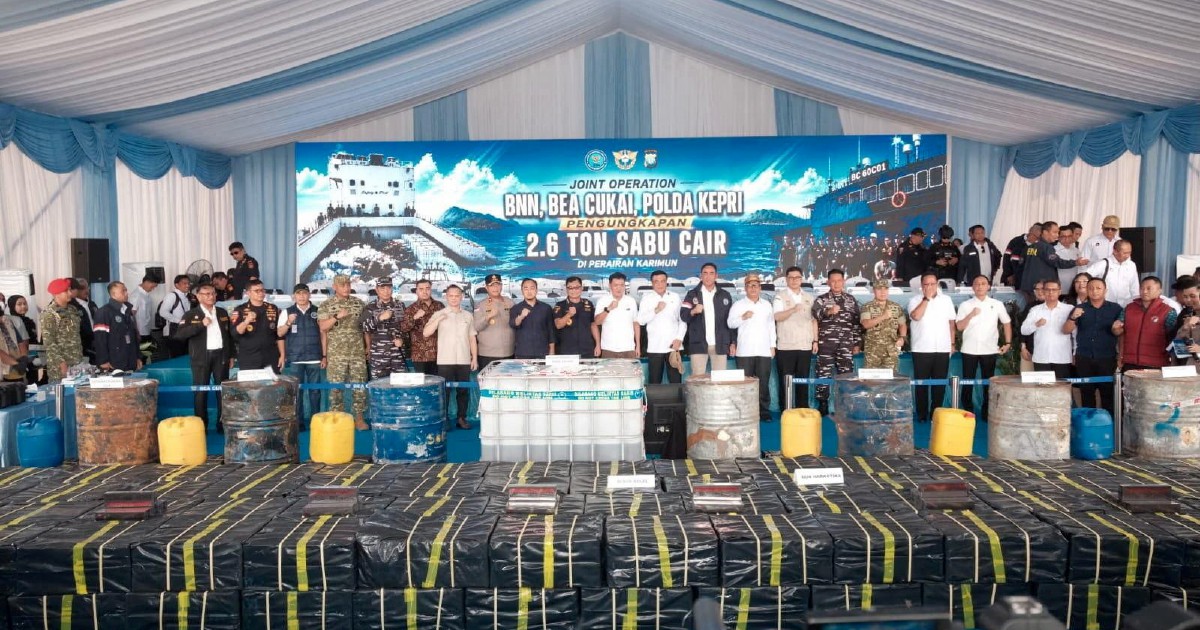
Indonesian law enforcement announced the arrest of 10 Myanmar nationals on Friday after intercepting a vessel carrying an exceptionally large cache of liquid methamphetamine. The contraband, totalling 2.6 metric tonnes, was discovered aboard a commercial ship registered under the Tanzanian flag, marking one of the region's most significant narcotics seizures in recent operations.
The interception and subsequent arrests represent a major enforcement action against the sophisticated drug smuggling networks that continue to exploit Southeast Asia's maritime trade routes. Officials disclosed details of the operation during a formal press conference, highlighting the scale of criminal activity targeting the archipelago as a transshipment point for illicit drugs destined for markets across Asia and beyond.
Liquid methamphetamine presents particular challenges for law enforcement agencies throughout the region. Its concentrated form allows traffickers to move substantially larger quantities within confined spaces compared to traditional crystalline variants, making detection significantly more difficult despite enhanced screening protocols at ports and coastal checkpoints. The liquid format also increases the difficulty of forensic analysis and verification procedures, requiring specialized testing facilities that remain limited in many Southeast Asian jurisdictions.
Myanmar's geographical positioning and internal instability have long made it a primary source region for methamphetamine production. Clandestine laboratories operate throughout border areas and conflict zones where state authority remains limited, with local armed groups frequently profiting from drug manufacturing operations. The country's porous boundaries facilitate the movement of precursor chemicals and finished products across international lines with relative ease.
Indonesia's role as a critical maritime hub makes it an inevitable waypoint for transnational drug trafficking. The archipelago's thousands of islands and extensive coastline present enormous surveillance challenges, while major ports and strategic chokepoints like the Malacca Strait concentrate shipping traffic that becomes impossible to monitor comprehensively. Smuggling organizations exploit this geography systematically, utilizing both established commercial shipping channels and clandestine maritime routes to move narcotics through the region.
The use of Tanzanian-flagged vessels illustrates how trafficking networks deliberately employ vessels registered under flags of convenience to obscure ownership and complicate enforcement efforts. This practice remains endemic within the global drug trade, with criminal organizations carefully selecting registry jurisdictions that offer minimal cooperation with regional law enforcement agencies or possess inadequate documentation systems. Such tactics force authorities to undertake time-consuming investigations to establish vessel ownership and operator responsibility.
Indonesian authorities have intensified maritime interdiction operations in recent years, recognizing that seaborne smuggling represents the dominant trafficking method for large-scale drug movements. Enhanced cooperation agreements with neighboring states, improved vessel tracking technologies, and specialized narcotics interdiction units have yielded increasing seizure quantities. However, the sheer volume of maritime traffic and the persistent sophistication of smuggling methodologies mean that many shipments successfully traverse regional waters undetected.
The arrest of the 10 Myanmar nationals will likely trigger extended investigation procedures to establish their individual roles within the trafficking organization and identify upstream suppliers and downstream distribution networks. Prosecutors will pursue charges under Indonesia's stringent narcotics legislation, which carries severe penalties including lengthy prison sentences and capital punishment for major traffickers. These legal consequences reflect official commitment to disrupting drug supply chains, though critics argue that such penalties primarily affect operatives rather than high-level organizers.
This seizure arrives amid broader regional concerns regarding methamphetamine proliferation throughout Southeast Asia and beyond. Laboratory production capabilities within the Golden Triangle region have expanded dramatically over the past decade, with production output increasing substantially despite periodic enforcement operations against known manufacturing sites. The drug's addiction potential and relatively affordable street pricing have driven surging demand across urban and rural populations throughout the region, creating sustained market incentives for smugglers.
The interception also underscores the interconnected nature of Southeast Asian security challenges, where transnational drug trafficking intersects with maritime piracy, migrant smuggling, and arms trafficking. These criminal networks frequently overlap or coordinate operations, sharing routes, vessels, and corruption networks that facilitate multiple forms of illicit commerce simultaneously. Addressing methamphetamine trafficking consequently requires comprehensive strategies addressing broader maritime security governance and regional cooperation frameworks.
For Malaysia specifically, this bust carries implications for national security and public health. Malaysian ports and territorial waters remain attractive transit routes for smugglers moving product northward toward China and other wealthy markets. Enhanced vigilance within Malaysian maritime enforcement agencies, coupled with intelligence-sharing arrangements with regional counterparts including Indonesian authorities, remains essential for disrupting trafficking flows before they reach domestic distribution networks that supply growing user populations across the peninsula and East Malaysia.
The operation demonstrates that significant interdiction victories remain achievable through sustained enforcement commitment. However, the persistence of massive shipments attempting transit through regional waters suggests that drug trafficking organizations maintain confidence in their operational security despite law enforcement successes. Breaking this cycle ultimately requires addressing the underlying economic incentives driving production in source countries, addressing demand reduction strategies in consuming markets, and building enforcement capacity within vulnerable transit jurisdictions throughout Southeast Asia.

