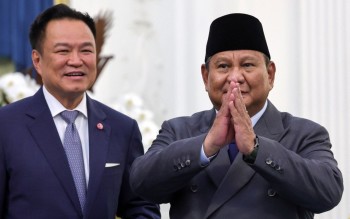
Indonesia and Thailand have laid ambitious groundwork for deeper economic integration, with both nations committing to achieve US$20 billion in annual bilateral trade by 2030 following the formal adoption of their Strategic Partnership Roadmap 2026-2030. The framework, endorsed during high-level talks at Jakarta's Merdeka Palace on Monday, represents a significant escalation in economic cooperation between Southeast Asia's two largest economies by GDP and signals the region's determination to build resilient cross-border commercial ties amid shifting global trade patterns.
President Prabowo Subianto framed the roadmap as more than symbolic agreement, positioning it as a concrete operational mechanism designed to eliminate structural barriers that have historically constrained trade flows between the neighbours. The framework will guide coordinated efforts across multiple sectors, addressing long-standing challenges around market access and investment facilitation. Notably, the two nations resolved to establish their inaugural Joint Trade Commission, an institutional innovation that reflects recognition that bilateral trade relationships require dedicated governance structures to function effectively at scale.
Thai Prime Minister Anutin Charnvirakul's visit marked the first official trip to Indonesia by a Thai premier in 15 years—a striking gap that underscores how institutional momentum can erode when high-level political engagement lapses. Anutin's visit itself constitutes only his first journey to Indonesia since assuming Thailand's premiership in September 2025, suggesting bilateral relations were somewhat underdeveloped relative to the economic potential. The second Leaders' Consultation in quick succession indicates both governments now view strengthening ties as an immediate priority, reversing a period of relative inattention.
Indonesia's vast agricultural capacity and Thailand's established regional role as a food exporter create natural complementarities that the roadmap explicitly targets. Both leaders emphasised food security cooperation spanning agricultural technology transfer, logistics infrastructure, food processing innovation, and supply chain fortification—areas where strategic cooperation could benefit the entire Southeast Asian region. Thailand specifically committed to remaining a dependable rice supplier to Indonesia while simultaneously seeking expanded market access for its dairy, meat, and agricultural machinery exports. The quid pro quo extends to fertiliser: Thailand aims to multiply its annual imports of Indonesian urea from the current modest baseline of approximately 60,000 tonnes to several hundred thousand tonnes, suggesting significant room for scaling existing trade patterns.
Energy security emerged as another critical pillar, with both countries agreeing to establish an Indonesia-Thailand Energy Forum designed to harmonise approaches to the renewable energy transition whilst meeting growing domestic power demand. This cooperation gains urgency given Southeast Asia's exposure to climate volatility and global fossil fuel price fluctuations. Strengthening bilateral energy collaboration creates buffers against market shocks whilst accelerating decarbonisation goals that both nations have internationally committed to pursuing.
The digital economy component of the roadmap addresses a rapidly expanding frontier for bilateral commerce. Specifically, Indonesia and Thailand agreed to promote transactions using local currencies—the Indonesian rupiah and Thai baht—rather than relying exclusively on US dollar settlements. This shift has profound implications beyond mere convenience. Local currency trading reduces exposure to exchange rate volatility, lowers transaction costs for smaller enterprises, and represents a subtle but meaningful step toward regional financial integration independent of Western financial infrastructure. For Malaysian observers and policymakers, this bilateral initiative carries implications for how ASEAN might collectively approach intra-regional payments systems.
The halal industry cooperation warrants particular attention given Malaysia's position as a global halal certification authority and major player in halal commerce. Both Indonesia and Thailand recognised that developing regional and global halal value chains represents a significant untapped opportunity. Critically, Anutin flagged the urgency of renewing their mutual recognition agreement on halal certification before its November expiry—renewal delays could disrupt commerce in halal-certified products across both economies. This technical but commercially important matter illustrates how trade frameworks require constant maintenance to prevent institutional atrophy.
Beyond the headline trade target, both governments signed supporting agreements addressing specific commercial domains. An education memorandum of understanding aims to strengthen human capital development, recognising that workforce capabilities underpin long-term competitiveness. Separate agreements between Thai tourism authorities and Indonesian logistics operators signal movement toward integrating tourism supply chains, whilst partnerships in organic waste processing point toward environmental sustainability becoming embedded in commercial relationships rather than treated as ancillary concern.
Indonesia's characterisation of Thailand as its fourth-largest ASEAN trading partner frames the relationship as already substantial but underdeveloped relative to economic scale. Both nations combined represent approximately 40 percent of ASEAN's total GDP yet their bilateral trade intensity remains modest—the US$20 billion target effectively calls for near-doubling current flows over the coming years. Achieving this would require deliberate removal of non-tariff barriers, simplification of customs procedures, and active promotion of business matchmaking between the two markets.
The timing of this elevated engagement carries geopolitical dimension worth noting. Both Indonesia and Thailand are consolidating their positions within Southeast Asia whilst navigating great power competition. Deepening bilateral economic ties enhances their regional leverage whilst creating mutual stakes in stability. For Malaysia and other ASEAN members, this Indonesia-Thailand partnership offers both opportunity and subtle competition—the success of their bilateral framework could become a model for subregional integration, potentially creating pressure for Malaysia to similarly upgrade partnerships with neighbouring economies.
The strategic roadmap ultimately reflects rational economic logic combined with political commitment to execute. Indonesia's demographic advantage and resource endowments paired with Thailand's manufacturing sophistication and service sector development create genuine complementarities. However, realising the US$20 billion target requires sustained implementation of the Joint Trade Commission framework and genuine removal of impediments rather than aspirational goal-setting. The next phase of Indonesia-Thailand cooperation will be measured by concrete tariff reductions, logistics efficiency gains, and tangible increases in bilateral investment flows across both countries' priority sectors.

