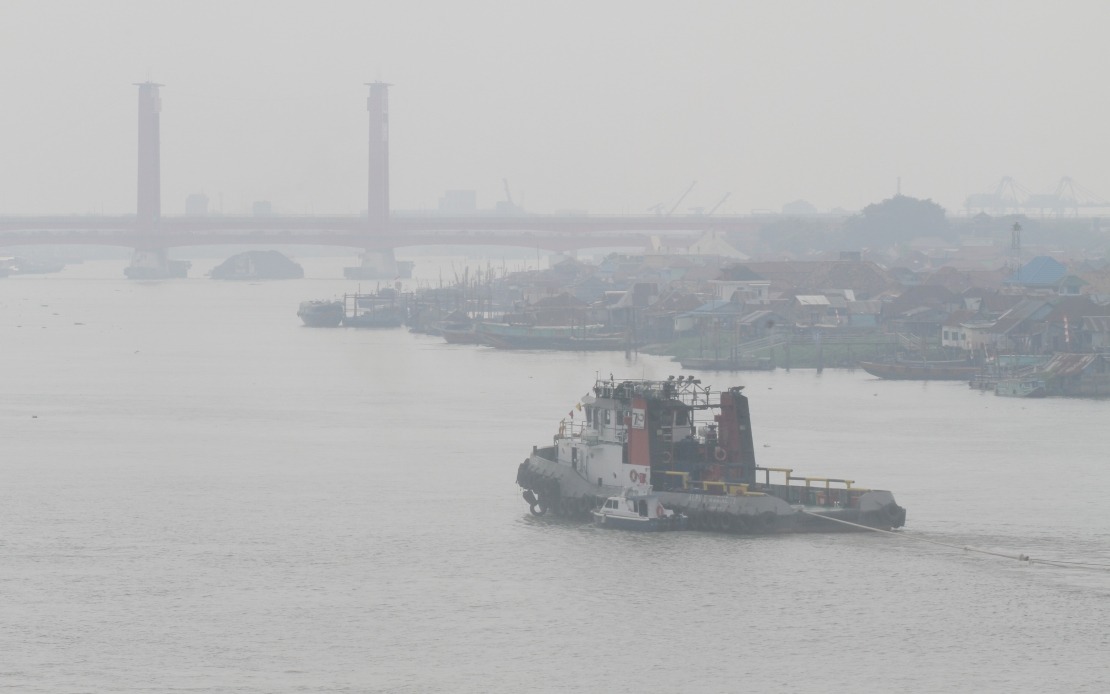
Indonesia has formally acknowledged an expanding coordination framework with Malaysia to address the escalating transboundary haze crisis, signalling a significant diplomatic commitment to managing the recurring environmental challenge that threatens millions across Southeast Asia. The initiative prioritises weather modification operations in border regions as an immediate intervention strategy, reflecting both nations' recognition that conventional firefighting alone cannot adequately contain the sprawling smoke crisis originating from raging forest and land fires in West Kalimantan.
The severity of the current situation has become starkly apparent through air quality measurements across the affected region. Sarawak has borne the brunt of initial pollution, with Air Pollutant Index readings reaching 195 in certain localities as of Friday morning—a level approaching the hazardous threshold of 201 that triggers very unhealthy air warnings. The impact has radiated further into Peninsular Malaysia, where Kuala Lumpur, Selangor, Penang, Kedah, and Perak have all registered unhealthy air quality classifications, demonstrating how rapidly transboundary pollution cascades across international borders and population centres regardless of distance.
According to Berton Panjaitan, Acting Head of the National Disaster Mitigation Agency (BNPB) Data, Information, and Disaster Communication Centre, bilateral discussions have progressed beyond preliminary acknowledgement into substantive cooperative arrangements. Both governments have committed to strengthening operational coordination across three core pillars: preventive measures to reduce fire incidence, continuous monitoring systems to track pollution spread, and crucially, technical support for weather modification initiatives that may artificially induce rainfall to suppress smoke dispersion and ground particulate matter.
The diplomatic groundwork for this enhanced cooperation was formally established during high-level discussions between Malaysian Natural Resources and Environmental Sustainability Minister Datuk Seri Arthur Joseph Kurup and Indonesian Environment Minister Jumhur Hidayat on August 24. These discussions yielded concrete operational permissions that enable Malaysia to conduct cloud-seeding operations directly within Indonesian airspace—a significant concession that removes technical and jurisdictional barriers that typically complicate cross-border environmental interventions in the region.
While Indonesia has not yet formally requested Australian-style water-bombing aerial support from Malaysia, Panjaitan's statements indicate that such escalation remains possible should ground conditions deteriorate further. Indonesia's measured approach reflects both the operational complexity of deploying sophisticated firefighting aircraft across national boundaries and the political sensitivity surrounding requests that might imply insufficient domestic capacity. Nevertheless, Panjaitan emphasised that Indonesia maintains openness to expanded cooperation through established bilateral mechanisms whenever circumstances necessitate such measures.
Malaysia's parallel confirmation of readiness to provide firefighting assistance signals a strategic shift in how Kuala Lumpur approaches the recurring haze phenomenon. Historically treated as an environmental nuisance requiring reactive diplomatic complaints through ASEAN channels, the haze has increasingly become a vehicle for demonstrating regional leadership and neighbourly cooperation. This positioning carries domestic political benefits whilst simultaneously addressing genuine public health concerns that resonate across Malaysian society, particularly among urban voters and expatriate communities affected by poor air quality.
The current 2025 haze represents a marked escalation compared to recent years. The Malaysian Consulate in Pontianak has reported that no severe haze incidents were recorded throughout 2024 and 2025 before the current crisis, suggesting that this outbreak constitutes an anomalous intensification rather than a continuation of previous patterns. This unpredictability underscores how climate variability and drought conditions in Indonesian Borneo create recurring vulnerability cycles that defy straightforward prediction or prevention through purely domestic measures.
The human dimensions of this crisis extend beyond air quality indices to encompass the lived experiences of expatriate communities and migrant workers scattered throughout Indonesian Kalimantan. The Malaysian Consulate oversees welfare responsibilities for 577 registered Malaysian citizens across West Kalimantan, the majority residing as expatriate workers rather than diplomatic personnel. These individuals face compounding hazards from hazardous air quality that necessitates mask-wearing, school closures, and restricted movement—inconveniences that compound existing separation from family networks and support systems in Malaysia.
Local institutional responses reflect the gravity of public health threats posed by prolonged haze exposure. Educational authorities have shifted to online instruction modalities to minimise children's exposure to polluted outdoor environments, whilst health authorities have recommended that residents restrict unnecessary outdoor activities. These measures, whilst prudent, impose significant social and economic costs on local populations dependent upon outdoor livelihoods and students requiring hands-on instruction. The consulate's emphasis on compliance with local directives demonstrates Malaysia's alignment with Indonesian governance frameworks, potentially strengthening diplomatic positioning for future cooperation requests.
Malaysia's track record of practical assistance to Indonesian firefighting efforts provides credibility to current cooperation commitments. In 2023, Malaysia's Pontianak Consulate donated six water pumps directly to the West Kalimantan Governor's Office—a gesture combining technical utility with symbolic demonstration of neighbourly commitment. Such precedents establish institutional channels and goodwill foundations that facilitate rapid scaling of cooperation when crises intensify, creating diplomatic infrastructure that transcends mere rhetoric or formal statements.
The weather modification component of the bilateral strategy deserves particular analytical attention as it represents a technologically sophisticated response to an environmentally complex problem. Cloud-seeding operations can artificially induce precipitation to suppress airborne particulates and accelerate pollutant deposition, though effectiveness depends upon atmospheric conditions and technical execution standards. The Indonesian grant of airspace permissions to Malaysian operators indicates sufficient mutual confidence in technical competency and operational procedures—a prerequisite that smaller or less diplomatically developed nations might struggle to negotiate.
Looking forward, the success of this coordination framework will depend upon sustained political commitment and operational coherence across Indonesian agencies that sometimes operate with inconsistent enforcement priorities regarding environmental regulations and land-use governance. Malaysian policymakers must balance supportive rhetoric with realistic acknowledgement that transboundary haze persists fundamentally because Indonesian domestic governance structures struggle to prevent forest clearance through agricultural expansion and slash-and-burn cultivation practices. Cooperation mechanisms can ameliorate immediate symptoms through weather modification and firefighting support, yet addressing underlying causes requires confronting Indonesian political economy of land development and agricultural intensification—considerably thornier diplomatic terrain than temporary weather modification agreements.

