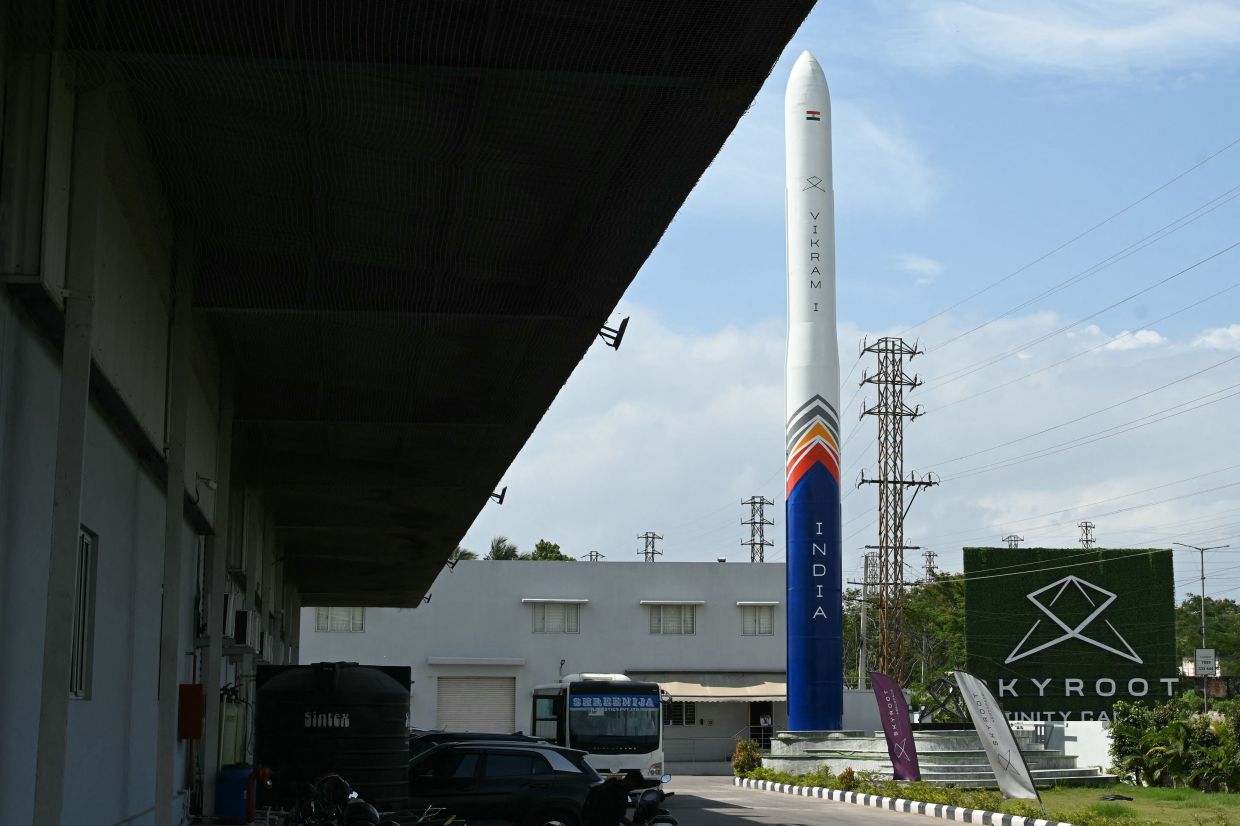
India stands poised to enter a new chapter in its space programme as Skyroot Aerospace prepares to launch the Vikram-1 rocket between July 12 and August 4, marking the first orbital-class rocket developed entirely by a private Indian company. The impending flight represents a watershed moment for New Delhi's space ambitions, underscoring how rapidly the sector has transformed following its opening to private capital four years ago. With over 400 space startups now operating within an ecosystem valued at US$8.4 billion, India's space economy has evolved from a government monopoly into a thriving entrepreneurial landscape that is attracting both domestic talent and international interest.
The expansion of India's private space sector reflects broader confidence in the nation's technological capabilities and long-term commitment to establishing itself as a major player in the global space economy. The Department of Space has articulated an increasingly ambitious vision encompassing deep-space exploration, scientific research, human spaceflight programmes, and orbital infrastructure development. This multifaceted approach positions India not merely as a participant in the international space community but as an aspirational leader capable of executing complex missions that rival those of established spacefaring nations. The trajectory suggests that within the next decade, India will command substantially larger market share in commercial space services and technology.
India's credibility in space exploration stems from decades of government-led achievement through the Indian Space Research Organisation (ISRO). The agency established the nation's credentials when it became the first Asian country to successfully insert a spacecraft into Martian orbit in 2014, demonstrating technical sophistication and engineering excellence. More recently, ISRO's Chandrayaan lunar programme has delivered increasingly impressive results, culminating in a successful 2023 rover deployment that positioned India as only the fourth nation worldwide to land unmanned equipment on the Moon's surface, following Russia, the United States, and China. These flagship missions have created institutional knowledge and manufacturing capacity that now benefits the entire ecosystem.
Beyond individual missions, ISRO has cultivated a distinctive reputation for delivering space capabilities at remarkably lower costs than international counterparts. This cost-efficiency has enabled the agency to conduct ambitious programmes with limited budgets whilst also generating substantial revenue through commercial services. The organisation has launched over 430 foreign satellites, earning more than US$600 million in the process, whilst simultaneously deploying more than 144 of its own satellites. This dual track—serving international clients whilst pursuing national objectives—has positioned ISRO as both a revenue-generating enterprise and a strategic asset for Indian policymakers. The commercial success validates India's technological approach and provides financial resources to fund increasingly ambitious future missions.
The scale of India's space ambitions extends far beyond Earth orbit. ISRO is executing an expanding portfolio of missions including the ongoing Aditya solar observatory, which is monitoring the Sun's corona and space weather phenomena relevant to telecommunications and power infrastructure worldwide. The agency has scheduled a fourth Chandrayaan mission for 2027 to collect and return lunar samples, a capability possessed by very few nations. Additionally, a Venus orbit mission slated for 2028 will further expand India's deep-space exploration reach. These programmes demonstrate that New Delhi views space not merely as a domain for satellite launches but as a frontier for fundamental scientific discovery and resource assessment.
The application of space technology to terrestrial challenges further illustrates India's strategic thinking. ISRO's technological contributions are enabling development of the Matsya submarine, an ambitious deep-ocean research vehicle designed to transport scientists six kilometres below the surface by 2027. According to Science Minister Jitendra Singh, this capability will facilitate exploration and potential harvesting of deep-ocean resources including rare earth elements and critical minerals—commodities central to global technology competition. This convergence of space technology and resource security reflects how New Delhi is weaponising space capabilities to address economic and strategic imperatives beyond traditional aerospace applications.
Private companies are now capturing an expanding share of India's space opportunity. Skyroot Aerospace's forthcoming Vikram-1 launch represents only the most visible example of entrepreneurial dynamism. Pixxel is developing advanced observation satellites for agricultural monitoring and environmental surveillance—applications with direct relevance to food security and climate assessment across South Asia. Bellatrix Aerospace is manufacturing satellite propulsion systems whilst Agnikul Cosmos is innovating through 3D-printed rocket engines for small-lift-to-orbit vehicles. This diversification of private enterprise across different space technology domains suggests that India is building a comprehensive, vertically-integrated industrial ecosystem rather than relying upon any single company or technology.
India's growth projections underscore confidence in this trajectory. Government forecasts anticipate the space industry will expand to US$44 billion by 2033 and US$100 billion by 2040, representing roughly twelve-fold growth over the current baseline. Supporting this projection is substantial infrastructure development underway at existing and new facilities. The primary launch complex at Sriharikota on Andhra Pradesh's southeast coast is undergoing major expansion whilst a second spaceport is being constructed at Kulasekarapattinam in Tamil Nadu. This geographic diversification of launch infrastructure reduces vulnerability to disruption and enables simultaneous mission operations—essential capabilities for a commercial space operator competing globally.
International partnerships have become integral to India's space strategy. Beyond its longstanding relationship with Russia—which is supporting India's human spaceflight preparations—New Delhi has cultivated partnerships with NASA, the European Space Agency, France, Germany, Italy, Japan, and Saudi Arabia. This network of collaborations provides both technical expertise and market access whilst reducing development costs through shared research initiatives. These partnerships also reflect geopolitical realities, positioning India as a trusted space partner for democratic nations whilst maintaining pragmatic relationships with Russia despite broader strategic tensions.
The deep integration between India's civilian space programme and defence establishment creates a dynamic wherein space capabilities directly support military modernisation. Several government and private companies now supply both ISRO and India's Defence Research and Development Organisation with identical or closely related technologies encompassing launch rockets, propulsion systems, satellites, electronics, and guidance systems. The Indian military's expanding missile and drone programmes benefit from technological advances driven by space competition. ISRO's acknowledged close coordination with the Defence Research and Development Organisation and its ongoing ties to the BrahMos missile programme—a joint India-Russia venture—illustrate how civilian space achievements translate into military capability enhancement. Companies supplying avionics and guidance systems to ISRO are experiencing surging military orders, creating profitable vertically-integrated enterprises that serve both civil and defence customers.
This space-defence nexus carries significant implications for regional security dynamics across South Asia and the broader Indo-Pacific. As India's space industrial base matures and private sector participation accelerates, the nation will acquire increasingly sophisticated capabilities in surveillance, communications, precision targeting, and autonomous systems. These capabilities will strengthen India's strategic position relative to China and Pakistan whilst providing technological foundations for forward defence postures. For Malaysia and other Southeast Asian nations, India's emergence as a space power creates both opportunities for regional cooperation and considerations regarding the security implications of an expanding Indian military-industrial complex.
The trajectory of India's space sector reflects broader patterns of Indian technological advancement and entrepreneurial dynamism. The convergence of government anchor institutions like ISRO, a rapidly growing startup ecosystem, international partnerships, and deliberate policy choices to open the sector to private investment has created conditions for sustained competitive advantage. As Skyroot's Vikram-1 lifts off in coming weeks, it will symbolise not merely a technical achievement but the maturation of India's capacity to combine historical expertise with modern entrepreneurial innovation. For regional observers and international partners alike, India's space awakening merits careful attention as a bellwether of the nation's broader technological trajectory and its expanding role in global competition for technological supremacy.

