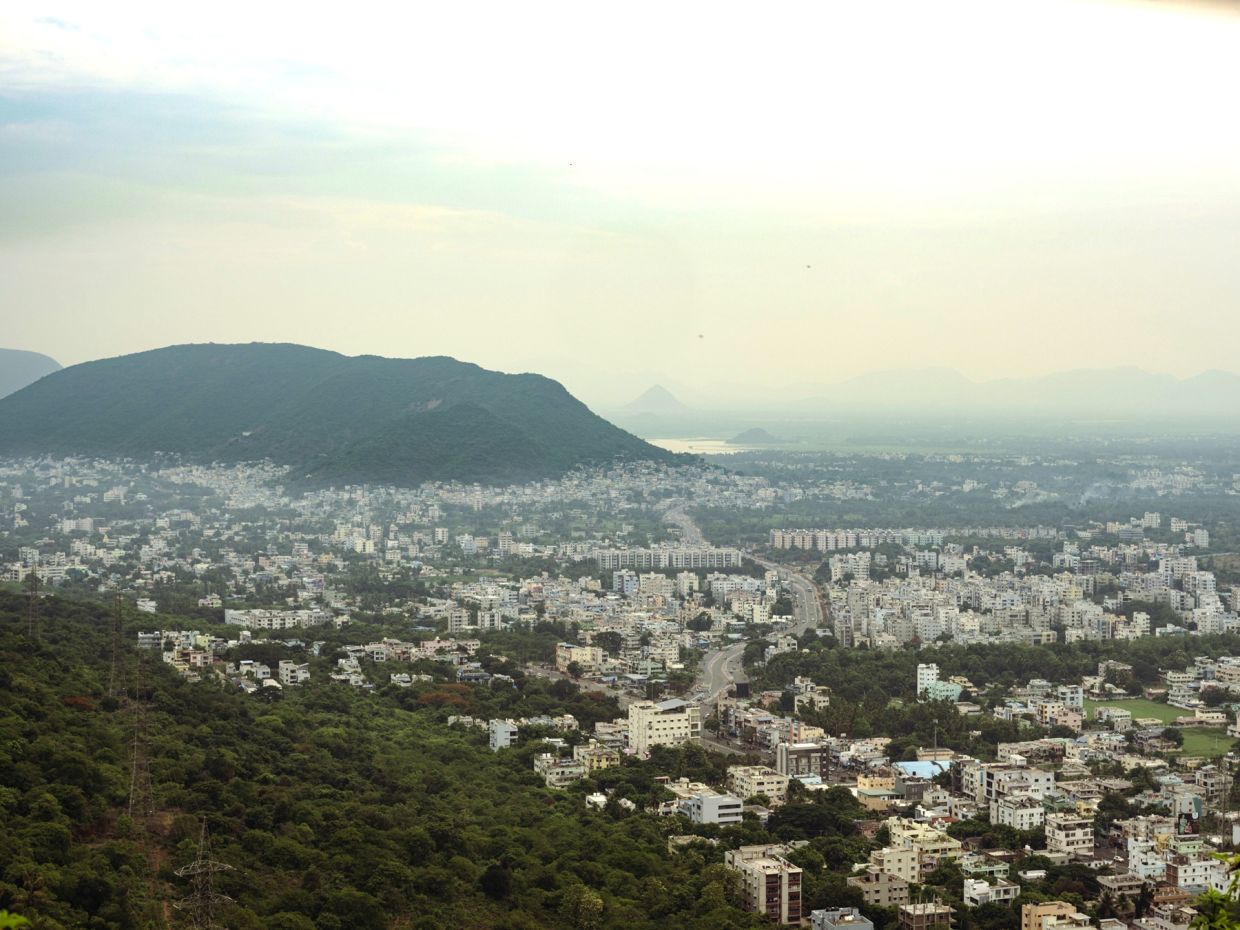
India's scramble to secure a foothold in the global artificial intelligence revolution is colliding head-on with grassroots resistance in Visakhapatnam, a coastal city where two massive data centre projects worth billions of dollars are reshaping the landscape. The most visible symbol of this transformation is a sprawling billboard in the village of Tarluvada, where faces of national and regional politicians beam down with the message "Welcome, Google, Welcome!" Yet beneath this celebratory facade lies a growing fault line between government ambitions and community apprehension about the true cost of rapid industrialisation.
Google is spearheading the charge with a RM61.36 billion investment that includes constructing a one-gigawatt data centre on the outskirts of Visakhapatnam, alongside laying new undersea telecommunications cables to connect the facility to global networks. The American technology giant has partnered with Gautam Adani, a billionaire industrialist with deep political ties to Prime Minister Narendra Modi, whose administration views data centres as foundational infrastructure for India's participation in the worldwide artificial intelligence boom. Complementing Google's ambitions is an equally substantial data centre being developed through a joint venture involving Brookfield Asset Management and India's Reliance Industries, also based in Visakhapatnam. Together, these two facilities will more than double India's existing data centre capacity relative to the previous year's levels, marking a seismic shift in the country's technological infrastructure.
State officials frame the development as a transformative opportunity extending far beyond mere computing power. Nara Lokesh, the information technology minister of Andhra Pradesh, envisions a cascading effect where investments in supporting industries—power electronics manufacturing, air conditioning systems, building materials, and related sectors—will gravitate toward his state as complementary businesses establish operations to service the data centres. This narrative of broad-based industrial development has been instrumental in securing political support for the projects, with assurances that the investment will catalyse further foreign direct investment and economic diversification in a region competing fiercely with other Indian states for corporate interest.
Yet the enthusiasm among government circles contrasts sharply with mounting scepticism among residents, activists, and former officials in Visakhapatnam itself. Hyperscale data centres are notorious for their voracious consumption of electricity and water while generating surprisingly few permanent employment opportunities—a paradox that has already triggered significant opposition in the United States, where communities have successfully blocked or delayed data centre projects worth tens of billions of dollars. In India's context, where water stress is endemic in many regions and electrical infrastructure remains stretched, these concerns take on particular urgency. Visakhapatnam, situated in a water-stressed area that regularly experiences supply disruptions during summer months, appears an especially fraught location for facilities with such enormous resource demands.
Critics are particularly alarmed by what they characterise as a compressed timeline and regulatory shortcuts that appear designed to circumvent ordinary scrutiny. There are allegations that environmental clearance rules have been flexed to permit construction in ecologically sensitive zones, raising questions about the durability of ecosystem protections. The Indian government has sweetened the deal with extensive incentives including discounted land prices, subsidised energy and water rates, and comprehensive tax breaks—a package comparable to what American communities have explicitly rejected in recent years. Yet in India, a culture of limited transparency and institutional constraints on public dissent have prevented the kind of open debate that might have occurred in Western democracies. Critical information remains opaque: the precise sources of water and electricity, the full scope of subsidy costs, and their ultimate allocation across society remain shrouded in administrative silence.
VS Krishna, a campaigner with the Human Rights Forum operating in the region, articulates the frustration felt by many residents. He argues that treating a major developmental project with the same secrecy typically applied to defence matters represents a fundamental departure from democratic principles. The entire region is being asked to absorb substantial infrastructure expenses, environmental risks, and potential long-term ecological damage without the benefit of genuine public consultation or transparent cost-benefit analysis. This pattern reflects India's broader struggle to balance rapid industrialisation with institutional accountability, a tension that becomes especially acute when powerful billionaires like Adani are involved. Adani's close relationship with Modi, combined with his well-documented track record of successfully navigating India's bureaucratic landscape, has only deepened public scepticism about whether ordinary citizens will have meaningful voice in decisions affecting their environment and livelihoods.
Google and Adani's representatives have attempted to address these concerns by claiming they have incorporated safeguards into project planning specifically designed to prevent any water or energy burden falling on local communities. They maintain that advanced cooling technologies will minimise water consumption while maintaining operational independence from municipal water supplies. The companies assert they will invest in clean energy generation and guarantee that no costs will be transferred to local households, businesses, or state government budgets. These assurances, however, have failed to convince many residents and former officials who question whether such commitments will hold once projects are completed and initial scrutiny diminishes.
India's urgency in pursuing these projects must be understood within the context of its precarious position in the global artificial intelligence competition. Despite possessing a massive domestic market and world-class technological talent, India has been classified as a "laggard" by Morgan Stanley analysts in developing autonomous AI capabilities. Billions of investment dollars that might have flowed to India have instead moved toward competitors like Taiwan and South Korea that manufacture cutting-edge artificial intelligence chips and other foundational technologies. India's role in the global AI ecosystem has been circumscribed to relatively downstream activities—deploying existing technologies domestically and for export markets—rather than participating in fundamental innovation at the technology's frontier. This structural positioning reflects decades of underinvestment in manufacturing infrastructure and research and development.
A particularly glaring gap that officials point to as justifying urgent action concerns data centre capacity relative to global data production. India generates approximately 20 percent of the world's data, yet its share of global data centre capacity represents merely a fraction of that proportion. This mismatch creates both a vulnerability and an opportunity: foreign technology companies reliant on Indian data cannot efficiently process and store that information domestically, while India itself loses economic value and strategic autonomy by depending on overseas infrastructure. From this perspective, the Visakhapatnam projects represent an attempt to recalibrate this imbalance and secure India's position in the global artificial intelligence infrastructure build-out before technological leadership becomes permanently consolidated elsewhere.
The employment question has emerged as particularly contentious. Officials claim the Google project alone will create approximately 120,000 jobs during construction and roughly 60,000 permanent positions afterward. However, critics and former government officials have questioned these figures, arguing they are wildly optimistic relative to employment patterns observed at comparable data centre facilities internationally. Project documents submitted for environmental clearance reveal surprisingly modest facility specifications in certain areas—including parking space requirements and daily water consumption for restroom facilities—that suggest permanent staffing will be substantially smaller than official projections. This discrepancy matters enormously because India faces an employment crisis of staggering proportions. With a population exceeding 1.4 billion people, the country urgently needs to generate millions of quality jobs annually. The International Monetary Fund has warned that artificial intelligence deployment could unleash a "tsunami hitting the labour market," potentially disrupting or severely contracting India's crucial information technology support sector, which currently employs hundreds of thousands of workers. Betting on data centres to address employment needs appears strategically risky.
EAS Sarma, a former senior official who directed divisions within India's ministries of finance and energy and holds a doctorate in energy planning, has emerged as an articulate voice for scepticism. Sarma contends that true costs far exceed acknowledged benefits, particularly regarding electricity infrastructure. Building the necessary transmission lines to deliver power to these massive facilities will require capital expenditure that ultimately translates into higher electricity bills for ordinary residents and businesses. Every subsidy provided to technology companies effectively becomes a cost borne by society, he argues, whether distributed immediately or across future years through higher utility rates. Sarma's analysis points to a fundamental asymmetry: corporations capture concentrated benefits through guaranteed profitability and tax breaks, while diffuse costs spread across the general population in ways that become difficult to reverse once infrastructure is built and operational.
Sarma's assessment reflects a broader concern that technology billionaires like Adani succeed not through superior innovation or efficiency but through superior political connections and capacity to navigate India's regulatory labyrinth. The partnership between Google and Adani is understood by critics not as complementary strengths but as a deliberate strategy: Google brings global capital and technology while Adani brings mastery of local political relationships and governmental decision-making. "Google is very clever," Sarma observed, "it has joined hands with Adani, because Adani can clear anything here in the government of India." This characterisation, while perhaps hyperbolic, reflects a deeper anxiety about whether India's commitment to artificial intelligence development is being pursued in ways that genuinely serve broad public interest or primarily benefits a narrow class of politically connected billionaires and multinational corporations.
For Malaysia and other Southeast Asian nations, the Visakhapatnam case offers important lessons about the dynamics of global technology competition and the often-hidden costs of rapid industrialisation in pursuit of artificial intelligence leadership. Regional policymakers considering similar data centre investments should carefully examine whether employment and economic development promises match international experience, whether environmental protections remain robust under political pressure to move quickly, and whether ordinary citizens retain genuine voice in decisions affecting their communities. India's experience demonstrates that artificial intelligence ambitions, while strategically important, cannot be pursued in ways that systematically exclude public input or treat technological development as categorically more important than environmental sustainability and social equity.

