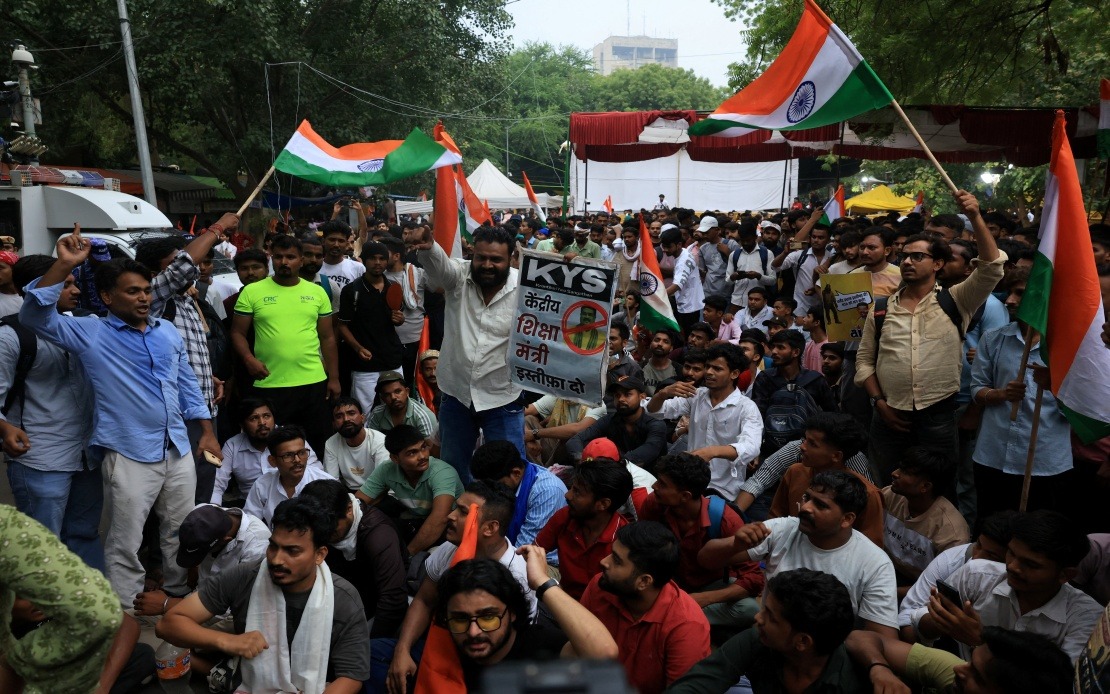
Demonstrations erupted across New Delhi on Monday as a newly mobilised youth movement orchestrated a large-scale march toward the Indian Parliament building, with protesters clashing against police barricades established to restrict access to the legislative complex. The so-called Sansad Chalo rally—a term meaning "march to parliament"—drew thousands of participants who pressed against security cordons despite authorities having announced strict limitations on public gatherings in the capital. Police responded with standard crowd-control procedures to manage the surging numbers and prevent breaches of the security perimeter that had been established around the parliamentary precinct.
The protest movement, which organisers claim commands millions of online adherents across digital platforms, represents a significant mobilisation of India's younger demographic around educational concerns. Rather than coalescing around a single issue, the movement has articulated a broader agenda centring on systemic deficiencies within India's academic framework. Organisers argue that the current structure fails to adequately prepare students for contemporary employment demands and does not address deep-seated pedagogical problems that have accumulated over decades of underinvestment and policy stagnation.
The timing of the demonstration coincided deliberately with the opening of the Monsoon Session of the Indian Parliament on Monday, a strategic choice that amplified the visibility of the protesters' grievances on the national stage. By positioning their march during the commencement of a new parliamentary session, organisers sought to ensure that education reform would command immediate attention from legislators and the executive branch. Prime Minister Narendra Modi was present at the parliament complex during the proceedings; security details escorted him through the grounds in a protective convoy as police personnel worked simultaneously to contain the gathering crowds in surrounding streets and public spaces.
India's education system has long been a subject of intense debate among policymakers, academics, and students themselves. The movement's demands for comprehensive reform touch upon persistent challenges including overcrowded classrooms, insufficient teacher training, limited access to quality vocational education, and curricula perceived as increasingly disconnected from practical skill requirements in evolving job markets. The youth-driven nature of this protest suggests growing frustration among students and recent graduates who view existing structures as impediments rather than enablers of their ambitions.
The scale and organisation displayed by the movement indicates sophisticated use of social media platforms to coordinate action and build momentum beyond traditional protest channels. With claims of millions of online followers, the group has evidently leveraged digital tools to overcome geographical dispersal and create a national movement that can mobilise participants across India's vast expanse. This contemporary protest model—combining grassroots street action with sustained digital engagement—represents an evolution in Indian activism and poses distinct challenges for public order management.
Security protocols were substantially enhanced across the national capital following the confrontations on Monday, with police deploying additional personnel and equipment to sensitive government installations and major thoroughfares. Officials implemented heightened screening procedures at checkpoints and restricted vehicular movement in numerous downtown areas to prevent potential recurrence of unauthorised marches or breaches of security zones. The decision to elevate security measures reflected authorities' assessment of the movement's capacity to remobilise larger numbers and their concern about maintaining order during a period of heightened political activity.
From a Southeast Asian perspective, India's political dynamics carry significant weight given the nation's regional influence and role as a democratic counterbalance within Asia. Large-scale youth movements advocating educational reform in India often presage broader policy discussions that ripple across the region, influencing how neighbouring democracies address comparable challenges. Malaysia, too, grapples with concerns about aligning educational outcomes with employment needs, workforce development, and the relevance of curricula in rapidly transforming economies. Indian precedents—both successful policy innovations and public pressure campaigns—serve as instructive reference points for policymakers across the region.
The interaction between the youth movement and state security apparatus during the Sansad Chalo march illustrates India's ongoing negotiation between protecting democratic space and maintaining public order. Rather than wholesale suppression, authorities employed targeted crowd-management techniques, suggesting an attempt to accommodate protest activity while preventing disruption to parliamentary functioning. This measured response contrasts with more repressive approaches elsewhere and underscores the institutional resilience of Indian democracy, though civil liberties organisations continue monitoring whether restrictions on assembly disproportionately burden particular protest movements.
The educational grievances articulated by the movement reflect structural problems that have accumulated over years of incremental policy changes without comprehensive reform. India's academic system produces millions of graduates annually, yet employers consistently report skills mismatches, suggesting fundamental disconnection between what universities teach and what labour markets require. Vocational training remains underfunded relative to traditional academic pathways, limiting opportunities for students uninterested in conventional university education. These systemic issues demand sustained policy attention rather than incremental tinkering, and the youth movement's emergence indicates growing impatience with the pace of change.
Looking ahead, the success of the Sansad Chalo movement in translating street mobilisation into concrete policy outcomes will largely determine whether comparable youth-led campaigns emerge around other governance issues. Should parliament respond seriously to educational reform demands—through committee enquiries, legislative proposals, or budgetary reallocation—the movement could establish a template for youth engagement with institutional politics. Conversely, should demands prove difficult to translate into tangible results, disenchantment among younger voters and activists might fuel broader anti-establishment sentiment or redirect energy toward alternative political vehicles.

