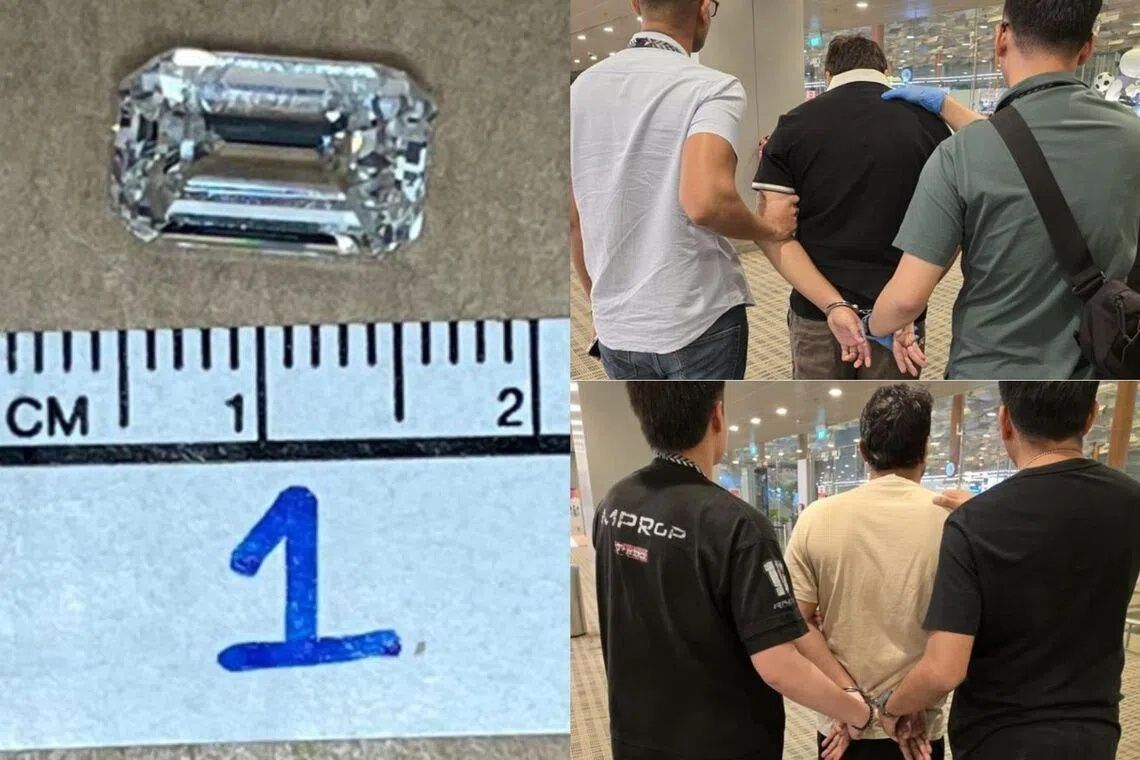
A carefully orchestrated jewellery heist at a Chinatown store in Singapore has resulted in a two-year prison sentence for one of two Indian nationals involved in the brazen theft of a nearly S$200,000 diamond. The incident, which unfolded on June 19, showcased the lengths criminals will go to in attempting high-value thefts at retail establishments, whilst also highlighting the effectiveness of airport security measures in catching offenders attempting to flee the jurisdiction. Mangroliya Manojkumar Kurjibhai, 41, pleaded guilty to theft charges and received his sentence on Friday, July 17, whilst his accomplice Serasiya Milan Ramnikbhai, 30, awaits trial on related charges.
The scheme began months before either man set foot in Singapore. Court documents reveal that Mangroliya and Serasiya meticulously planned their operation whilst still in India, commissioning a counterfeit diamond that perfectly matched the specifications and serial number of a genuine 4.95-carat stone held at Dianoche jewellery store on Kreta Ayer Road. Investigators have not publicly disclosed how the pair initially learned of this particular diamond or conducted the reconnaissance necessary to identify it as a suitable target. The level of premeditation suggests familiarity with jewellery store operations and security vulnerabilities, raising questions about whether either man had prior experience in similar criminal enterprises or had received guidance from others in the international gem-smuggling underworld.
On the day of the theft, both men arrived in Singapore and proceeded directly to the Chinatown store at approximately 3pm. Serasiya concealed the fake diamond inside his mouth, a technique commonly employed in jewellery thefts to enable quick exchanges without drawing suspicion. Once inside, Mangroliya requested to examine the genuine 4.95-carat diamond, valued at approximately US$154,000 or over S$199,000 in Singapore dollars. To create distraction and opportunity, Mangroliya asked the sales manager to retrieve several additional items, requiring the staff member to repeatedly leave his position. This calculated approach to managing the victim's attention demonstrates awareness of how retail jewellery transactions typically proceed.
The actual swap occurred with practised efficiency. At Mangroliya's signal, Serasiya expelled the counterfeit stone from his mouth and made the exchange, quickly concealing the authentic diamond in his own mouth before both men departed the store with apparent casualness. Had the store's security systems not been adequately maintained, the theft might well have succeeded entirely. However, the Dianoche store's CCTV cameras captured the entire transaction, and the sales manager's subsequent examination of the left-behind stone using an optical gemstone identification machine immediately revealed its fraudulent nature.
The timeline of events following the theft demonstrates how quickly authorities mobilised once the crime was detected. After leaving the jewellery store, the two men returned to their hotel, checked out, and arranged flights back to India. Their apparent confidence in escaping Singapore undetected, combined with their failure to anticipate airport security protocols, proved to be a critical miscalculation. At Changi Airport Terminal 3 shortly after 9pm that evening, immigration and customs officers intercepted the pair before they could complete their departure. A search of Serasiya's haversack revealed the stolen diamond, securing the crucial physical evidence needed for prosecution.
State Prosecuting Officer Yip Cheng Yee presented the case methodically to the court, walking through each stage of the premeditated scheme. The evidence proved overwhelming—CCTV footage, the counterfeit diamond recovered from the store, the genuine diamond found in the suspect's possession, and the incriminating timeline of events all pointed to deliberate and calculated theft. Mangroliya's guilty plea likely reflected the strength of the prosecution's case and the difficulty of mounting a credible defence against such comprehensive evidence. His sentence of two years, two months, and two weeks in prison sits well within the maximum penalty of seven years' imprisonment prescribed for theft offences under Singapore law, suggesting the court exercised moderation in sentencing, possibly reflecting his guilty plea and cooperation with authorities.
For Malaysian observers and businesses, this case illustrates both the transnational nature of organised retail crime and the importance of security infrastructure in luxury goods retail. The involvement of Indian nationals planning and executing a theft in Singapore demonstrates how criminal networks operate across borders, with individuals willing to travel internationally to commit targeted crimes. Jewellery stores throughout Malaysia, Thailand, and the wider region would be wise to review their security protocols, including CCTV coverage, gemstone authentication procedures, and staff training in identifying suspicious customer behaviour. The perpetrators' familiarity with store operations and their ability to commission a nearly-perfect counterfeit diamond suggest they possessed significant resources and expertise.
The case also underscores the critical role that airport security plays in apprehending fleeing offenders. Despite their apparent confidence in escaping detection, the individuals were caught at the point of departure, highlighting how travel restrictions and border controls remain highly effective counter-measures. Singapore's Changi Airport, one of Asia's busiest international hubs, maintains rigorous security standards that made it impossible for the thieves to depart undetected. This reality should give pause to would-be offenders throughout the region who assume they can simply flee back to their home countries following crimes in neighbouring jurisdictions.
Serasiya's case remains pending before the courts, suggesting his legal team may be contesting charges or negotiating terms, unlike his accomplice Mangroliya who accepted responsibility. The outcome of his trial will likely depend on questions of culpability and the role he played beyond merely being the individual who physically exchanged the diamonds. Some jurisdictions distinguish between the mastermind of a theft and subordinate participants, potentially affecting sentence length. However, given his active participation in the scheme and the fact that the genuine diamond was recovered from his personal possession, conviction appears probable, and his sentence will likely prove comparable to or potentially heavier than Mangroliya's, depending on judicial interpretation of their respective roles.

