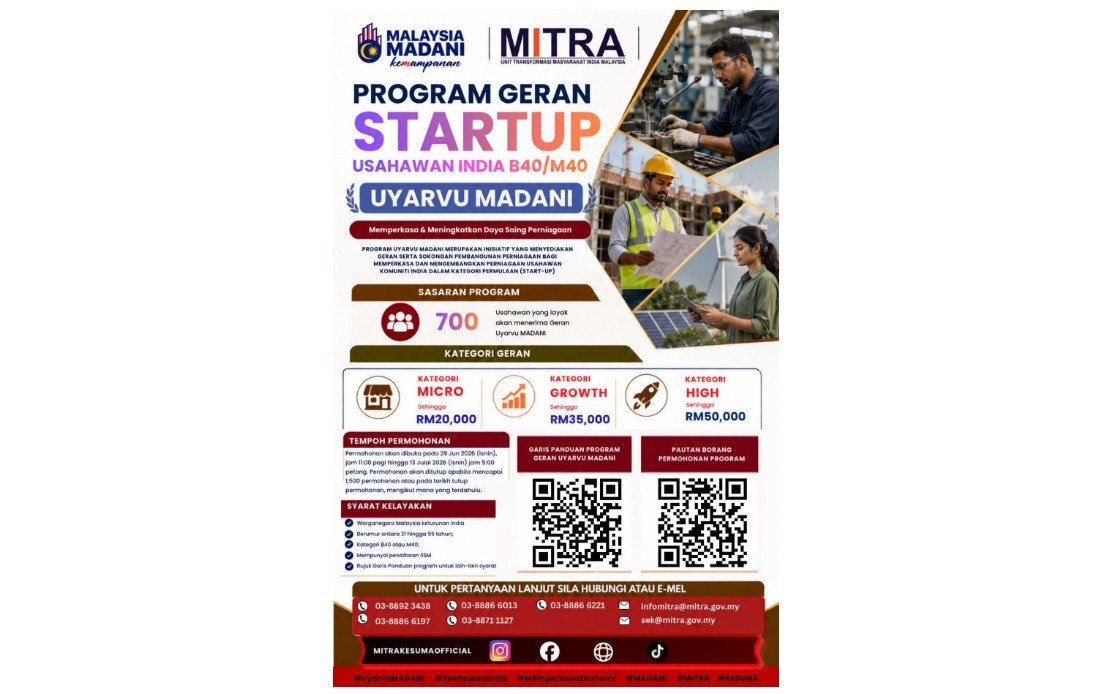
The Malaysian Indian Transformation Unit (MITRA) has launched the application period for the Startup Accelerator Grant Assistance Programme, known as Uyarvu MADANI, providing an opportunity for Indian entrepreneurs to secure crucial early-stage funding. The initiative opened on June 29 and will receive applications until 5 pm on July 13, marking a significant intervention in support of business development within Malaysia's Indian community.
The programme targets entrepreneurs from the B40 and M40 income groups—those earning between roughly RM2,300 and RM7,900 monthly—reflecting government emphasis on inclusive economic participation. Successful applicants will receive grants ranging from RM20,000 to RM50,000, sums designed to bridge the gap between entrepreneurial ambition and financial capability that often prevents talented individuals from lower-income households from launching ventures. This targeted approach acknowledges that access to startup capital remains one of the most significant barriers to business creation among underrepresented communities.
MITRA has set an ambitious target of supporting 700 entrepreneurs through this scheme, with funding allocated not merely as a one-time grant but as part of a broader ecosystem of business development assistance. Beyond the monetary award, successful grantees will gain access to mentorship, training, and technical support designed to enhance their competitive positioning in Malaysia's increasingly complex business landscape. The combination of financial and non-financial support recognises that funding alone cannot guarantee success; entrepreneurs require knowledge transfer and market navigation guidance to convert initial capital into sustainable enterprises.
The application portal is designed with an adaptive closing mechanism: the deadline will arrive earlier than July 13 should applications reach 1,500 submissions, suggesting significant anticipated demand. This early-closure provision indicates MITRA's capacity constraints while simultaneously signalling confidence in programme appeal. Entrepreneurs interested in participating should prepare comprehensive applications promptly, as competition for available slots may intensify as the official deadline approaches.
Uyarvu MADANI represents one facet of a broader strategic initiative launched by MITRA for 2026, which encompasses six distinct programmes collectively allocated RM65.5 million. This multi-pronged approach reflects government recognition that accelerating Indian community economic participation requires simultaneous interventions across skills development, financial access, business infrastructure, and market linkages. The aggregate investment demonstrates commitment beyond symbolic gestures toward substantive resource deployment.
For Malaysian entrepreneurs, particularly those from Indian backgrounds navigating systemic underrepresentation in formal credit markets, such schemes address a documented gap in financing availability. Traditional banking institutions frequently demand collateral, business history, and established credit records that startup founders lack, creating a structural disadvantage. Government-backed programmes circumvent these barriers by accepting greater risk and evaluating applications on entrepreneurial potential and community commitment rather than balance-sheet metrics alone.
The timing of this announcement coincides with broader national discourse surrounding inclusive economic growth and wealth distribution across demographic lines. Malaysia's B40 and M40 segments represent millions of households with entrepreneurial aspirations constrained by capital scarcity. By directing resources specifically toward Indian community members within these income brackets, MITRA acknowledges historical patterns of economic participation disparities and attempts corrective intervention through targeted support mechanisms.
Applicants should note that meeting the income-group criteria and demonstrating viable business concepts will be essential. MITRA's assessment process, while not detailed in the official announcement, likely evaluates factors including business plan feasibility, market understanding, applicant qualifications, and community impact potential. Prospective entrepreneurs should prepare detailed documentation and realistic financial projections to strengthen their submissions.
The programme's success will partly depend on implementation quality and post-disbursement support effectiveness. Grant-funded startups often face challenges beyond initial capital shortages, including access to distribution networks, regulatory compliance, and scaling operations. MITRA's commitment to providing ongoing business development support suggests recognition of these extended needs, though execution will determine whether funded entrepreneurs achieve sustainable success rates comparable to or exceeding typical startup survival benchmarks.
For Malaysian entrepreneurs from other communities, the Uyarvu MADANI model may presage expanded targeted grant schemes. Success here could justify similar initiatives for other underrepresented segments, gradually building a more robust ecosystem of accessible financing for startup founders across demographic lines. As Malaysia pursues its vision of high-income nation status and inclusive economic participation, programmes directly addressing capital access gaps represent pragmatic policy implementation aligned with stated development objectives.

