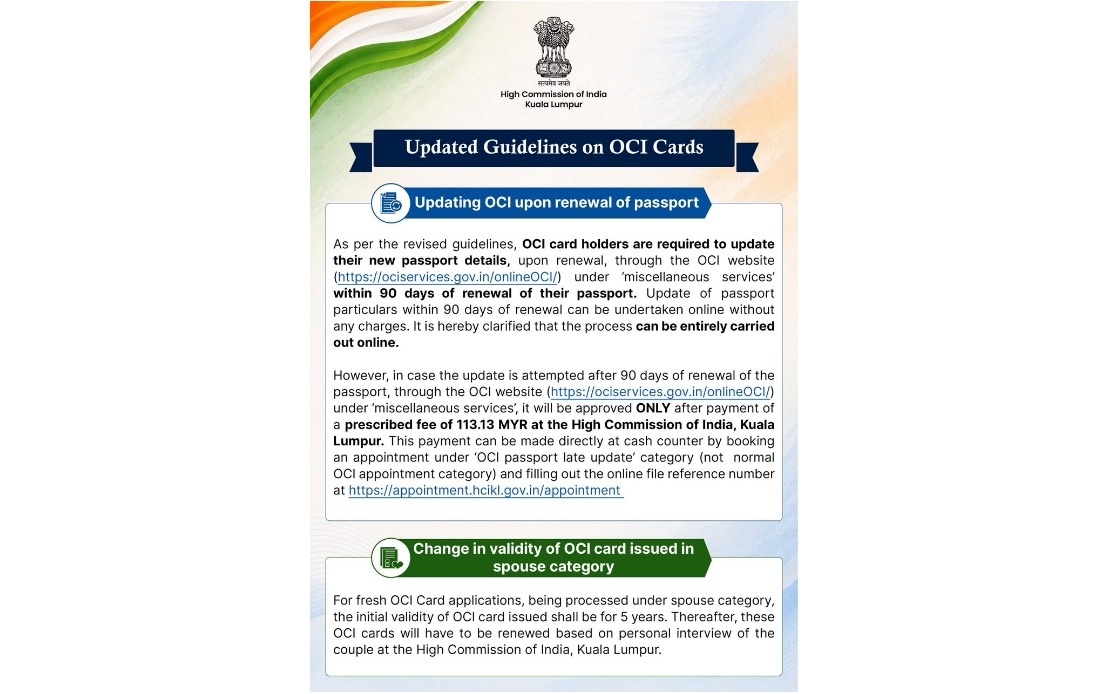
The High Commission of India in Kuala Lumpur has unveiled a revised set of operational guidelines for Overseas Citizen of India (OCI) card holders, introducing a deadline-driven system for updating passport particulars and introducing new validity terms for spouse-category applicants. The changes, announced via the mission's social media channels, represent a tightening of administrative procedures that will affect the significant Indian diaspora community in Malaysia and others holding OCI status in the country.
Under the new framework, OCI cardholders must submit updated passport details through the official OCI website within 90 days of completing their passport renewal process. The High Commission has positioned this initial window as a grace period, permitting applicants to carry out the entire update procedure online at no cost. This approach provides a straightforward pathway for compliant individuals to keep their OCI documentation current without incurring additional expenses, streamlining what has historically been a more cumbersome administrative requirement.
The regulatory shift becomes more stringent beyond this 90-day threshold. Any passport detail updates attempted after the grace period expires will require payment of a prescribed fee set at RM113.13, collected directly at the High Commission's cash counter in Kuala Lumpur. This financial penalty structure appears designed to incentivize timely compliance while generating revenue for processing delayed applications. Applicants seeking to undertake late updates must first reserve an appointment specifically under the "OCI passport late update" category—distinct from standard OCI appointment slots—and supply their online file reference number when presenting for payment.
The requirement to update passport information reflects administrative realities facing consular services globally. As passports undergo renewal, the identity documents linked to status certificates such as OCI cards naturally require corresponding updates to maintain consistency across government records. By establishing a deadline with graduated consequences, the High Commission aims to manage workflow efficiency while ensuring its databases remain accurate. For Malaysian residents holding OCI status, the implications are significant: failure to adhere to the 90-day window could result in both administrative inconvenience and unexpected costs.
Beyond passport update procedures, the High Commission has simultaneously introduced modifications affecting spouse-category OCI applications. Going forward, fresh OCI cards granted under the spouse classification will carry an initial validity period of five years rather than the extended terms previously offered. This reduction in the initial validity window appears to introduce a verification checkpoint into the OCI lifecycle, particularly for applications dependent on spousal relationships.
Following the expiration of this five-year initial term, renewal of spouse-category OCI cards will mandate a personal interview with both partners at the High Commission's Kuala Lumpur office. This requirement introduces an additional layer of scrutiny into the renewal process, necessitating that couples travel together to demonstrate the continuing validity of their relationship and spousal status. The measure suggests a shift toward more rigorous verification protocols, possibly reflecting increased administrative caution regarding the documentation supporting spouse-category applications.
The reasoning behind the spouse-category modifications likely stems from administrative audits revealing inconsistencies or documentation concerns within this particular application stream. By shortening the initial validity period and mandating in-person renewal interviews, the High Commission establishes periodic verification points that were previously absent. For Malaysian couples where one spouse holds Indian citizenship and the other seeks OCI status, this change introduces both practical considerations—such as coordinating travel schedules—and potential financial implications through renewal fees and administrative processing costs.
Implementation details for both sets of revised guidelines are accessible through two primary channels: the official OCI portal operated by the Government of India and the High Commission's dedicated appointment booking website. These digital platforms serve as centralized repositories for updated procedural information, allowing applicants to review requirements, understand timelines, and schedule necessary appointments without visiting the physical mission location. The availability of comprehensive online information represents a modernization effort aimed at improving accessibility for Malaysia's geographically dispersed Indian diaspora.
For the broader Malaysian context, these revisions carry implications beyond individual administrative compliance. Malaysia hosts a substantial Indian expatriate community, including business professionals, skilled workers, students, and long-term residents, many of whom hold or seek OCI status as a mechanism for maintaining ties to India while remaining domiciled in Malaysia. The OCI scheme itself has proven increasingly popular among overseas Indians, offering certain privileges including visa-free travel to India and greater economic participation rights without requiring renunciation of Malaysian citizenship or permanent residence status.
The timing and nature of these guideline changes suggest ongoing refinement of India's approach to OCI administration. By introducing cost incentives for timely compliance and more rigorous spouse verification procedures, New Delhi appears to be balancing accessibility with administrative control. The 90-day deadline structure provides reasonable time for most passport renewals to be processed and updated, though applicants must remain vigilant regarding their renewal dates to avoid triggering the late-update fee.
For Malaysian residents planning passport renewals, immediate action proves prudent. Those holding OCI cards should cross-reference their passport renewal schedules with the 90-day update window, potentially scheduling their OCI updates shortly after receiving new passports to ensure compliance without incurring additional costs. Similarly, couples applying for or renewing spouse-category OCI cards should prepare for mandatory in-person interviews, factoring travel time and coordination into their planning processes.
The High Commission's announcement underscores the importance of maintaining current documentation and staying informed regarding regulatory changes affecting India-related services in Malaysia. As bilateral relations between India and Malaysia continue to deepen across trade, investment, and cultural dimensions, efficient consular administration becomes increasingly vital for supporting the Indian community's integration and participation in Malaysian society while preserving their connections to their homeland.

