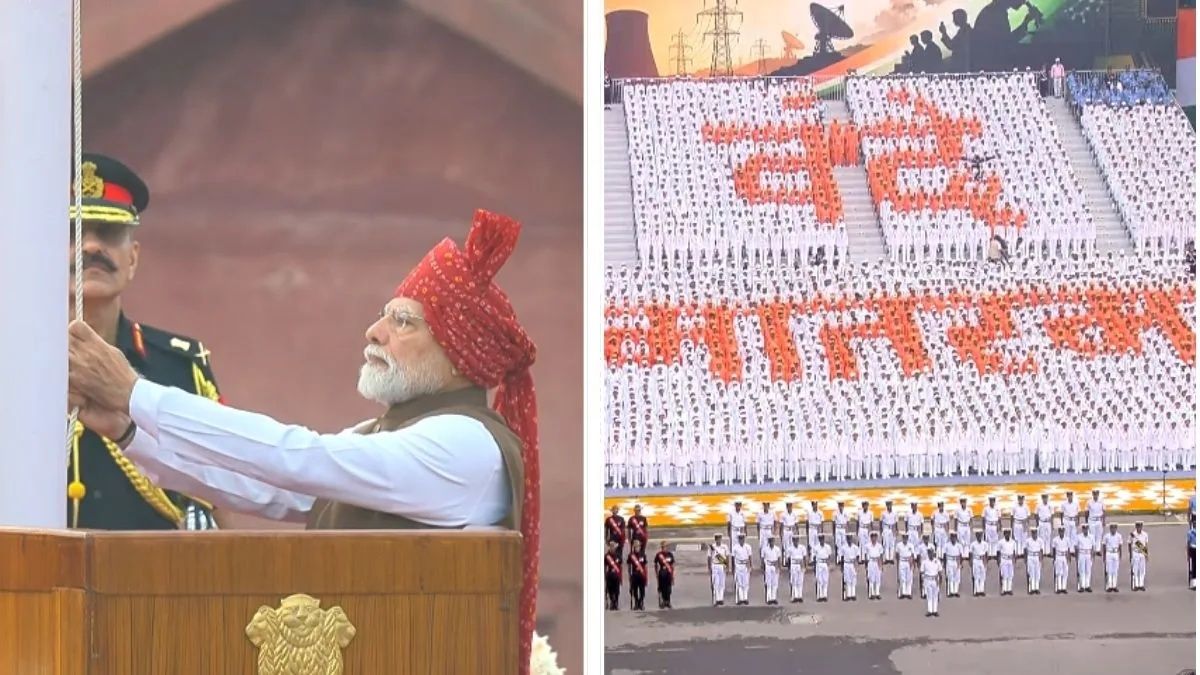
Prime Minister Narendra Modi has articulated an ambitious long-term development blueprint for India, declaring from the Red Fort on the country's 80th Independence Day that the nation will transition to developed status by 2047. Addressing citizens gathered for the ceremonial flag hoisting, Modi framed this as more than an economic target, presenting it as a fundamental transformation in how India views itself and how the world perceives the nation's standing. The announcement represents a consolidation of policy direction, signalling that India's governance approach will remain oriented toward sustained growth and structural modernisation across the coming two decades.
The Prime Minister's articulation of the "Viksit Bharat" vision carries particular significance for the broader South Asian region, where India's trajectory influences investment patterns, technology adoption, and competitive positioning. By explicitly committing to developed nation status within a defined timeframe, Modi has established a benchmark against which his government's performance will be measured—a politically consequential declaration that acknowledges India's growing economic weight and geopolitical influence. For Malaysian policymakers and businesses monitoring regional dynamics, India's development priorities become a critical variable in bilateral trade negotiations, supply chain strategies, and technology partnerships across Southeast Asia.
Modi's emphasis on expanding national ambition rather than accepting incremental progress reflects a deliberate rhetorical strategy aimed at mobilising social energy around long-term objectives. His insistence that "small dreams will no longer suffice" and repeated calls for citizens to "think bigger" suggest a conscious effort to shift the national conversation from immediate concerns toward future possibilities. This aspirational framing serves multiple purposes: it provides psychological momentum for sustained reform efforts, it rallies diverse constituencies around a unifying goal, and it establishes permission structures for the difficult economic adjustments development entails. Such messaging becomes particularly relevant in contexts where poverty and inequality remain substantial, as it requires citizens to balance present-day hardships against promised future prosperity.
Contextualising India's economic transformation over the preceding dozen years, Modi highlighted the nation's transition from the "Fragile Five"—a designation applied during periods of financial vulnerability—to its current position as a major fast-growing economy. This repositioning reflects genuine macroeconomic shifts: India has stabilised its fiscal position, attracted sustained foreign investment, and achieved consistent growth rates that differentiate it from many comparable economies. The reference to previous economic fragility serves a dual purpose, simultaneously acknowledging past vulnerabilities while asserting that systemic constraints have been overcome through policy intervention.
The Prime Minister cited concrete sectoral achievements to substantiate claims of transformation and to illustrate the mechanisms through which development occurs. Defence production expansion by 400 percent demonstrates government capacity to build indigenous manufacturing capabilities in sensitive sectors. Khadi and Gramodyog output increases of 500 percent represent support for small-scale and traditional industries, linking development to preservation of cultural heritage and rural employment. Electronic manufacturing growth of 700 percent reflects India's successful positioning within global technology supply chains, while the 33 percent expansion in mobile phone production speaks to deeper penetration of digital infrastructure. Digital transaction growth of 100 percent indicates transformational shifts in financial inclusion and cash economy reduction—changes with far-reaching implications for tax compliance, monetary policy transmission, and informal economy formalisation.
The ceremonial dimensions of Independence Day observances themselves carried symbolic weight in Modi's framing. The full rendition of "Vande Mataram" at the Red Fort represented a restoration practice, marking the first complete performance of the national song at this location since independence. Modi characterised this as a "historic moment," signalling that national identity affirmation constitutes an integral component of development discourse. The coordination between flag hoisting, the 21-gun salute utilising indigenously manufactured 105mm Light Field Guns, and military ceremony itself conveyed messages about national self-sufficiency and institutional modernisation.
Yet Modi's address also acknowledged immediate national challenges, specifically recent flooding that had affected multiple regions. His assurance that "the whole country stands by" affected families balanced aspirational long-term vision with demonstrated present-day concern. This rhetorical balance proves politically significant, as development narratives that ignore immediate suffering risk losing legitimacy among populations experiencing acute hardship. The integration of flood-related acknowledgment within the broader development address suggests recognition that national resilience requires addressing both structural weaknesses and contemporary crisis response capacity.
From a Southeast Asian perspective, India's development ambitions carry substantial implications for the region's economic architecture. An India that successfully achieves developed nation status would become an increasingly significant competitor for investment capital, skilled labour, and technological leadership. Simultaneously, deeper Indian development could expand regional demand for Southeast Asian exports, enhance technology transfer opportunities, and strengthen bilateral trade relationships. Malaysian companies and policymakers must consider how an economically transformed India would alter competitive dynamics within ASEAN and reshape bilateral relationships with New Delhi.
The 2047 timeframe itself merits examination. Twenty-three years permits substantial structural transformation while remaining within planning horizons where current policy decisions demonstrably influence outcomes. This duration allows for completion of major infrastructure projects, full implementation of educational reforms, and generational shifts in human capital development. However, it also establishes a demanding timeline requiring sustained political consensus across potential leadership transitions, maintenance of policy direction regardless of electoral cycles, and absence of major external shocks that could derail development trajectories.
Modi's emphasis on collective effort and citizen participation suggests recognition that development cannot be imposed through government action alone. The call for citizens to "stay determined" and "work together" distributes responsibility across society, framing development as a national endeavour requiring contribution from multiple sectors. This approach potentially mobilises energy but also diffuses accountability, as failure could be attributed to insufficient collective commitment rather than policy shortcomings. The vision's ultimate success will depend on whether the combination of policy implementation, infrastructure investment, institutional reform, and social mobilisation produces outcomes sufficient to achieve developed nation classification within the stipulated timeframe.

