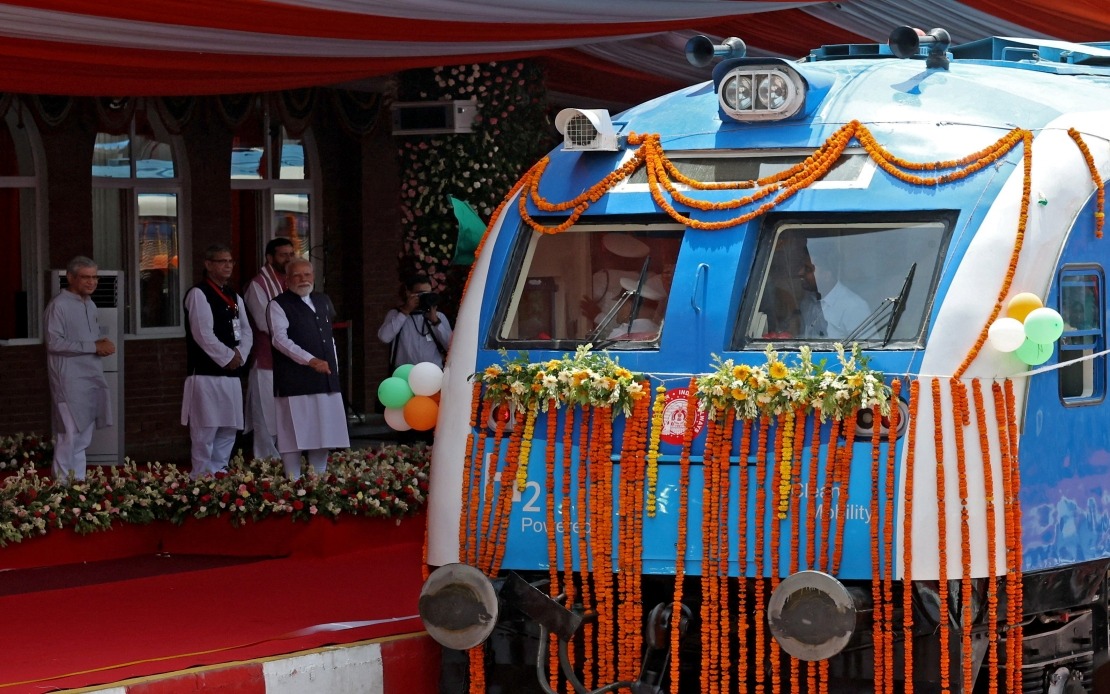
India has taken a major step toward sustainable railway transport with the launch of its first hydrogen-powered train. Prime Minister Narendra Modi formally inaugurated the service on Friday, positioning the nation alongside a small circle of advanced economies already deploying this clean technology on their rail networks. The breakthrough deployment underscores New Delhi's commitment to transitioning away from traditional diesel propulsion and aligns with broader climate goals across South and Southeast Asia, where railway expansion remains critical to infrastructure development.
The newly operational hydrogen train will serve the 89-kilometre corridor connecting Jind and Sonipat in the northern state of Haryana. This choice of route is strategic: Haryana is a densely populated industrial hub with growing commuter demands, making it an ideal testing ground for scaling hydrogen technology across India's vast railway network. The route selection also reflects government confidence that the technology can handle passenger loads and operational schedules comparable to conventional services, paving the way for broader rollout across the country's 43,000-kilometre rail infrastructure.
What makes this achievement particularly significant for India is the use of indigenously developed hydrogen fuel cell technology. Rather than importing systems from established manufacturers, Indian engineers and researchers have spearheaded the design and construction of the propulsion system. This domestic innovation reduces dependence on foreign technology and builds local expertise in a sector poised to become increasingly important as countries worldwide commit to net-zero emissions targets. The achievement positions India as a potential supplier of hydrogen rail solutions to other developing nations in South Asia and beyond.
At the core of the hydrogen train's propulsion system sits a 1,200-kilowatt Proton Exchange Membrane Fuel Cell, or PEMFC. This device generates electricity through an electrochemical reaction between stored hydrogen gas and oxygen from the atmosphere. The elegance of this approach lies in its simplicity and environmental profile: the only outputs are electricity for traction, water vapour, and waste heat. Unlike diesel engines that emit nitrogen oxides, particulates, and carbon dioxide, hydrogen fuel cells produce zero harmful emissions during operation, transforming air quality around rail corridors and reducing the transport sector's contribution to climate change.
The 10-coach train configuration has been certified to operate at speeds up to 75 kilometres per hour, though its design capacity reaches 110 km/h. This differential between operating and design speeds reflects standard railway practice, allowing operational flexibility and potential for future acceleration protocols as operators and maintenance teams gain experience with the technology. The capacity to eventually run faster will improve journey times on the Jind-Sonipat route and demonstrate viability for longer-distance services where speed and efficiency directly impact commercial performance and passenger convenience.
India's entry into hydrogen rail operations places it in distinguished company. Germany, with its Coradia iLint trains operating since 2018, pioneered commercial hydrogen rail deployment in Europe. China has been advancing hydrogen technology in parallel with battery-electric and conventional rail solutions across its vast network. Japan, too, has invested substantially in hydrogen transport as part of its hydrogen society vision. The United States has experimental programmes in various states. By joining this cohort, India gains access to international experience while demonstrating technological capability that enhances its standing in global clean-energy conversations and positions it as a credible partner for technology-sharing agreements with developing nations.
The hydrogen train initiative carries particular resonance for Southeast Asia and South Asia, regions facing escalating transport demand driven by urbanization and economic growth. Many countries in these areas are simultaneously expanding rail capacity and grappling with air quality crises linked to transport emissions. India's success with hydrogen trains provides a replicable model for nations like Thailand, Vietnam, Indonesia, and Bangladesh, which are investing heavily in rail infrastructure. The technology demonstrates that developing economies need not remain locked into diesel-based systems and can leapfrog to cleaner alternatives, provided industrial capacity and engineering expertise are built domestically.
From a practical operational standpoint, hydrogen trains require new supply chain infrastructure, including hydrogen production facilities, storage, and refuelling stations. The Haryana deployment will generate crucial data on these logistical requirements and operational costs. This information will inform decisions about expanding hydrogen services to other routes and potentially shifting India's entire railway fleet toward cleaner propulsion over the coming decades. The Indian Railways, already one of Asia's largest transport operators, could emerge as a significant hydrogen consumer, potentially stimulating domestic hydrogen production industries and creating new employment in green manufacturing.
The environmental calculus extends beyond the train itself. Hydrogen production methods matter significantly: hydrogen derived from renewable electricity through water electrolysis represents true zero-carbon transport, whereas hydrogen made from natural gas still embeds fossil fuels in the supply chain. India's renewable energy capacity, already expanding rapidly, positions the country to eventually source hydrogen sustainably, multiplying the climate benefits of this railway transition. Government support for simultaneous development of both hydrogen production capacity and rail deployment indicates awareness of this interconnection.
Financial viability remains a key test for hydrogen rail technology. Initial capital costs for hydrogen trains exceed diesel equivalents, though operational expenses—particularly fuel costs—can be lower over the train's lifetime. The Jind-Sonipat corridor will provide empirical evidence on this economic trade-off, informing future investment decisions. If operating costs prove competitive, hydrogen trains could become attractive to Indian Railways and neighbouring South Asian operators facing budget constraints, making clean transport accessible without unrealistic subsidies.
The hydrogen train also signals broader policy shifts within India's transport sector. As the nation pursues ambitious emissions reductions, diversifying away from fossil fuels across rail, road, and aviation becomes essential. Hydrogen technology complements battery-electric solutions rather than replacing them; different applications suit different propulsion methods. Buses and cars may favour batteries, whereas heavy rail and long-distance freight increasingly look toward hydrogen, creating a multi-technology ecosystem tailored to specific transport needs.
International observers will closely monitor the hydrogen train's operational performance over coming months. Reliability, passenger acceptance, maintenance requirements, and actual energy efficiency will either accelerate global hydrogen rail adoption or highlight challenges requiring technological refinement. For Malaysia and other regional economies planning rail modernization, the Haryana experience offers valuable lessons. Whether hydrogen becomes a mainstream Indian railway solution within five years will significantly influence technology choices across Southeast Asia, potentially determining whether nations import mature hydrogen systems or develop domestic capabilities from scratch.

