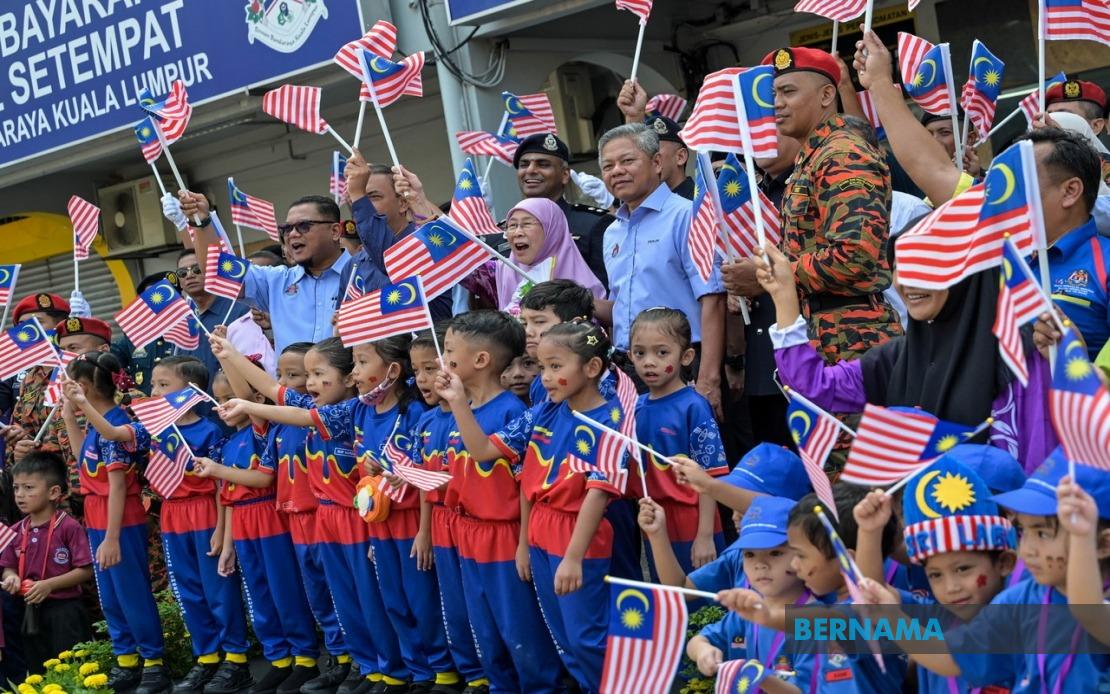
Malaysia's Prime Minister's wife, Datuk Seri Dr Wan Azizah Wan Ismail, has used the nation's independence celebration as an occasion to underscore the profound civic duty that underpins national cohesion. Speaking at the Semarak Merdeka Programme in her capacity as Bandar Tun Razak Member of Parliament, Dr Wan Azizah moved beyond the customary patriotic rhetoric to frame independence as an active commitment requiring citizens to understand and honour the foundational struggles that secured the nation's sovereignty.
The significance of her message lies in its departure from surface-level nationalism. Dr Wan Azizah contended that true independence transcends the ceremonial raising of flags and collective recitation of "Merdeka". Rather, she positioned it as a living legacy embodying the freedom won through earlier generations' sacrifices and the ongoing responsibility to protect the nation's cohesion. This framing carries particular weight in contemporary Malaysia, where social divisions along ethnic and religious lines periodically test national unity. By reframing independence as a custodial obligation rather than merely a historical achievement, Dr Wan Azizah offered a lens through which Malaysians might reconsider their individual roles in sustaining the multicultural compact underlying the federal state.
Her remarks aligned with this year's National Day theme, "Malaysia Madani: Jiwa Merdeka", which the government has positioned as an umbrella concept linking celebrations to substantive policy goals. These objectives include raising living standards, distributing economic opportunities equitably, and reinforcing the bonds of national unity. The connection Dr Wan Azizah drew between commemorative activities and tangible improvements in citizens' lives suggested that independence should manifest not merely in symbolic gestures but in concrete improvements to governance and social welfare.
The demographic composition of Bandar Tun Razak, Dr Wan Azizah's parliamentary constituency, served as a microcosm illustrating her broader thesis. The locality comprises approximately 191,000 residents distributed across multiple communities: Malays representing 60 per cent, Chinese citizens forming 24 per cent, and Indian Malaysians accounting for eight per cent according to Malaysian Population and Housing Census data. Rather than treating this diversity as a challenge to manage, Dr Wan Azizah characterised it as evidence of a functioning, harmonious community—a model suggesting that Malaysia's pluralist structure, when properly nurtured, represents a source of collective strength rather than fragmentation.
Beyond her rhetorical intervention, Dr Wan Azizah's visit to three families at the Seri Pulau Pinang and Desa Tun Razak People's Housing Projects demonstrated a material dimension to her message about shared responsibility. The visits involved distributing welfare assistance from institutional sources including the Social Security Organisation (PERKESO) and the Federal Territories Islamic Religious Council (MAIWP). This coupling of commemoration with direct welfare engagement underscored that independence, in her conception, carries tangible obligations toward vulnerable citizens whose circumstances require collective support mechanisms.
One recipient, K. Moganavalli, a 39-year-old widow, had recently experienced the sudden death of her husband Edwin Anthony Dass on August 2, leaving her the sole income earner for three young dependents. Moganavalli, who had been a homemaker while her late husband worked as a lorry and Grab driver, expressed profound disorientation following his passing. The assistance she received—comprising a one-off Funeral Management Benefit of RM3,000 and a monthly Survivor's Pension of RM1,118.33 from PERKESO alongside Kotak Prihatin support—addressed immediate financial catastrophe while underscore the welfare infrastructure undergirding Malaysian citizenship.
Another beneficiary, 64-year-old Khalijah Binti Nazir, exemplified the complex vulnerabilities faced by segments of Malaysia's lower-income populations. Khalijah had abandoned her employment to assume caregiving duties for two children, one of whom carries a hearing impairment requiring ongoing support. Her precarious financial situation was ameliorated through multiple assistance channels: RM800 monthly in Baitulmal support, RM300 distributed through Boost eWallet, and RM150 via Sumbangan Asas Rahmah (SARA), with her son receiving an additional RM100 monthly through the same scheme. The layered nature of these interventions revealed the fragmentation of Malaysia's welfare delivery mechanism, wherein support flows through separate institutions and funding streams rather than integrated systems.
For Malaysian readers and regional observers, Dr Wan Azizah's intervention carries several implications. First, it signals an intellectual repositioning within Malaysia's political establishment regarding how independence and national identity ought to be conceived—moving from celebration-as-spectacle toward citizenship-as-responsibility. Second, her emphasis on multicommunal harmony, grounded in Bandar Tun Razak's demographic reality, offers a counternarrative to divisive framings of Malaysian pluralism that have periodically surfaced in public discourse. Third, the coupling of her symbolic messaging with welfare distribution highlights the tension between rhetorical appeals and institutional capacity to address economic precarity.
The welfare cases also illustrate deeper structural challenges. Both recipients depended substantially on social safety net provision, yet the multiple overlapping schemes through which they received assistance suggest a system requiring rationalisation and integration. For Southeast Asia more broadly, Malaysia's approach to balancing commemoration with material welfare provision offers lessons regarding how developing nations navigate the relationship between national identity formation and social protection infrastructure. The region's middling-income economies face similar pressures to maintain social cohesion while managing limited fiscal space for expanded entitlements.
Dr Wan Azizah's message, delivered alongside these welfare interventions, implicitly endorsed a conception of independence rooted not in historical achievement alone but in continuous recommitment to the principles of shared flourishing and mutual obligation. Whether such recommitment, translated through formal governance structures and welfare mechanisms, proves sufficient to sustain the unity she advocates remains an open question in a Malaysian context where competing visions of nationalism, citizenship, and collective identity periodically surface.

