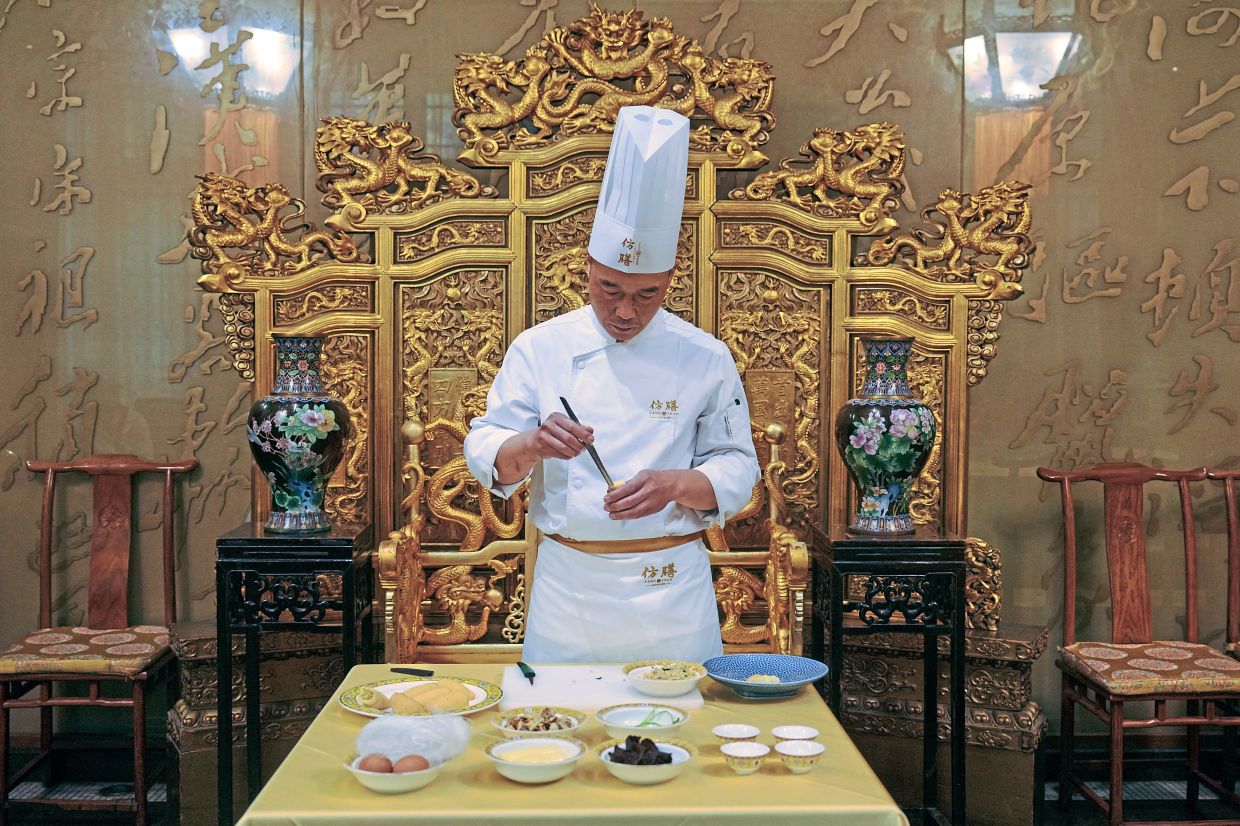
In the closing years of China's imperial era, legend has it that Empress Dowager Cixi dreamed of a pastry so vivid that it manifested at her breakfast table the next morning. Enchanted by this culinary coincidence, she summoned her chef and rewarded him generously with silver. What was once simply called minced pork pancake earned a new name that day: dream pastry, a moniker reflecting the intersection of royal whim and culinary ambition that defined imperial Chinese cooking.
This anecdote, recounted by Zhou Tong, a pastry chef at Fangshan Restaurant in Beijing, illustrates the distinctive character of imperial cuisine—a culinary tradition where the act of eating transcended mere sustenance to become theatre, politics and cultural expression. Fangshan, established in 1925 by former Qing Dynasty court chefs, occupies a historic site within Beihai Park, the garden retreat where successive dynasties' rulers conducted state affairs, sought leisure and performed sacred rituals. The restaurant's name translates as "imitating the imperial cuisine," a modest descriptor for its ambitious mission to resurrect and maintain the gastronomic practices of China's most powerful figures across centuries.
Imperial cuisine comprised both the quotidian meals consumed by emperors and the elaborate ceremonial feasts that punctuated the court calendar, each governed by rigid protocols that communicated hierarchy, respect and cultural continuity. Teng Deyong, a researcher at China's Palace Museum, describes how Qing Dynasty banquets commenced with milk tea service, a ritualistic opening act that established the formal nature of the gathering. During these feasts, emperors exercised power through culinary generosity, bestowing wine and delicacies upon princes and officials who performed elaborate bows and paid homage before consuming what had been granted to them.
Beyond celebratory banquets lay sacrificial rituals that operated under entirely separate systems, often involving meat offerings with profound spiritual significance. The Palace of Earthly Tranquillity hosted one of the Qing court's most solemn ceremonies: the consumption of sacrificial pork boiled deliberately without salt or seasoning. This unseasoned preparation carried symbolic weight, evoking cultural memory and honouring antiquity through deliberate culinary austerity. Wandi Wang, a professor of Chinese at Lehigh University, notes that this practice extended back to classical texts such as the Book of Rites, where ceremonial meat broths called "grand stew" were similarly prepared without added flavouring to communicate ritual ideals and connection to ancestral traditions.
The sophistication of imperial cuisine manifested most visibly in its pastry arts, where the court maintained dedicated institutions staffed with specialists whose sole responsibility involved creating delicacies for the ruler's table. Fangshan's contemporary repertoire, prepared by hand-trained artisans, includes dishes like Cixi's dream pastry and delicate steamed corn buns, each recipe anchored in documented court traditions transmitted through unbroken chains of mentorship. These are not merely historical recreations; they represent living connections to centuries of culinary knowledge, with each generation of chefs learning from predecessors who themselves learned from their own masters.
The insistence on traditional methods distinguishes imperial cuisine fundamentally from modern restaurant cooking. No electric blenders or food processors are permitted in Fangshan's kitchen; instead, ingredients like beans are meticulously pulverised using sieves, and particular flours are manipulated within custom copper vessels designed specifically for the task. Zhou emphasizes that mechanical shortcuts produce fundamentally different results, stripping away the delicate graininess and sandy texture that define authentic imperial pastries. This labour-intensive commitment reflects a philosophy where process matters as much as outcome, and where efficiency must yield to excellence.
Fangshan's bestselling items—pea flour cake and red bean roll—illustrate the commercial viability of this approach. During peak seasons, the kitchen produces over two hundred pea flour cakes daily, suggesting that Malaysian and Southeast Asian diners who encounter this Beijing institution find genuine value in the historical narratives and carefully crafted preparations rather than viewing them as nostalgic curiosities. Executive chef Fan Liangliang, who arrived at Fangshan after formal culinary training, discovered that his conventional techniques proved inadequate and required complete re-education in approaches his instructors had never taught him. One signature method, "Nizihuo," involves reducing fish, shrimp or chicken to impossibly smooth paste, then reforming the mixture into elaborate decorative shapes—frogs, birds, flowers—that transformed protein into edible sculpture. Fan describes this practice as emblematic of imperial cuisine's foundational principle: every dish required innovation, visual beauty, nutritional completeness and presentation worthy of the emperor's dining table.
While rare ingredients such as bear paws have been justifiably retired from contemporary menus, chefs at Fangshan maintain dishes' essential spirits through thoughtful adaptations that honour historical precedent without perpetuating practices now recognized as ethically problematic. This balance between preservation and evolution extends to the literary dimensions of Chinese cuisine, aspects often overlooked by Western dining contexts. The celebrated poet Du Fu composed verses about cold noodles made with pagoda-tree leaves, but these were never simple food descriptions; rather, Wang argues, Du Fu transformed a modest green dish into an expression of political loyalty and unfulfilled imperial ambition. Chinese culinary traditions have consistently transcended nutrition, encoding broader cultural meanings about aesthetics, politics and social order that shift with changing circumstances.
At its philosophical core, Fangshan's imperial cuisine represents a fusion of Manchu and Han culinary traditions, the court cuisine of Qing Dynasty rulers interweaved with the gastronomic practices of China's Han majority population. This synthesis embodied in food the political reality of Manchu rule over predominantly Han territories, demonstrating how eating patterns communicate and negotiate cultural identity. Preserving such traditions demands more than recipe documentation; it requires taking history seriously, recognizing that culinary heritage reveals not merely how past generations consumed food, but how contemporary practitioners choose to remember and construct meaning around that past. For Malaysian diners and others in Southeast Asia increasingly interested in Chinese cultural heritage, Fangshan represents a bridge connecting contemporary appetite to historical consciousness, where each carefully prepared pastry or delicately sculpted dish carries echoes of imperial court, ritual significance and centuries of accumulated human expertise.

