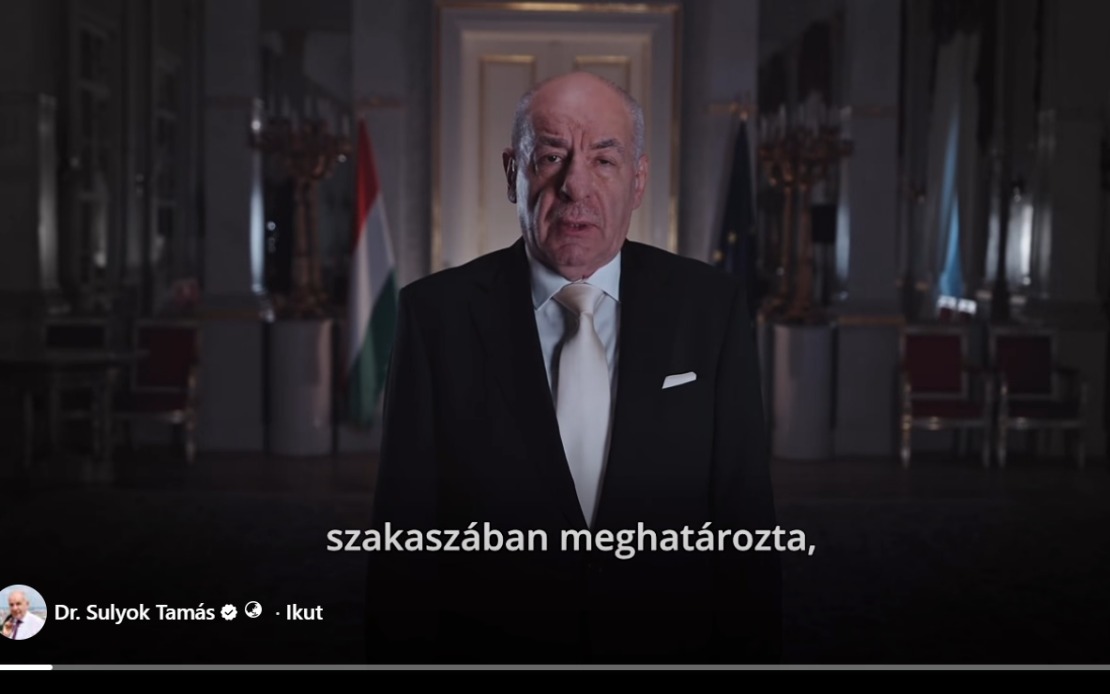
Hungarian President Tamás Sulyok has capitulated to mounting political pressure by agreeing to countersign a constitutional amendment designed to remove him from office, marking a dramatic culmination to an intense power struggle within Budapest's political establishment. After days of internal deliberation, Sulyok announced his decision to authorize the constitutional changes, effectively sealing his own departure and clearing the path for a new presidential election. The move represents a significant victory for newly installed Prime Minister Péter Magyar, who had issued an ultimatum: either Sulyok sign the amendment or face impeachment proceedings initiated through parliament.
Sulyok's position had become increasingly untenable following Magyar's decisive victory in April, when the reform-minded politician ousted former Prime Minister Viktor Orbán's governing coalition. Though Sulyok had been elevated to the presidency as an Orbán ally before the political landscape shifted dramatically, he found himself stranded without meaningful support as the political establishment mobilised against him. Magyar's government had secured parliamentary approval for the constitutional amendment on the previous Monday, then delivered the ultimatum with a five-day deadline. Faced with the certainty of impeachment—a more damaging political scenario—Sulyok chose the path of resignation, though he continues to maintain that parliament's decision itself violates constitutional principles.
The vacancy at the presidential office will be filled through a parliamentary election process that must conclude within 30 days. Until that election occurs, parliamentary speaker Agnes Forsthoffer will exercise presidential powers, ensuring continuity of governmental functions during this transitional period. This arrangement reflects Hungary's constitutional framework, where the head of state is elected exclusively by members of parliament rather than through direct popular vote, giving considerable leverage to the legislative majority. Sulyok's departure formally takes effect beginning Monday, officially terminating his role in the country's highest ceremonial and constitutional position.
Sulyok's agreement to countersign the amendment, despite his public objections, underscores a crucial constraint on presidential power in Hungary's system. When confronted with the legal reality that no viable legal recourse existed to challenge parliament's decision, the outgoing president ultimately acquiesced. Constitutional experts had previously observed that even Hungary's constitutional court possessed limited grounds for intervention—it could theoretically object on narrow procedural matters but held no authority to prevent substantive removal decisions made by the parliamentary majority. This structural weakness in presidential protections effectively eliminated Sulyok's options for resistance.
Magyar's government has framed this constitutional restructuring as essential to restoring democratic accountability and reversing systematic erosion of institutional checks that characterized the Orbán era. In a Facebook statement, the prime minister characterised the changes as returning fundamental rights to Hungarian citizens, particularly the principle that governmental power remains subject to constitutional limits and cannot be concentrated indefinitely in executive hands. Magyar specifically referenced the restoration of common property protections and the reorientation of state institutions toward serving the broader public interest rather than narrowly defined political factions. These constitutional amendments represent the opening moves in a broader agenda to transform Hungary's political architecture.
Sulyok's own public statements reveal the philosophical tensions embedded in his situation. While acknowledging the constitutional amendment's passage through proper parliamentary procedure, he maintained that the decision itself violated foundational constitutional principles, creating an apparent paradox at the heart of the reform process. In a video address distributed via social media, Sulyok lamented that Hungary's presidential office had been systematically reduced to a position of ornamental authority, stripped of meaningful oversight functions and vulnerable to executive manipulation. He specifically warned that all future heads of state would operate under similar vulnerabilities, permanently subjugated to the demands of parliamentary majorities and executive pressure.
This episode carries significant implications for constitutional governance across Central Europe. Hungary's experience demonstrates both the fragility of institutional protections when political control shifts dramatically and the potential for rapid constitutional restructuring when governing coalitions consolidate sufficient parliamentary support. The transition from Orbán's extensive centralization of authority to Magyar's declared commitment to institutional balance represents a fundamental ideological realignment in Hungarian politics. For regional observers, the case illustrates how constitutional frameworks can be simultaneously exploited to concentrate power and then rapidly recalibrated when political circumstances favour reform-minded majorities.
The broader Hungarian context makes this constitutional amendment particularly significant. The Orbán government had been repeatedly criticized by European Union institutions and international democracy watchdogs for gradually degrading judicial independence, undermining press freedom, and concentrating executive authority. Magyar's coalition campaign explicitly positioned constitutional restoration as central to Hungary's democratic rehabilitation and potential reconciliation with broader European democratic standards. The presidential removal thus functions as both a symbolic and substantive opening salvo in this reformation process, signalling willingness to dismantle concentrated authority structures even when they technically benefit the current regime.
Magyar's government can now proceed with implementing far-reaching institutional reforms that were previously blocked or constrained by presidential opposition or constitutional resistance. The constitutional amendment framework enables the government to restructure fundamental aspects of state organization, judicial function, and executive-legislative relationships. These changes represent the concrete expression of Magyar's campaign promises to dismantle what he characterized as the systematized authoritarianism of the preceding administration. The constitutional transformation will likely extend considerably beyond presidential replacement, touching core institutional relationships throughout the Hungarian state apparatus.

