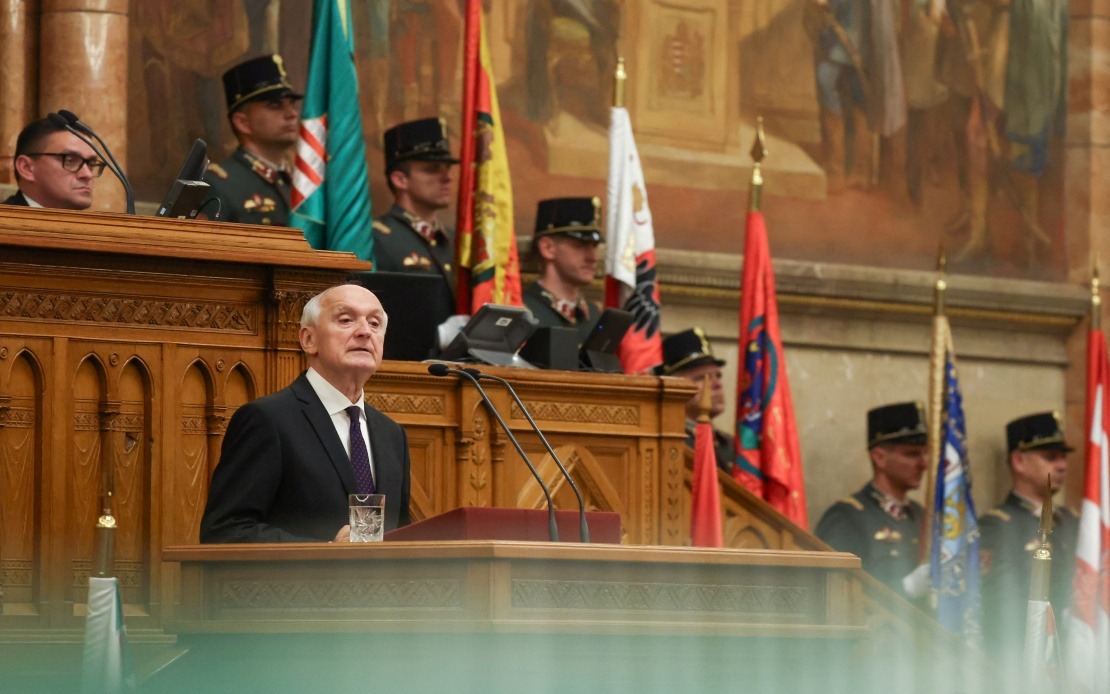
Andras Baka officially became President of Hungary on August 19, 2026, after being elected by the country's Parliament on August 11. Prime Minister Peter Magyar announced the transition on social media, stating that the new president would bring humanism to the constitutional office. The inauguration marks a significant moment in Hungarian politics, but one shadowed by deep institutional divisions and parliamentary acrimony.
Baka brings extensive judicial experience to the role, having previously served as president of Hungary's Supreme Court from 2009 to 2011. His tenure in that position proved consequential, as he ultimately resigned rather than oversee the judicial restructuring that the government of then-Prime Minister Viktor Orban sought to implement. This decision to step down rather than facilitate what he evidently viewed as problematic reforms established Baka as an independent voice willing to challenge executive overreach, a quality that resonates with many observers concerned about judicial independence in Central Europe.
Before assuming his first judicial leadership position, Baka had worked at the European Court of Human Rights in Strasbourg, where he gained direct exposure to international human rights jurisprudence and supranational legal standards. This background suggests a president shaped by continental European legal traditions emphasising judicial autonomy and individual rights protection. Following his resignation from the Supreme Court, Baka remained active in Hungary's legal establishment, serving as chairman of the Hungarian Curia from 2012 to 2020. The Curia itself was a product of the Orban government's earlier judicial reforms, representing the institutional reconfiguration that had prompted Baka's earlier departure.
The political context surrounding Baka's election reveals widening fractures within the Hungarian state. Opposition parties, including Fidesz and the Christian Democratic People's Party, collectively boycotted the presidential election in protest against the removal of the previous president, Tamas Szujok. This procedural objection reflects deeper constitutional disputes: the manner in which Szujok's presidency was terminated through constitutional amendments rather than conventional electoral processes troubled opposition figures sufficiently that they chose to withdraw entirely from the selection of his successor. Such a boycott carries symbolic weight, signalling that portions of Parliament view the legitimacy of the presidential succession as compromised.
Hungary's political trajectory over the past two decades has increasingly concerned international observers and regional partners. Successive constitutional modifications have often favoured the executive branch at the expense of legislative and judicial checks. The removal of Szujok through constitutional amendment exemplifies this pattern: instead of standard electoral competition, constitutional mechanisms were deployed to dislodge an incumbent president. For smaller nations within the European Union, such constitutional engineering raises questions about institutional equilibrium and democratic resilience.
Baka's appointment carries paradoxical implications. On one hand, his judicial background and his historical resistance to problematic reforms suggest that he may represent a counterweight to unchecked executive authority. On the other hand, his election occurred within a parliamentary framework that opposition parties deemed sufficiently flawed to warrant complete non-participation. This tension means that Baka assumes office without the broad political consensus that typically legitimises a head of state, particularly in parliamentary systems where the president's authority derives from legislative confidence.
For Southeast Asian observers, Hungary's constitutional struggles offer instructive parallels. Regional states grapple with comparable tensions between executive efficiency and institutional pluralism, between the desire for strong leadership and the need for constitutional restraint. Hungary demonstrates that constitutional instability need not involve explicit authoritarianism; instead, it can manifest through incremental modifications that subtly shift institutional balances. The use of constitutional amendments to remove a president without general election represents a technique that other democracies might employ, making Hungary's experience relevant across diverse contexts.
International observers will monitor whether Baka's judicial independence translates into presidential conduct that moderates executive overreach. His appointment occurs at a moment when Hungary's relationship with European institutions remains strained over questions of judicial independence, media freedom, and democratic norms. The new president's ability to navigate these pressures while maintaining institutional integrity will significantly influence Hungary's standing within the European Union and its appeal as a model of democratic governance.
The boycott by opposition parties signals that Hungary's political elite remain divided on fundamental constitutional questions. Rather than converging around institutional arrangements, major political forces have instead chosen to contest the legitimacy of the very processes through which leadership transitions occur. This metapolitical dispute—disagreement about the rules themselves—suggests that Baka's presidency begins under challenging circumstances, with substantial portions of Parliament questioning the constitutional procedures that brought him to office. Whether his leadership can help bridge these divides or whether institutional divisions will continue deepening remains an open question that will preoccupy Hungarian politics in coming months.

