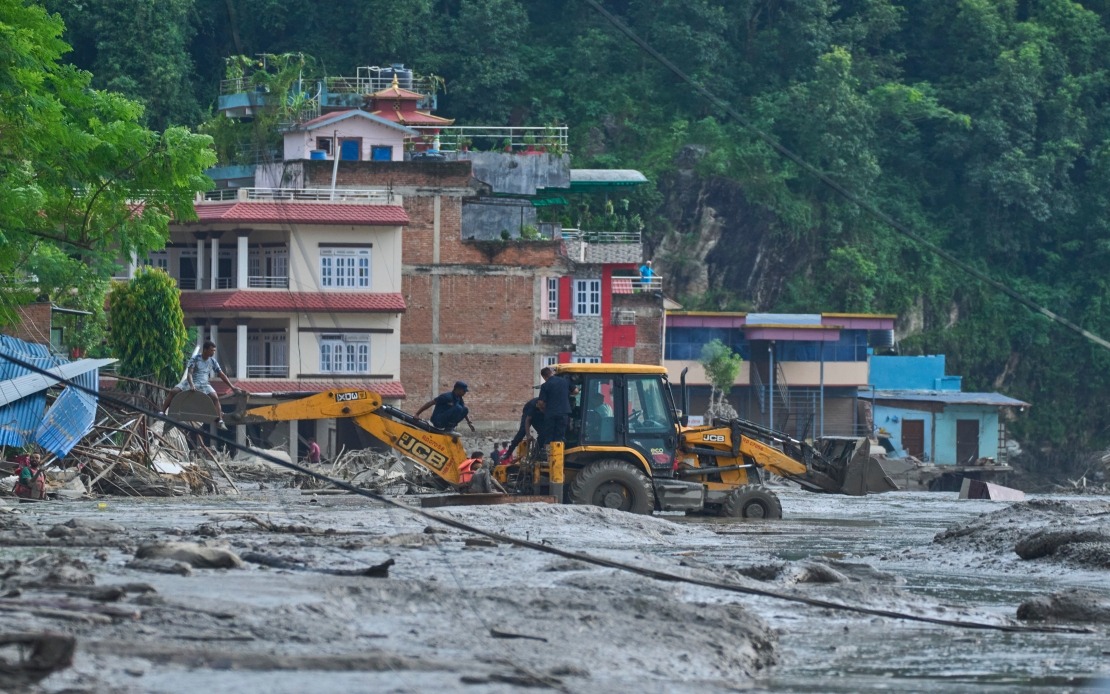
The death toll from flash floods and devastating mudslides that tore through the Nepal-China border region has reached at least 160, with rescue officials reporting over 680 people unaccounted for across both countries as of Wednesday. The catastrophic natural disaster has transformed the region into a humanitarian crisis, with coordinated search and rescue operations now underway on both sides of the international boundary. Nepalese police confirmed that recovery teams have retrieved 157 bodies thus far, while successfully extracting 54 survivors from the affected zones. Separately, Chinese state media indicated that the Tibetan region of the country had registered three confirmed deaths and approximately 265 missing persons.
The scope of the missing persons encompasses a tragic cross-section of those in the region at the time of the disaster. Nepal's Prime Minister's Office detailed that among the unaccounted include 44 military personnel, 28 police officers, 13 members of the armed police force, and 60 civilian workers deployed to hydropower construction sites. The number of missing tourists and travellers initially stood at 484 individuals, comprising 391 foreign nationals and 93 Nepali citizens. The international dimension of the tragedy is evident from the nationalities represented: victims and missing persons hail from Nepal, India, the United Kingdom, South Africa, Malaysia, Australia, the Netherlands, and South Korea, with many others whose nationalities remain unconfirmed pending formal identification.
The physical destruction wrought by the deluge has been staggering in scale. At least 19 bridges have been completely washed away by the floodwaters, whilst approximately 40 kilometres of critical roadway has been rendered unusable. Particularly impacted have been the hydropower projects that dot the region—a development sector crucial to Nepal's energy infrastructure—with 13 facilities suffering severe damage or complete destruction. Nepalese Foreign Minister Sishir Khanal informed parliament that the floods obliterated extensive hydropower infrastructure, government administrative buildings, and vital road networks throughout the affected areas. The destruction concentrated primarily in three districts: Rasuwa, Dhading, and Chitwan, each suffering widespread devastation that will likely take months or years to repair.
The Rasuwagadhi border crossing, which sits at the heart of the disaster zone, has become a focal point of the crisis. This area serves as a gateway for trekkers heading to Langtang, one of Nepal's most celebrated trekking destinations, and for pilgrims travelling toward Mount Kailash and Lake Mansarovar in China. The Gyirong Port crossing on the Chinese side near where the mudslide struck has been completely cut off by destroyed roads, severed communications infrastructure, and downed power supplies. The disruption of these vital international transit routes has compounded the humanitarian challenge, complicating delivery of aid and coordination of rescue operations across the border.
For Malaysia and other Southeast Asian nations, the disaster carries particular resonance given that Malaysian citizens are among the confirmed missing and affected populations. The incident underscores the vulnerability that tourists and workers from the region face when traversing remote mountainous territories, particularly during seasons prone to extreme weather events. The presence of Malaysian nationals among those unaccounted for has prompted concerns about the adequacy of support mechanisms for citizens abroad during sudden natural disasters, a question that resonates across the ASEAN bloc where outbound tourism and labour migration remain economically significant phenomena.
Chinese President Xi Jinping issued directives for an all-encompassing search and rescue mobilisation, ordering authorities to evacuate those in immediate danger and provide emergency medical care to the injured. Authorities in the Xizang Autonomous Region have marshalled available resources for recovery operations, with Xinhua News Agency confirming that rescue efforts are proceeding on multiple fronts. The emergency management bureau in Gyirong County has been coordinating regional response efforts, though the scale of the disaster and geographical constraints present formidable operational challenges to rescue teams navigating the treacherous terrain.
Nepal's response has mobilised all available state resources. The Nepal Police, Armed Police Force, and Nepal Army have deployed personnel equipped with helicopters, drones, and rafting equipment to search the flood-affected zones. Kathmandu's government-run hospitals and military medical facilities have been converted into treatment centres to manage the influx of injured survivors. These coordinated efforts represent a comprehensive national mobilisation to address what has rapidly evolved into one of the region's most significant natural disasters in recent years.
The international community has responded with solidarity and material support. Indian Prime Minister Narendra Modi conveyed condolences to Nepal's leadership during direct communication with Prime Minister Balendra Shah, pledging India's commitment to comprehensive humanitarian assistance. India subsequently dispatched 10 tonnes of relief supplies, disaster response materials, and essential medications to Nepal's borders. Additionally, India's Bihar state government, which shares a border with Nepal and sits downstream from the affected region, has initiated precautionary measures including round-the-clock embankment monitoring and enhanced night patrols in vulnerable districts to guard against secondary flooding impacts.
South Korea's Foreign Ministry reported that eight of its nationals remain unaccounted for whilst ten others have been stranded in Nepal by the flooding. This multinational dimension reflects how global connectivity means that natural disasters in remote regions now carry international consequences, with citizens from dozens of countries finding themselves caught in the catastrophe. The coordination required to trace missing persons, repatriate remains, and provide support to affected foreign nationals adds another layer of complexity to an already overwhelming rescue and recovery operation.
The flooding's timing and intensity point to the escalating climate-related risks that characterise the Himalayan region. The monsoon-swollen waterways and destabilised mountain terrain created conditions where massive quantities of water and debris cascaded downslope with little warning, giving residents and travellers minimal opportunity to evacuate. The disaster serves as a stark reminder of the environmental vulnerabilities facing South Asia's mountainous regions, where climate variability increasingly translates into catastrophic hydrometeorological events. For policymakers across Southeast Asia, the tragedy reinforces the urgent need for enhanced disaster preparedness, improved early warning systems, and regional cooperation frameworks capable of responding to transboundary humanitarian emergencies.

