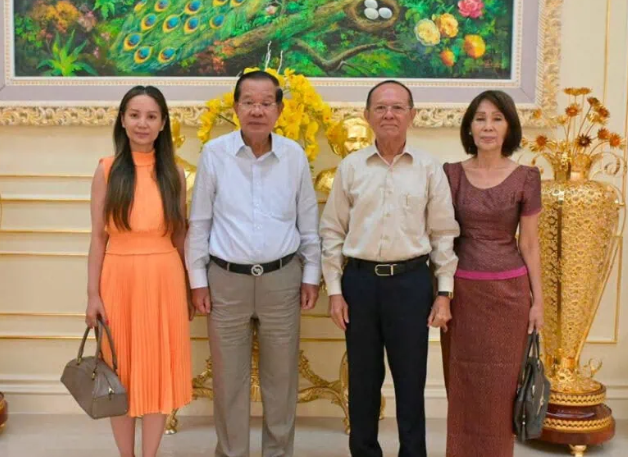
Hun Sen, Cambodia's Senate president and leader of the ruling Cambodian People's Party, hosted former opposition figure Kem Sokha at his home on Sunday for a three-hour meeting that underscores the shifting dynamics of Cambodian politics. The gathering, which included Sokha's wife and daughter Kem Monovithya, represents another chapter in what appears to be a gradual rapprochement between two figures who once stood as principal adversaries in the kingdom's polarised political landscape. Hun Sen announced the meeting through social media, emphasizing that discussions began at 9am and concluded at noon, though he refrained from specifying the substance of their lengthy conversation.
The most striking element of Hun Sen's public announcement was his effusive praise for Monovithya, whom he described as "an excellent human resource for the nation." Hun Sen noted that he had devoted considerable time during the meeting to speaking with Sokha's daughter, a comment that carries particular weight given her deep association with opposition politics. This endorsement from Cambodia's most powerful political leader suggests an attempt at bridging a generational and ideological divide that has long characterised Cambodian politics, though Hun Sen stopped short of clarifying whether he envisioned any specific future role for her.
Sokha's gradual re-emergence into public life follows a tumultuous period of legal jeopardy and restrictions. The veteran politician was convicted in 2023 on treason-related charges alleging conspiracy with foreign powers and received a 27-year prison sentence. He endured house arrest under stringent conditions that curtailed his movement and political activity, remaining largely out of public view for years. The Phnom Penh Appeal Court maintained his conviction and sentence on April 30, 2026, while imposing a five-year international travel ban, further constraining his ability to interact with the outside world and consolidate any remaining political network.
The trajectory changed markedly in May when King Norodom Sihamoni issued a royal pardon that terminated Sokha's remaining prison sentence and lifted his house arrest status. This act of clemency represented a significant turning point, though the pardon preserved the restrictions preventing him from engaging in political activities—a crucial limitation that prevents any immediate return to formal political participation. The pardon signalled what many observers interpreted as a message from Cambodia's leadership that they viewed Sokha no longer as a primary security threat, even if political rehabilitation remained circumscribed.
Further easing arrived in late July when a royal decree abolished the five-year overseas travel restriction that had confined Sokha to Cambodia's borders. This removal opened possibilities for international engagement and travel that had been systematically denied. Days later, Sokha demonstrated his newfound mobility by journeying to Banteay Meanchey province to encounter families displaced by ongoing Cambodia-Thailand border tensions. During that visit, he characterised his actions as those of a private citizen rather than a partisan operative or state representative, a careful rhetorical formulation that acknowledged his current legal constraints while asserting meaningful civic engagement.
Hun Sen's contact with Sokha has intensified following these developments. The Senate president revealed that Sokha had visited his residence several weeks prior to the August meeting, before embarking on his border displacement assessment mission. This progression of meetings suggests a deliberate, orchestrated process of normalisation rather than chance encounter. The decision to receive Sokha at his private home—rather than in an official capacity—lends an air of personal rather than strictly political engagement, potentially allowing both figures to manage optics carefully while conducting substantive discussions.
The historical context of their antagonism cannot be overlooked when evaluating these recent interactions. Sokha served as co-founder and president of the Cambodia National Rescue Party (CNRP), which emerged as the ruling party's most credible electoral challenger. The party achieved remarkable gains in the 2013 general election and 2017 commune elections, suggesting growing public appetite for political alternatives. The CNRP's momentum was abruptly terminated in November 2017 when Cambodia's Supreme Court dissolved the organisation entirely, a manoeuvre that came two months after Sokha's arrest and effectively eliminated the principal organised opposition force.
Movnovithya's political background amplifies the significance of Hun Sen's remarks about her qualities. She possessed prominent standing within the CNRP apparatus and maintained visibility as an opposition figure even as her father faced legal proceedings and confinement. Her association with Cambodia's democracy movement and opposition politics represented a generational continuity of resistance to authoritarian consolidation. Hun Sen's public commendation of her as valuable human capital carries implications that extend beyond mere courtesy, possibly signalling receptivity to her participation in some capacity within Cambodia's evolving political order, though deliberate ambiguity characterises any such suggestion.
The meetings remain unexplained in their substantive dimensions, with neither party disclosing discussion topics or outcomes. Hun Sen notably avoided indicating whether political matters featured in their conversations, leaving observers to speculate whether this constitutes a prelude to reconciliation, rehabilitation of opposition figures, or something else entirely. The absence of any joint statement or mutual declaration suggests both sides prefer to move carefully, avoiding premature public commitments that could provoke reaction from hardline factions within their respective camps.
For Southeast Asian observers, these developments carry broader implications regarding Cambodia's political trajectory. The region has watched Hun Sen gradually consolidate power while simultaneously managing the appearance of legitimacy through periodic gestures toward pluralism. Sokha's partial rehabilitation could indicate confidence that opposition politics poses no meaningful challenge to ruling party dominance, or alternatively, a calculation that demonstrable magnanimity toward former rivals enhances international standing regarding democracy and governance. Equally significant is what Sokha's cautious re-emergence reveals about the conditions under which former opponents might be incorporated into Cambodia's political establishment.
The interaction between Hun Sen and Sokha also reflects broader regional patterns wherein once-bitter political rivals eventually occupy shared space within power structures. Thailand, Indonesia, and the Philippines have all witnessed similar transitions whereby opposition figures achieve some form of accommodation with dominant political forces. Cambodia appears to be following comparable trajectory, though the persistent prohibition on Sokha's direct political participation distinguishes this case from full reconciliation. Whether these meetings represent preliminary steps toward deeper integration or constitute limited, managed engagement designed to neutralise perceived threats remains unclear, but the trajectory suggests Cambodia's political configuration continues evolving in complex, multidirectional ways.

