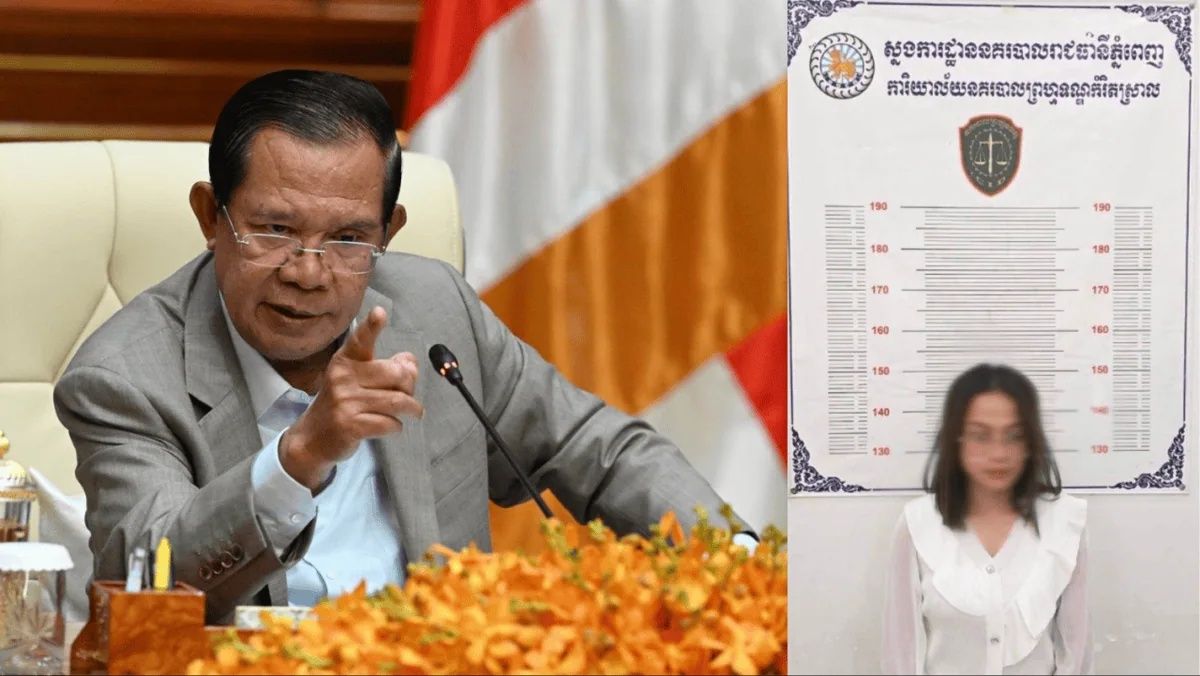
Cambodia's Senate president Hun Sen has launched a directive to strengthen legal enforcement against individuals who engage in speech deemed offensive to women and the national social fabric. During an August 14 meeting with a National Council for Women delegation in Phnom Penh, Hun Sen tasked the council with acting as plaintiff in court cases against those who use abusive language that diminishes women's standing and Khmer cultural values. The announcement represents a significant tightening of Cambodia's approach to regulating speech around gender and national dignity.
The initiative emerged from Hun Sen's concern over specific recent incidents that he characterized as particularly egregious breaches of social propriety. He referenced an unnamed woman who had recently employed vulgar language in public criticism of government bodies and civil servants. According to Hun Sen's account, authorities intervened by summoning both the woman and her husband to issue a formal written apology, marking an intervention into private speech that raised questions about the parameters of acceptable expression in contemporary Cambodia.
Another case that motivated the directive involved a woman identified as Chenda Sovannary, who allegedly hurled insults at a soldier during a disagreement concerning a mobile phone transaction. Hun Sen used this incident to illustrate what he framed as an unacceptable pattern of disrespect toward state representatives and uniformed personnel. His comments suggested frustration that a dispute over a consumer transaction had escalated into what he viewed as a grave affront to state dignity and individual honour.
Hun Sen's characterization of these incidents went beyond the specific cases, positioning them within a broader framework of social deterioration. He emphasized that respect should extend uniformly across all occupational groups and social strata, arguing that insulting any worker—whether a soldier or construction laborer—represented a violation of fundamental social ethics. This universalist appeal suggested that the directive aimed to establish a comprehensive standard for acceptable public and private conduct rather than targeting specific groups.
The Senate president framed the initiative as aligned with globally accepted standards rather than as an exceptional measure. He drew a parallel between Cambodia's proposed legal mechanism and the content moderation policies deployed by major social media corporations, which maintain community standards and ethical guidelines. This comparison appeared designed to normalize the enforcement action by situating it within international practices, though the parallel glossed over important distinctions between private platform governance and state-directed legal prosecution.
Hun Sen explicitly rejected the characterization of these measures as authoritarian, insisting instead that protecting women's dignity and social morality represented legitimate state functions consonant with democratic governance. He reframed the enforcement mechanism as a protective rather than restrictive apparatus, arguing that safeguarding national values should not be confused with suppressing legitimate rights. This rhetorical repositioning sought to preempt international criticism while asserting the state's authority to define and enforce standards of acceptable expression.
The directive extends far beyond reactive legal prosecution to establish an institutional surveillance infrastructure. Hun Sen instructed the National Council for Women to establish a dedicated monitoring mechanism, specifically tasking officials with systematic tracking of cases involving curse words and insulting language on Facebook and other platforms. This proactive surveillance function suggests Cambodia intends to move from responding to isolated incidents toward continuous monitoring of online discourse related to women and state institutions.
Implementing the directive requires coordination across multiple government agencies, reflecting the scope of Hun Sen's ambitions. The National Council for Women is to collaborate with the Ministry of Interior, responsible for domestic security and police functions; the Ministry of Information, which oversees state communications; the Ministry of Culture and Fine Arts, managing cultural policy; and the Ministry of Post and Telecommunications, regulating digital infrastructure. This multi-agency apparatus indicates the state's intent to create comprehensive enforcement capacity spanning law enforcement, administrative control, digital monitoring, and cultural management.
The initiative holds significant implications for free expression in Cambodia and Southeast Asia more broadly. While the directive's language emphasizes protection of women and social ethics, the mechanism potentially creates legal pathways for prosecuting speech that authorities deem insufficiently respectful toward state institutions and officials. The emphasis on monitoring social media suggests Cambodia may be testing frameworks for systematic online surveillance justified through appeals to protect women's dignity. For regional observers, the directive raises questions about whether similar frameworks might proliferate across Southeast Asia as governments seek justifications for expanded content moderation authority.
The directive also reflects tensions within Cambodia's political culture regarding modernization and tradition. Hun Sen's repeated invocation of Khmer values and social morality suggests anxiety about rapid social change, particularly regarding gender relations and respect for hierarchy. By framing enhanced legal enforcement as necessary to preserve essential cultural principles, the government positions restrictions on expression as conservative rather than repressive measures. This framing resonates with nationalist sentiment while deflecting international criticism concerning press and expression freedoms.
For women's rights advocates in Cambodia and the region, the directive presents an ambiguous landscape. While ostensibly protecting women's dignity, the enforcement mechanism vests significant authority in state bodies to define what constitutes insulting or immoral speech. This grants governments substantial discretion to prosecute women—particularly those whose public speech challenges official narratives—under the guise of protecting feminine values. The cases Hun Sen highlighted involved women expressing themselves in ways state authorities deemed inappropriate, suggesting the framework may constrain women's public participation more than protect their interests.
The international dimensions warrant attention as well, particularly given Cambodia's relationship with bilateral and multilateral partners who emphasize democratic governance and free expression. The directive's announcement may signal Cambodia's willingness to pursue more assertive restrictions on online speech and expression regardless of external pressure. Whether Cambodia's ASEAN peers develop comparable frameworks, and how international bodies respond to the initiative, will shape the trajectory of digital governance and expression rights across the region.
Hun Sen's directive ultimately represents a deliberate expansion of state authority over speech justified through appeals to protect women and preserve cultural values. The initiative combines legal prosecution with systematic surveillance and multi-agency coordination, creating a comprehensive apparatus for regulating expression deemed disrespectful to women, state institutions, or national dignity. Whether characterized as protection or restriction, the directive marks a significant evolution in Cambodia's approach to governing public discourse and establishes precedents with potential significance throughout Southeast Asia.

