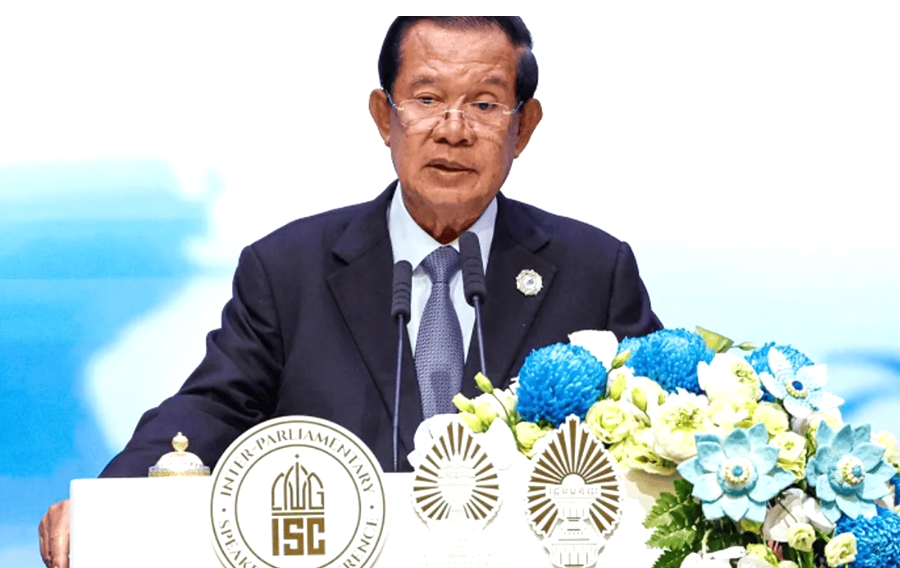
At a gathering of parliamentary leaders in Phnom Penh this week, Cambodian Senate President Hun Sen delivered a pointed accusation against Thailand, asserting that the country has deployed the global concern over online scams as a smokescreen for what he characterises as illegal territorial occupation. His remarks at the 2nd Inter-Parliamentary Speakers' Conference (ISC-2), which drew senior legislators from Pakistan, Malaysia, Myanmar, Australia, Russia and numerous other nations, signalled deepening tensions over the longstanding Cambodia-Thailand border dispute and offered a window into how Cambodia's leadership interprets contemporary geopolitical conflicts.
Hun Sen framed the Cambodia-Thailand border question within a broader analysis of what he termed "modern warfare," describing a system where traditional military conflict has been replaced by multifaceted pressure campaigns that exploit legitimate international concerns to achieve territorial or political objectives. By presenting the online scam issue as a pretext rather than a genuine concern, Hun Sen suggested that powerful nations are willing to abandon established international norms when strategic interests align. This accusation strikes at the heart of how weaker nations in Southeast Asia perceive their vulnerability to great power manipulation and selective application of international law.
The Cambodian leader elaborated on the nature of contemporary conflict beyond military engagement, identifying several overlapping domains through which nations exercise coercive power. Trade warfare, he noted, operates through discriminatory customs practices and the arbitrary withdrawal of trade privileges, creating economic instability that disproportionately harms developing nations dependent on market access. Technology competition, particularly over semiconductors and cyber infrastructure, has become another flashpoint where control over critical resources translates into geopolitical leverage. Resource nationalism surrounding energy reserves and rare earth minerals further concentrates power in the hands of nations with geological advantages or the capital to monopolise supply chains.
Central to Hun Sen's argument was a warning about the deterioration of collective security frameworks and the international non-proliferation regime. He argued that when powerful actors abandon international law to exercise unilateral self-defence rights and launch preemptive military strikes without UN authorisation, the fundamental architecture designed to prevent unchecked aggression collapses. This anxiety, he suggested, drives weaker nations to pursue independent military capabilities rather than rely on treaty protections, thereby accelerating a global arms race that undermines rather than strengthens international stability. For Southeast Asian nations like Cambodia, which lack the economic or military capacity to project power beyond their borders, this dynamic creates acute strategic vulnerability.
Hun Sen explicitly connected his critique to Cambodia's own position, describing how his country faces pressure through multiple simultaneous channels. Beyond the border occupation he attributes to Thailand, Cambodia encounters criticism regarding human rights standards, environmental practices, and governance issues. While such concerns merit serious consideration, Hun Sen's point centred on the application of asymmetric standards, whereby wealthy developed nations impose stringent criteria on developing countries struggling with post-conflict recovery and limited state capacity. This complaint resonates across Southeast Asia, where many nations bristle against what they perceive as conditionality and double standards embedded in Western-led international governance.
The Cambodian Senate President's invocation of treaty violations and the abandonment of rules-based order carries particular significance for Southeast Asian states invested in institutions like ASEAN and the United Nations system. These frameworks, imperfect though they are, have provided smaller nations with platforms for collective action and formal mechanisms through which to challenge more powerful actors. When Hun Sen warns that those who wrote international rules are now systematically dismantling them, he articulates a fear shared by policymakers throughout the region: that the post-Cold War international order, whatever its flaws, is being replaced by a frankly anarchic system where military strength and economic scale determine outcomes.
The conference itself, bringing together parliamentarians from ideologically diverse nations including democracies and authoritarian systems alike, underscores how regional leaders seek alternative forums for dialogue beyond the Western-dominated institutions that have historically shaped international norms. The presence of delegations from Russia and Pakistan alongside representatives from Australia and ASEAN capitals suggests an effort to construct parallel governance spaces where middle powers and smaller nations can articulate interests without presumed Western mediation. Hun Sen's speech can be read partly as an attempt to mobilise this coalition around a shared grievance: that powerful nations exploit selective invocation of international law to advance narrow interests.
Remarkably, Hun Sen did not specify which ceasefire agreement Thailand allegedly violated, suggesting either diplomatic restraint or an attempt to keep allegations sufficiently vague to maintain negotiating space. Yet his criticism that such agreements are treated as "just on paper" reflects widespread frustration across the region with the gap between formal commitments and actual state behaviour. The Cambodia-Thailand border has witnessed periodic military clashes, with competing territorial claims predating the modern nation-states themselves. Hun Sen's framing of this dispute as a consequence of modern warfare tactics rather than historical disputes or legitimate security concerns represents a specific political choice in how to narrativise the conflict.
The warning about the collapse of international non-proliferation frameworks deserves particular attention for Southeast Asian audiences. Should Cambodia or other regional states lose confidence in international law's capacity to protect them, proliferation pressures would intensify throughout a region already concerning to global security analysts. Small states typically benefit from non-proliferation regimes because such regimes limit the advantages available to militarily stronger neighbours. If Cambodia or other regional states begin pursuing independent deterrents, the security dilemma deepens for all parties, with cascading destabilisation effects.
Hun Sen's broader point about the weaponisation of economics and unpredictable rule-changing reflects genuine challenges facing developing nations in an increasingly fragmented global system. When trade rules shift unexpectedly, when investment protections are withdrawn, when sanctions are applied inconsistently, development planning becomes nearly impossible. This systematic unpredictability harms smaller economies more severely than large diversified ones, as Cambodia depends heavily on garment exports, tourism, and agricultural products vulnerable to market access restrictions. The anxiety Hun Sen expressed about guarantees dissolving resonates with concerns voiced by policymakers throughout Southeast Asia.
Ultimately, Hun Sen's intervention at the Inter-Parliamentary Speakers' Conference represented an attempt to reframe regional disputes within a critique of global governance collapse. By positioning the Cambodia-Thailand border conflict as emblematic of broader trends—the selective application of international law, the weaponisation of legitimate concerns, and the abandonment of collective security—he sought to mobilise international sympathy and to normalise Cambodia's grievances within a framework of systemic injustice affecting all developing nations. Whether this narrative persuades regional partners or merely deepens existing divisions remains uncertain, but it reflects how smaller Southeast Asian states increasingly articulate their security interests in opposition to what they perceive as an arbitrary and destabilising international order.

